Chainlink price is hovering near the top of its recent range with traders watching for a decisive move following the launch of the Bitwise Chainlink ETF. LINK wasChainlink price is hovering near the top of its recent range with traders watching for a decisive move following the launch of the Bitwise Chainlink ETF. LINK was

Chainlink price nears breakout as Bollinger Bands tighten after Bitwise LINK ETF launch

3 min read

Chainlink price is hovering near the top of its recent range with traders watching for a decisive move following the launch of the Bitwise Chainlink ETF.

Summary
  • LINK is consolidating as volatility tightens and leverage cools.
  • ETF launch improves access despite short-term trading currently cautious.
  • Technical setup points to a sharp move once range breaks.

LINK was trading around $13.84 at press time, down 1.5% on the day. Despite the dip, the token is still up 3.7% over the past week and more than 8% over the last month, showing steady upward drift rather than sharp momentum.

Spot trading activity has cooled slightly. Daily volume slipped to about $618 million, down 0.4%. Derivatives data tells a similar story. CoinGlass data shows futures volume down 2.8% to $872 million, while open interest edged lower by 0.4% to $668.8 million.

When both metrics fall together, it usually points to traders reducing leverage and waiting for a clearer direction rather than pressing new bets.

ETF launch and fundamentals add context 

The Bitwise Chainlink ETF (CLNK) officially began trading on NYSE Arca on Jan. 14, making it the second U.S. spot ETF offering direct exposure to LINK after Grayscale’s GLNK launch in December.

The fund is physically backed by Chainlink (LINK) held with Coinbase Custody, with BNY Mellon handling cash operations. Bitwise set a 0.34% management fee, waived for the first three months on up to $500 million in assets to encourage early participation.

On its first day, the ETF recorded $2.59 million in net inflows, $3.24 million in trading volume, and a net asset value of $5.18 million. Staking is not supported at this stage.

While the initial inflows were modest, ETF launches often have a delayed impact. They lower the friction for institutions and advisors who cannot access tokens directly, which can slowly improve liquidity and reduce reactive selling during pullbacks.

Beyond the ETF, Chainlink has seen several supportive developments this month. A draft version of the U.S. Digital Asset Market Clarity Act proposes treating LINK as a network token under CFTC oversight, potentially easing long-term regulatory risk. 

Additionally, Chainlink recently introduced Confidential Compute at the protocol level, a feature targeted at institutional and enterprise use cases that permits private off-chain execution with on-chain settlement.

From a technical perspective, LINK is clearly in consolidation mode. Price has been holding between roughly $13.00 and $14.20, forming a tight base after the ETF launch.

Candles have smaller bodies and limited wicks, showing neither buyers nor sellers are pushing aggressively. This type of price action often appears before expansion.
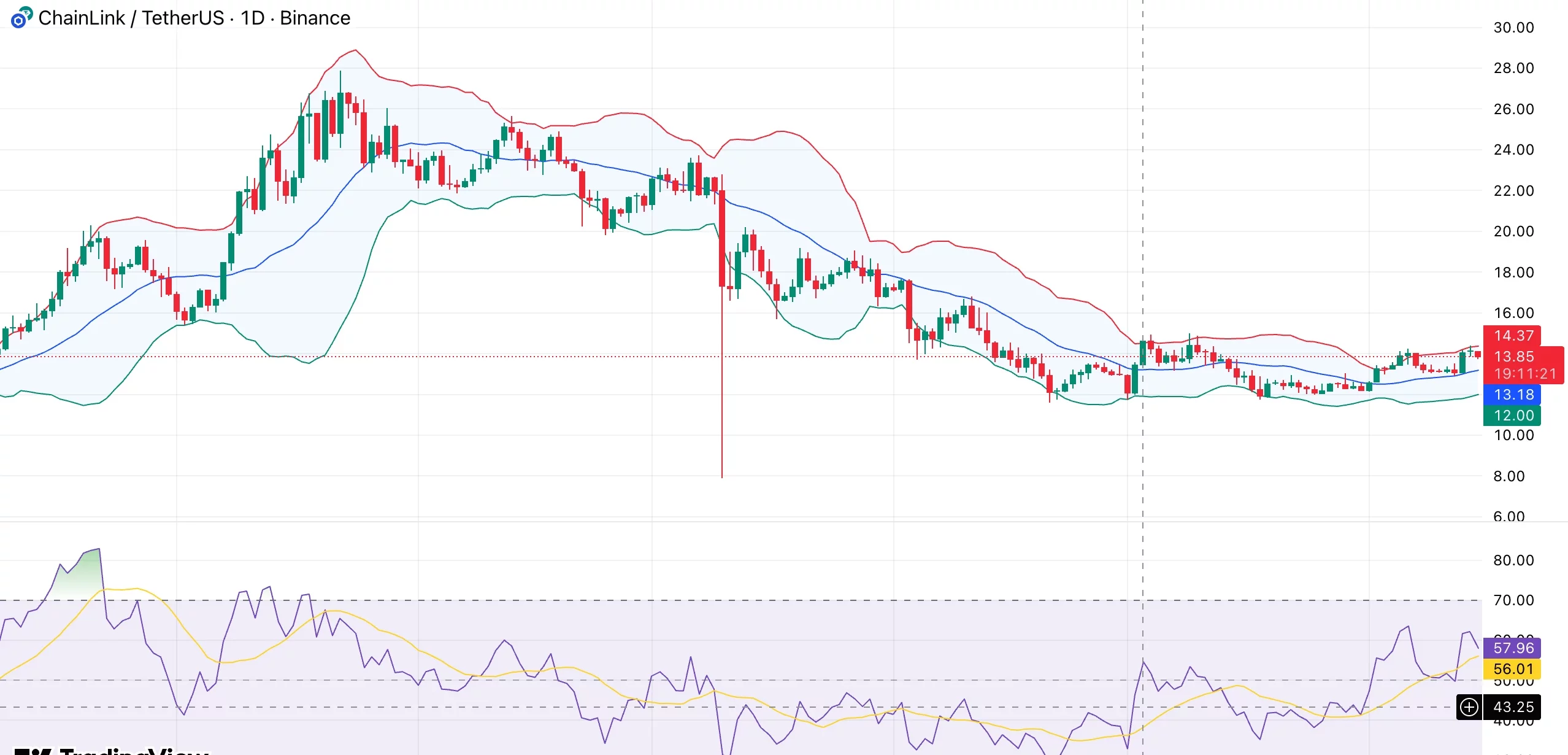
Chainlink price nears breakout as Bollinger Bands tighten after Bitwise LINK ETF launch - 1

Bollinger Bands are now tightly compressed, confirming a low-volatility regime. Prices often move sharply when they break out of the band. 

Momentum indicators lean constructive but not stretched. There is space for follow-through as the relative strength index is close to 58. The average directional index indicates that trend strength is still developing rather than fully established, and the MACD is in positive territory.

Support is clearly defined between $13.00 and $13.20, which corresponds to the 20- and 30-day moving averages. The structure remains intact as long as the price stays above this range on daily closes. A clean break below $13 would likely invite a deeper pullback toward the $12.80 region.

On the upside, resistance sits at $14.00–$14.20. This level has  capped price multiple times and lines up with short-term horizontal supply. A daily close above $14.20, especially with rising volume, would open the door toward $15.00, where the 100-day moving average comes into view.

Market Opportunity
Chainlink Logo
Chainlink Price(LINK)
$9.15
$9.15$9.15
-0.75%
USD
Chainlink (LINK) Live Price Chart
Disclaimer: The articles reposted on this site are sourced from public platforms and are provided for informational purposes only. They do not necessarily reflect the views of MEXC. All rights remain with the original authors. If you believe any content infringes on third-party rights, please contact [email protected] for removal. MEXC makes no guarantees regarding the accuracy, completeness, or timeliness of the content and is not responsible for any actions taken based on the information provided. The content does not constitute financial, legal, or other professional advice, nor should it be considered a recommendation or endorsement by MEXC.

You May Also Like

Trading time: Tonight, the US GDP and the upcoming non-farm data will become the market focus. Institutions are bullish on BTC to $120,000 in the second quarter.

Trading time: Tonight, the US GDP and the upcoming non-farm data will become the market focus. Institutions are bullish on BTC to $120,000 in the second quarter.

Daily market key data review and trend analysis, produced by PANews.
Share
PANews2025/04/30 13:50
Ethereum Fusaka Upgrade Set for December 3 Mainnet Launch, Blob Capacity to Double

Ethereum Fusaka Upgrade Set for December 3 Mainnet Launch, Blob Capacity to Double

Ethereum developers confirmed the Fusaka upgrade will activate on mainnet on December 3, 2025, following a systematic testnet rollout beginning on October 1 on Holesky. The major hard fork will implement around 11-12 Ethereum Improvement Proposals targeting scalability, node efficiency, and data availability improvements without adding new user-facing features. According to Christine Kim, the upgrade introduces a phased blob capacity expansion through Blob Parameter Only forks occurring two weeks after Fusaka activation. Initially maintaining current blob limits of 6/9 target/max, the first BPO fork will increase capacity to 10/15 blobs one week later. A second BPO fork will further expand limits to 14/21 blobs, more than doubling total capacity within two weeks. Strategic Infrastructure Overhaul Fusaka prioritizes backend protocol improvements over user-facing features, focusing on making Ethereum faster and less resource-intensive. The upgrade includes PeerDAS implementation through EIP-7594, allowing validator nodes to verify data by sampling small pieces rather than downloading entire blobs. This reduces bandwidth and storage requirements while enhancing Layer 2 rollup scalability. The upgrade builds on recent gas limit increases from 30 million to 45 million gas, with ongoing discussions for further expansion. EIP-7935 proposes increasing limits to 150 million gas, potentially enabling significantly higher transaction throughput. These improvements complement broader scalability efforts, including EIP-9698, which suggests a 100x gas limit increase over two years to reach 2,000 transactions per second. Fusaka removes the previously planned EVM Object Format redesign to reduce complexity while maintaining focus on essential infrastructure improvements. The upgrade introduces bounded base fees for blob transactions via EIP-7918, creating more predictable transaction costs for data-heavy applications. Enhanced spam resistance and security improvements strengthen network resilience against scalability bottlenecks and attacks. Technical Implementation and Testing Timeline The Fusaka rollout follows a conservative four-phase approach across Ethereum testnets before mainnet deployment. Holesky upgrade occurs October 1, followed by Sepolia on October 14 and Hoodi on October 28. Each testnet will undergo the complete BPO fork sequence to validate the blob capacity expansion mechanism. BPO forks activate automatically based on predetermined epochs rather than requiring separate hard fork processes. On mainnet, the first BPO fork launches December 17, increasing blob capacity to 10/15 target/max. The second BPO fork activates January 7, 2026, reaching the final capacity of 14/21 blobs. This automated approach enables flexible blob scaling without requiring full network upgrades. Notably, node operators face release deadlines ranging from September 25 for Holesky to November 3 for mainnet preparation. The staggered timeline, according to the developers, allows comprehensive testing while giving infrastructure providers sufficient preparation time. Speculatively, the developers use this backward-compatible approach to ensure smooth transitions with minimal disruption to existing applications. PeerDAS implementation reduces node resource demands, potentially increasing network decentralization by lowering barriers for smaller operators. The technology enables more efficient data availability sampling, crucial for supporting growing Layer 2 rollup adoption. Overall, these improvements, combined with increased gas limits, will enable Ethereum to handle higher transaction volumes while maintaining security guarantees. Addressing Network Scalability Pressures The Fusaka upgrade addresses mounting pressure for Ethereum base layer improvements amid criticism of Layer 2 fragmentation strategies. Critics argue that reliance on rollups has created isolated chains with limited interoperability, complicating user experiences. The upgrade’s focus on infrastructure improvements aims to enhance base layer capacity while supporting continued Layer 2 growth. The recent validator queue controversy particularly highlights ongoing network scalability challenges. According to a Cryptonews report covered yesterday, currently, over 2M ETH sits in exit queues facing 43-day delays, while entry queues process in just 7 days.Ethereum Validator Queue (Source: ValidatorQueue) However, Vitalik Buterin defended these delays as essential for network security, comparing validator commitments to military service requiring “friction in quitting.” The upgrade coincides with growing institutional interest in Ethereum infrastructure, with VanEck predicting that Layer 2 networks could reach $1 trillion market capitalization within six years. Fusaka’s emphasis on data availability and node efficiency supports Ethereum’s evolution toward seamless cross-chain interoperability. The upgrade complements initiatives like the Open Intents Framework, where Coinbase Payments recently joined as a core contributor. The initiative, if successful, will address the $21B surge in cross-chain crime. These coordinated efforts aim to unify the fragmented multichain experience while maintaining Ethereum’s security and decentralization principles
Share
CryptoNews2025/09/19 16:37
VectorUSA Achieves Fortinet’s Engage Preferred Services Partner Designation

VectorUSA Achieves Fortinet’s Engage Preferred Services Partner Designation

TORRANCE, Calif., Feb. 3, 2026 /PRNewswire/ — VectorUSA, a trusted technology solutions provider, specializes in delivering integrated IT, security, and infrastructure
Share
AI Journal2026/02/05 00:02
