This article applies game theory to a firm, demonstrating how a fair bonus distribution system can create a self-enforcing Nash equilibrium for teamwork.This article applies game theory to a firm, demonstrating how a fair bonus distribution system can create a self-enforcing Nash equilibrium for teamwork.

Game Theory in the Workplace: Using Bonuses to Ensure a Self-Enforcing Equilibrium

2025/09/17 22:45
4 min read
For feedback or concerns regarding this content, please contact us at [email protected]

Abstract and 1. Introduction

  1. A free and fair economy: definition, existence and uniqueness

    2.1 A free economy

    2.2 A free and fair economy

  2. Equilibrium existence in a free and fair economy

    3.1 A free and fair economy as a strategic form game

    3.2 Existence of an equilibrium

  3. Equilibrium efficiency in a free and fair economy

  4. A free economy with social justice and inclusion

    5.1 Equilibrium existence and efficiency in a free economy with social justice

    5.2 Choosing a reference point to achieve equilibrium efficiency

  5. Some applications

    6.1 Teamwork: surplus distribution in a firm

    6.2 Contagion and self-enforcing lockdown in a networked economy

    6.3 Bias in academic publishing

    6.4 Exchange economies

  6. Contributions to the closely related literature

  7. Conclusion and References

Appendix

6 Some applications

There a wide variety of applications of our theory. In this section, we provide applications to the distribution of surplus in a firm, exchange economies, self-enforcing lockdowns in a networked economy facing a pandemic, and publication bias in the academic peer-review system.

6.1 Teamwork: surplus distribution in a firm

In this first application, we use our theory to show how bonuses can be distributed among workers in a way that incentivizes them to work efficiently.

\
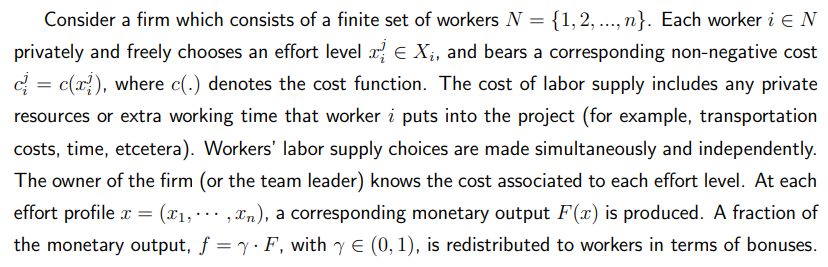
\ The existence of a pure strategy Nash equilibrium in this teamwork game follows from Lemma 1. To see this, observe that the payoff function of a worker can be decomposed in two parts: the bonus that is determined by the Shapley payoff and the cost function. Lemma 1 shows that the sum of excess payoffs in any cycle of deviations equals 0 in any free and fair economy (or any strategic game with Shapley payoffs). The reader can check that the sum of excess costs in any cycle of strategy profiles is zero as well in the game. The latter implies that the sum of excess payoffs in any cycle of strategy profiles of the teamwork game is equal to 0. Therefore, the teamwork game admits no cycle of deviations. As the game is finite, we conclude that it admits at least a Nash equilibrium profile in pure strategies. (Recall that the total output of the firm, F, and the total bonus, f, are perfectly correlated.) We should point out that a pure strategy Nash equilibrium always exists in the teamwork game, even if costs are high. In the latter case, some workers, if not all, might find it optimal to remain inactive at the equilibrium. In such a situation, the owner might want to raise the total bonus to be redistributed to workers.

\
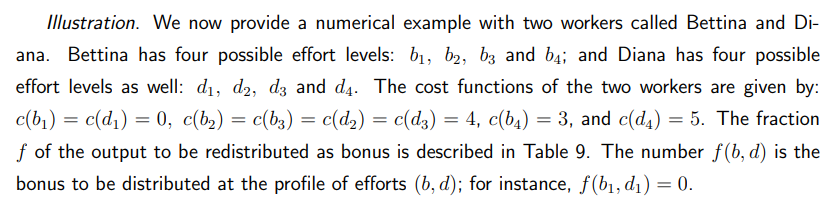
\ Table 9: Total bonus function in a teamwork game
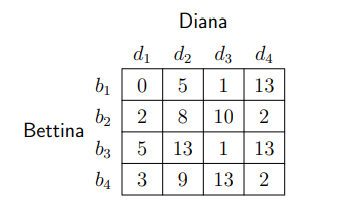
\ The corresponding Shapley payoffs are described in Table 10 and the net payoffs of Bettina and Diana in the teamwork game are described in Table 11.

\ The profile (b4, d3) is a pure strategy Nash equilibrium. Therefore, the owner of the firm can implement the profile (b4, d3) without any need of monitoring the actions of Bettina and Diana, as (b4, d3) is self-enforcing. The owner can implement the profile (b1, d4) as well. Note that the set of equilibrium effort profiles depend on the cost functions, and that no worker receives a non

\ Table 10: Shapley payoffs: redistribution of total bonus in a teamwork game
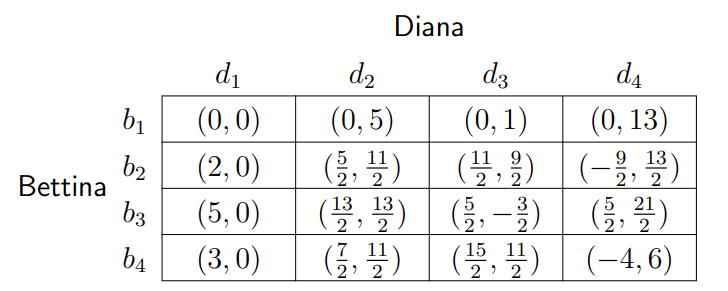
\ Table 11: Bettina and Diana’s net payoffs in a teamwork game

\ positive bonus at the equilibrium. The reason is that each worker i always has the option to remain inactive, which is equivalent to Bettina choosing b1 or Diana choosing d1 in this illustration. The two equilibria in this teamwork game are Pareto-efficient.

\

:::info Authors:

(1) Ghislain H. Demeze-Jouatsa, Center for Mathematical Economics, University of Bielefeld (demeze [email protected]);

(2) Roland Pongou, Department of Economics, University of Ottawa ([email protected]);

(3) Jean-Baptiste Tondji, Department of Economics and Finance, The University of Texas Rio Grande Valley ([email protected]).

:::


:::info This paper is available on arxiv under CC BY 4.0 DEED license.

:::

\

Market Opportunity
SQUID MEME Logo
SQUID MEME Price(GAME)
$27.7859
$27.7859$27.7859
+2.72%
USD
SQUID MEME (GAME) Live Price Chart
Disclaimer: The articles reposted on this site are sourced from public platforms and are provided for informational purposes only. They do not necessarily reflect the views of MEXC. All rights remain with the original authors. If you believe any content infringes on third-party rights, please contact [email protected] for removal. MEXC makes no guarantees regarding the accuracy, completeness, or timeliness of the content and is not responsible for any actions taken based on the information provided. The content does not constitute financial, legal, or other professional advice, nor should it be considered a recommendation or endorsement by MEXC.
Tags:

You May Also Like

Franklin Templeton CEO Dismisses 50bps Rate Cut Ahead FOMC
Franklin Templeton CEO Dismisses 50bps Rate Cut Ahead FOMC

The post Franklin Templeton CEO Dismisses 50bps Rate Cut Ahead FOMC appeared on BitcoinEthereumNews.com. Franklin Templeton CEO Jenny Johnson has weighed in on whether the Federal Reserve should make a 25 basis points (bps) Fed rate cut or 50 bps cut. This comes ahead of the Fed decision today at today’s FOMC meeting, with the market pricing in a 25 bps cut. Bitcoin and the broader crypto market are currently trading flat ahead of the rate cut decision. Franklin Templeton CEO Weighs In On Potential FOMC Decision In a CNBC interview, Jenny Johnson said that she expects the Fed to make a 25 bps cut today instead of a 50 bps cut. She acknowledged the jobs data, which suggested that the labor market is weakening. However, she noted that this data is backward-looking, indicating that it doesn’t show the current state of the economy. She alluded to the wage growth, which she remarked is an indication of a robust labor market. She added that retail sales are up and that consumers are still spending, despite inflation being sticky at 3%, which makes a case for why the FOMC should opt against a 50-basis-point Fed rate cut. In line with this, the Franklin Templeton CEO said that she would go with a 25 bps rate cut if she were Jerome Powell. She remarked that the Fed still has the October and December FOMC meetings to make further cuts if the incoming data warrants it. Johnson also asserted that the data show a robust economy. However, she noted that there can’t be an argument for no Fed rate cut since Powell already signaled at Jackson Hole that they were likely to lower interest rates at this meeting due to concerns over a weakening labor market. Notably, her comment comes as experts argue for both sides on why the Fed should make a 25 bps cut or…
Share
BitcoinEthereumNews2025/09/18 00:36
Melania Trump humiliated her husband as he tries to outrun his decay: analysts

Melania Trump humiliated her husband as he tries to outrun his decay: analysts

First lady Melania Trump just handed President Donald Trump his biggest humiliation yet as the president tried to outrun his decay, according to two political analysts
Share
Rawstory2026/05/05 11:42
Peter Brandt Agrees: This COT Shift Could Be Bitcoin’s Biggest Bull Signal Since 2025

Peter Brandt Agrees: This COT Shift Could Be Bitcoin’s Biggest Bull Signal Since 2025

Peter Brandt backs a rare COT positioning flip in Bitcoin futures. McClellan says large specs turned net long with urgency. Is a rally coming? Three strikes. That
Share
LiveBitcoinNews2026/05/05 11:30

Starter Gold Rush: Win $2,500!

Starter Gold Rush: Win $2,500!Starter Gold Rush: Win $2,500!

Start your first trade & capture every Alpha move