

LuxAlgo vs. EzAlgo vs. SMRTAlgo vs. Infinity Algo — Which AI Trading Indicator is the best?
LuxAlgo, EzAlgo, SMRTAlgo, and Infinity Algo all pitch themselves as advanced solutions for traders who want smarter entries, cleaner confirmations, and less chart-side confusion, but their actual value depends on far more than marketing claims. In this comparison, we break down LuxAlgo vs. EzAlgo vs. SMRTAlgo vs. Infinity Algo to see which one offers the best features.
LuxAlgo vs. EzAlgo vs. SMRTAlgo vs. Infinity Algo: Overview
LuxAlgo
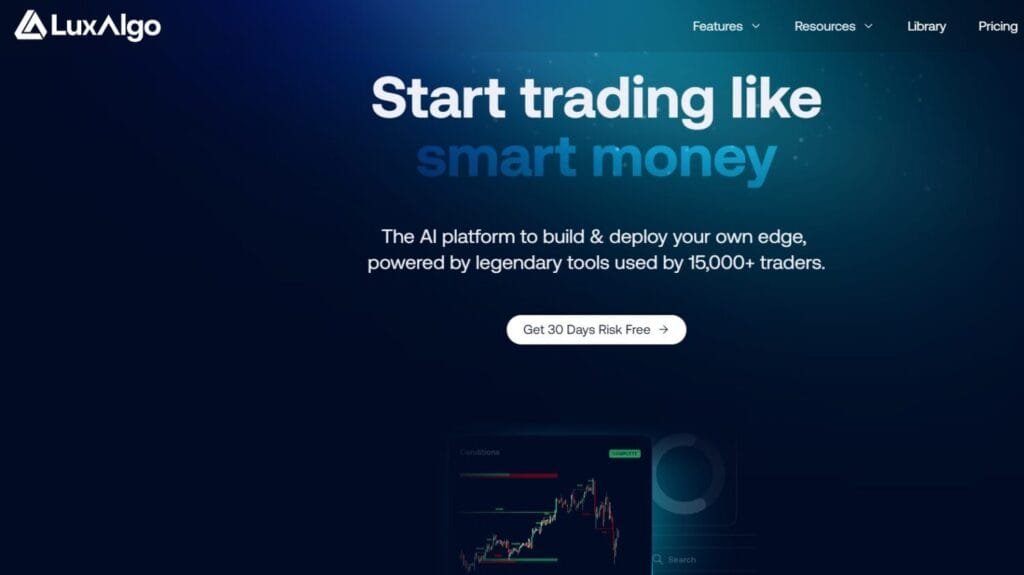
LuxAlgo presents itself as a broad trading-intelligence platform rather than just a single TradingView script. Its official positioning now spans indicator suites, AI backtesting, strategy building, alert automation, and Pine Script-oriented tooling, which makes it feel more like a full ecosystem for traders who want research, signal generation, and deployment workflows in one place. Its three flagship toolkits — Price Action Concepts, Signals & Overlays, and the Oscillator Matrix — are backed by screeners, an AI tool called Quant for generating and validating indicators, and a Discord community of more than 150,000 members. For anyone asking which AI trading indicator actually delivers, LuxAlgo is the most visible contender because it blends signal quality with research infrastructure instead of relying solely on buy and sell arrows.
 LuxAlgo vs. EzAlgo vs. SMRTAlgo vs. Infinity Algo
EzAlgo
EzAlgo is positioned more as a direct signal-and-execution aid for TradingView users who want algorithm-powered trading assistance without getting buried in overly technical workflow layers. Its official messaging focuses on buy and sell points, multi-timeframe support and resistance, live-data-driven analysis, and usability across different assets and timeframes. Compared with the others, EzAlgo comes across as a more straightforward trader-facing product that emphasizes practical chart guidance, accessibility, and community-oriented usage rather than a highly expanded AI research stack. It leans heavily on its EzTrades Discord community, daily setups, weekly livestreams, and a free Smart Money Indicator as an on-ramp, which keeps the product approachable for newer traders.
 LuxAlgo vs. EzAlgo vs. SMRTAlgo vs. Infinity Algo
SMRTAlgo
SMRTAlgo is positioned as an institutional-style TradingView suite built around smart money concepts, liquidity reactions, momentum confirmation, and structured market reading. Its official site emphasizes clear buy and sell signals, smart money levels, AI-backed strategy generation, and real-time risk control, which gives it a strong market-structure identity rather than a generic signal-service feel. The suite includes 8+ advanced indicators such as Pro V3, Pro V4, Smart Money Toolkit, SMRT Oscillator, Volume Profile, Multi-Asset Screener, Scalper Bot, Swing Indicator, and Reversal Finder, with more than 15,000 reported users. In a comparison article, SMRTAlgo can be described as the option that leans hardest into the smart-money and professional chart-reading narrative for traders who want more contextual structure behind entries and confirmations.
 LuxAlgo vs. EzAlgo vs. SMRTAlgo vs. Infinity Algo
Infinity Algo
Infinity Algo positions itself as more than a TradingView indicator by combining signal generation with a broader web-based trading suite, AI analyst features, risk-planning tools, and multi-market support. Its official messaging highlights non-repainting buy and sell signals, take-profit and stop-loss alerting, pre-signal warnings, and a platform layer designed to help traders plan, execute, and review trades more systematically. The product is built around three indicators — Infinity Algo V3, Infinity Backtest, and the Infinity Dashboard — plus five signal systems (Normal, Smart, AI, HL Sniper, Hybrid), an auto-tune engine, and a web platform with AI analyst and journaling features. Infinity Algo sits between a pure signal service and a wider trading workspace, making it attractive for traders who want alerts, dashboards, and additional workflow support beyond pure TradingView overlays.
 LuxAlgo vs. EzAlgo vs. SMRTAlgo vs. Infinity Algo
LuxAlgo vs. EzAlgo vs. SMRTAlgo vs. Infinity Algo: Key Features
LuxAlgo
• Full premium ecosystem: LuxAlgo bundles indicators, screeners, alerts, AI backtesting, and an AI code generator into a single subscription, which makes it the most research-oriented option of the four.
• Three flagship toolkits: Price Action Concepts, Signals & Overlays, and the Oscillator Matrix cover market structure, directional signals, and momentum in a coordinated system.
• AI-driven backtesting: The Ultimate plan unlocks an AI backtester that explores large volumes of strategy combinations to surface configurations worth running live.
• Large free library: LuxAlgo publishes hundreds of free open-source indicators on TradingView, which lets traders sample the style before subscribing.
• Huge community layer: A Discord community of more than 150,000 members plus nearly 24/7 live chat support makes it the most beginner-friendly of the four.
• Best suited for traders who want depth: LuxAlgo fits traders who want signals, screeners, automation, and research in one workflow rather than just chart overlays.
 LuxAlgo vs. EzAlgo vs. SMRTAlgo vs. Infinity Algo
EzAlgo
• Signal-first design: EzAlgo focuses on clear buy and sell arrows, multi-timeframe support and resistance, and AI reversal signals engineered to be intuitive rather than technical.
• Non-repainting claim: EzAlgo markets its signals as real-time and non-repainting, which is an important differentiator in a category where repainting is a frequent complaint.
• Strong community backbone: The EzTrades Discord hosts around 30,000 traders with daily setups, weekly livestreams, and pro signals from in-house analysts.
• Free Smart Money Indicator: EzAlgo offers permanent free access to its Smart Money Indicator module covering order blocks, fair value gaps, and trendlines, which serves as an on-ramp to paid plans.
• Education-heavy framing: A 26-page usage PDF, 20+ preset strategies, and structured livestreams aim to shorten the learning curve compared with purely technical suites.
• Best suited for newer traders: EzAlgo fits traders who want a straightforward signal assistant and an active community rather than an expanded research stack.
 LuxAlgo vs. EzAlgo vs. SMRTAlgo vs. Infinity Algo
SMRTAlgo
• Smart money focus: SMRTAlgo is built around smart money concepts — liquidity sweeps, fair value gaps, and institutional footprints — rather than generic trend-following signals.
• Multi-indicator suite: The product includes Pro V3, Pro V4, Smart Money Toolkit, SMRT Oscillator, Volume Profile, Multi-Asset Screener, Scalper Bot, Swing Indicator, and Reversal Finder across 55+ features.
• Non-repainting and fake-out protection: Signals lock on bar close with no retroactive redrawing, and selective signal printing plus fake-out protection are designed to cut false breakouts.
• Scalper Bot component: An automated scalper module targets rapid entries and exits on lower timeframes, and integrates with automated trading software through webhooks.
• Prop-firm orientation: SMRTAlgo is frequently referenced in the context of prop-firm evaluations, with marketing aimed at traders pursuing FTMO-style funded accounts.
• Best suited for structure-focused traders: SMRTAlgo fits intermediate to advanced traders who want deeper market-structure and institutional-flow context rather than a beginner dashboard.
 LuxAlgo vs. EzAlgo vs. SMRTAlgo vs. Infinity Algo
Infinity Algo
• Three-indicator suite: Infinity Algo V3 handles live signals, Infinity Backtest handles historical performance testing, and the Infinity Dashboard handles multi-timeframe trend mapping.
• Five signal modes: Normal (contrarian), Smart (trend-following), AI (adaptive), HL Sniper (precision), and Hybrid modes let traders switch logic based on whether the market is trending or ranging.
• Auto-tune engine: The indicator can test 500+ parameter combinations against historical data and select the highest-scoring configuration automatically, which removes some of the manual optimization work.
• Built-in risk management: Six configurable take-profit levels, three trailing stop-loss modes (static, breakeven, moving target), and peak-profit tracking are part of the core indicator.
• Web platform layer: Paid plans bundle browser-based AI analyst tools, Crypto Radar, Market Pulse, Trade Planner, and journaling features alongside the TradingView indicators.
• Best suited for workflow-focused traders: Infinity Algo fits traders who want signals plus planning, journaling, and dashboards in a single platform rather than pure chart overlays.
 LuxAlgo vs. EzAlgo vs. SMRTAlgo vs. Infinity Algo
LuxAlgo vs. EzAlgo vs. SMRTAlgo vs. Infinity Algo: Pricing
LuxAlgo vs. EzAlgo vs. SMRTAlgo vs. Infinity Algo: Comparative Analysis
Which AI Trading Indicator Actually Delivers?
Not one of the four delivers in the same way, and that is the real answer. LuxAlgo, EzAlgo, SMRTAlgo, and Infinity Algo all target traders who want faster chart interpretation and more structured decision-making, but they do not deliver value on the same terms.
LuxAlgo stands out as the most complete ecosystem for traders who want more than signals, especially if they care about backtesting, strategy development, and alert automation. It is the safest first subscription for traders who are still figuring out what they want from a premium indicator.
 LuxAlgo vs. EzAlgo vs. SMRTAlgo vs. Infinity Algo
EzAlgo is the more straightforward choice for traders who want cleaner plug-and-play signal assistance without committing to a broader platform workflow. Its combination of simple chart arrows, multi-timeframe support and resistance, and the active EzTrades community makes it the most approachable option for newer traders, even if the lifetime price is the steepest of the four.
 LuxAlgo vs. EzAlgo vs. SMRTAlgo vs. Infinity Algo
SMRTAlgo is the strongest fit for traders who prefer smart money concepts, liquidity-based chart reading, and more contextual market-structure analysis. Its 8-indicator suite and prop-firm orientation make it attractive for traders pursuing FTMO-style evaluations or aiming to replicate institutional-style setups, though the learning curve is the steepest of the four.
 LuxAlgo vs. EzAlgo vs. SMRTAlgo vs. Infinity Algo
Infinity Algo sits between a signal service and a wider trading workspace, making it attractive for traders who want alerts, dashboards, planning tools, and additional workflow support beyond TradingView overlays. The auto-tune engine and built-in risk management differentiate it from indicator-only competitors, and the lifetime plan removes the friction of recurring billing.
 LuxAlgo vs. EzAlgo vs. SMRTAlgo vs. Infinity Algo
Conclusion
LuxAlgo wins on ecosystem and research depth. EzAlgo wins on simplicity and community. SMRTAlgo wins on smart money specialization. Infinity Algo wins on workflow integration and risk management.
None of the four guarantees trading profits, and all four derive their signals from the same underlying price and volume data available on TradingView. The edge comes from how the tools are used, combined with sound risk management, and not from the indicators themselves. For most active traders, the smartest approach is to start with the free tier or free indicators that each platform offers, identify the gap in their current workflow, and pay only for the suite that genuinely closes that gap. An AI trading indicator delivers when it saves time, sharpens decision-making, and fits the trader’s process — not when its marketing promises the most accuracy.
Frequently Asked Questions
Which AI trading indicator actually delivers the best results?
No single AI trading indicator consistently outperforms the others because results depend on the trader’s style and discipline. LuxAlgo delivers the most complete ecosystem, EzAlgo delivers the simplest signal experience, SMRTAlgo delivers the deepest smart money framework, and Infinity Algo delivers the strongest workflow integration.
Which option focuses most on smart money concepts?
SMRTAlgo is the clearest smart-money-focused option in this group because its official positioning emphasizes smart money concepts, liquidity reactions, support and resistance structure, and momentum confirmation.
Which platform has the highest lifetime price?
EzAlgo has the highest lifetime price among the four based on the official pricing pages reviewed for this comparison, with a one-time lifetime plan around $1,499. SMRTAlgo and Infinity Algo both offer lifetime plans at lower price points.


You May Also Like

XRP Whales Move $592 Million From Exchanges In Two Days. Discover What Triggered It

Garlinghouse Takes XRP to Miami as ETF Assets Cross $1B




