Bitcoin endured one of its sharpest selloffs of the year on Tuesday, knifing below the six-figure threshold and printing lows around the $99,000 area on major composites before rebounding. At press time, bitcoin (BTC) hovered near $101,700 after an intraday trough just above $99,000 on widely used benchmarks, marking a fall of roughly 6% day-over-day and the lowest print since June. The slide came as US equities limped into mid-week, with the Nasdaq up 20.9% year-to-date and the S&P 500 up 15.1% as of Tuesday’s close—gains that underscore how much bitcoin has lagged other risk assets during long stretches of 2025. That divergence, together with a growing body of ETF-flow data showing several straight sessions of net outflows from US spot bitcoin funds into early November, provided the macro backdrop for a fragile crypto tape. Independent tallies from Farside/SoSoValue and multiple outlets point to a roughly $1.3–$1.4 billion cumulative bleed over four trading days into November 3–4, led by BlackRock’s IBIT. Why Is Bitcoin Price Down? Into that context, Joe Consorti—Head of Growth at Horizon (Theya, YC)—argues the selloff is less a loss of conviction than a structural handoff of supply. In a video analysis posted late November 4 US time, he framed the day’s move as “one of its roughest days of the year, down more than 6 percent, falling to $99,000 for the first time since June,” adding that while equities would call that “the start of a bear market… for Bitcoin, though, this is typical of a bull market drawdown.” He noted that “we’ve already weathered two separate 30 percent drawdowns during this bull run,” and characterized the present action as “a transfer of Bitcoin’s ownership base from the old guard to the new guard.” Related Reading: CryptoQuant Head Reveals Reason Behind Bearish Bitcoin Trend Consorti anchored his thesis to a now-viral framework from macro investor Jordi Visser: bitcoin’s “silent IPO.” In Visser’s Substack essay—shared widely since the weekend—he posits that 2025’s rangebound price belies an orderly, IPO-like distribution as early-era holders access the deepest liquidity the asset has ever had through ETFs, institutional custodians and corporate balance sheets. “Early-stage investors… need liquidity. They need an exit. They need to diversify,” Visser wrote, arguing that methodical selling “results [in] a sideways grind that drives everyone crazy.” Consorti adopted the frame bluntly: “This isn’t panic selling, it’s the natural evolution of an asset that’s reached maturity… a transfer of ownership from concentrated hands to distributed ones.” Evidence for that churn has been visible on-chain. Multiple instances of Satoshi-era wallets and miner addresses reanimating this quarter—some after 14 years—have been documented, including July’s duo of 10,000-BTC wallets and late-October movement from a 4,000-BTC miner address. While not dispositive that coins are being market-sold, the pattern is consistent with supply redistributing from early concentrates to broader, regulated channels. Technically, Consorti cast the drop as part of “digestion,” not exhaustion. “The RSI tells us Bitcoin is at its most oversold level since April, when the last leg of the bull run began. Every drawdown this cycle, 30%, 35%, and now 20%, has built support rather than destroyed it.” He added a key conditional: “If we spend too much time below $100,000, that could suggest the distribution isn’t done… perhaps we’re in for a bull-market reversal into a bear market.” Macro, however, is intruding. The Federal Reserve cut rates by 25 bps on October 29 to a 3.75%–4.00% target range, but Chair Jerome Powell carefully pushed back on the idea of an automatic December cut, citing “strongly differing views” inside the FOMC and a “data fog” from the ongoing government shutdown. Markets promptly tempered their odds for further near-term easing. Consorti’s warning that bitcoin “is extremely correlated” to risk-asset drawdowns therefore looms large: if equities lurch meaningfully lower or funding stress reappears, crypto will feel it. Related Reading: Bitcoin Bull Run: Over Or Just Paused? CryptoQuant CEO Presents The Data If Visser’s “silent IPO” is right, ETFs are both symptom and salve. They have delivered the two-sided depth to absorb legacy supply but also introduced a new, faster-moving cohort whose redemptions can amplify downdrafts. That dynamic showed up again this week in the four-day string of net outflows concentrated in IBIT, even as longer-term assets under management remain enormous by historical standards. Consorti’s conclusion was starkly patient, not euphoric. “For every seller looking to liquidate their position, there’s a new participant stepping in for the long haul… It’s slow, it’s uneven, and it’s psychologically draining, but once it’s finished, it unlocks the next leg higher. Because the marginal seller is gone, and what’s left is a base of holders who don’t need to sell.” Whether Tuesday’s pierce of the six-figure floor proves the climactic flush—or merely another chapter in a months-long ownership transfer—will hinge on how quickly price reclaims and bases above $100,000, how ETF flows stabilize, and whether the Fed’s path from here restores risk appetite or starves it. For now, the most important story in bitcoin may be happening under the surface, not on the chart. At press time, BTC traded at $101,865. Featured image created with DALL.E, chart from TradingView.comBitcoin endured one of its sharpest selloffs of the year on Tuesday, knifing below the six-figure threshold and printing lows around the $99,000 area on major composites before rebounding. At press time, bitcoin (BTC) hovered near $101,700 after an intraday trough just above $99,000 on widely used benchmarks, marking a fall of roughly 6% day-over-day and the lowest print since June. The slide came as US equities limped into mid-week, with the Nasdaq up 20.9% year-to-date and the S&P 500 up 15.1% as of Tuesday’s close—gains that underscore how much bitcoin has lagged other risk assets during long stretches of 2025. That divergence, together with a growing body of ETF-flow data showing several straight sessions of net outflows from US spot bitcoin funds into early November, provided the macro backdrop for a fragile crypto tape. Independent tallies from Farside/SoSoValue and multiple outlets point to a roughly $1.3–$1.4 billion cumulative bleed over four trading days into November 3–4, led by BlackRock’s IBIT. Why Is Bitcoin Price Down? Into that context, Joe Consorti—Head of Growth at Horizon (Theya, YC)—argues the selloff is less a loss of conviction than a structural handoff of supply. In a video analysis posted late November 4 US time, he framed the day’s move as “one of its roughest days of the year, down more than 6 percent, falling to $99,000 for the first time since June,” adding that while equities would call that “the start of a bear market… for Bitcoin, though, this is typical of a bull market drawdown.” He noted that “we’ve already weathered two separate 30 percent drawdowns during this bull run,” and characterized the present action as “a transfer of Bitcoin’s ownership base from the old guard to the new guard.” Related Reading: CryptoQuant Head Reveals Reason Behind Bearish Bitcoin Trend Consorti anchored his thesis to a now-viral framework from macro investor Jordi Visser: bitcoin’s “silent IPO.” In Visser’s Substack essay—shared widely since the weekend—he posits that 2025’s rangebound price belies an orderly, IPO-like distribution as early-era holders access the deepest liquidity the asset has ever had through ETFs, institutional custodians and corporate balance sheets. “Early-stage investors… need liquidity. They need an exit. They need to diversify,” Visser wrote, arguing that methodical selling “results [in] a sideways grind that drives everyone crazy.” Consorti adopted the frame bluntly: “This isn’t panic selling, it’s the natural evolution of an asset that’s reached maturity… a transfer of ownership from concentrated hands to distributed ones.” Evidence for that churn has been visible on-chain. Multiple instances of Satoshi-era wallets and miner addresses reanimating this quarter—some after 14 years—have been documented, including July’s duo of 10,000-BTC wallets and late-October movement from a 4,000-BTC miner address. While not dispositive that coins are being market-sold, the pattern is consistent with supply redistributing from early concentrates to broader, regulated channels. Technically, Consorti cast the drop as part of “digestion,” not exhaustion. “The RSI tells us Bitcoin is at its most oversold level since April, when the last leg of the bull run began. Every drawdown this cycle, 30%, 35%, and now 20%, has built support rather than destroyed it.” He added a key conditional: “If we spend too much time below $100,000, that could suggest the distribution isn’t done… perhaps we’re in for a bull-market reversal into a bear market.” Macro, however, is intruding. The Federal Reserve cut rates by 25 bps on October 29 to a 3.75%–4.00% target range, but Chair Jerome Powell carefully pushed back on the idea of an automatic December cut, citing “strongly differing views” inside the FOMC and a “data fog” from the ongoing government shutdown. Markets promptly tempered their odds for further near-term easing. Consorti’s warning that bitcoin “is extremely correlated” to risk-asset drawdowns therefore looms large: if equities lurch meaningfully lower or funding stress reappears, crypto will feel it. Related Reading: Bitcoin Bull Run: Over Or Just Paused? CryptoQuant CEO Presents The Data If Visser’s “silent IPO” is right, ETFs are both symptom and salve. They have delivered the two-sided depth to absorb legacy supply but also introduced a new, faster-moving cohort whose redemptions can amplify downdrafts. That dynamic showed up again this week in the four-day string of net outflows concentrated in IBIT, even as longer-term assets under management remain enormous by historical standards. Consorti’s conclusion was starkly patient, not euphoric. “For every seller looking to liquidate their position, there’s a new participant stepping in for the long haul… It’s slow, it’s uneven, and it’s psychologically draining, but once it’s finished, it unlocks the next leg higher. Because the marginal seller is gone, and what’s left is a base of holders who don’t need to sell.” Whether Tuesday’s pierce of the six-figure floor proves the climactic flush—or merely another chapter in a months-long ownership transfer—will hinge on how quickly price reclaims and bases above $100,000, how ETF flows stabilize, and whether the Fed’s path from here restores risk appetite or starves it. For now, the most important story in bitcoin may be happening under the surface, not on the chart. At press time, BTC traded at $101,865. Featured image created with DALL.E, chart from TradingView.com
Bitcoin Price Crashes Below $99,000: Expert Breaks Down Why

2025/11/05 16:00

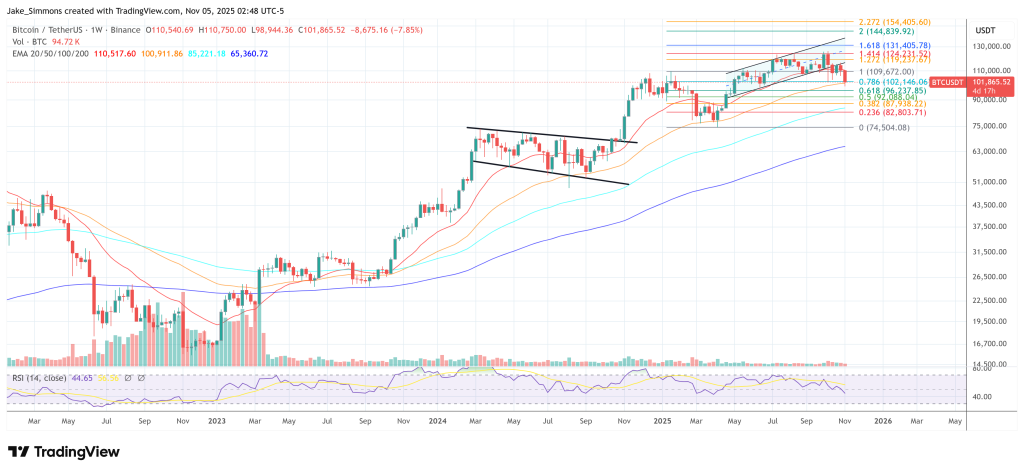
Bitcoin endured one of its sharpest selloffs of the year on Tuesday, knifing below the six-figure threshold and printing lows around the $99,000 area on major composites before rebounding. At press time, bitcoin (BTC) hovered near $101,700 after an intraday trough just above $99,000 on widely used benchmarks, marking a fall of roughly 6% day-over-day and the lowest print since June.

The slide came as US equities limped into mid-week, with the Nasdaq up 20.9% year-to-date and the S&P 500 up 15.1% as of Tuesday’s close—gains that underscore how much bitcoin has lagged other risk assets during long stretches of 2025. That divergence, together with a growing body of ETF-flow data showing several straight sessions of net outflows from US spot bitcoin funds into early November, provided the macro backdrop for a fragile crypto tape. Independent tallies from Farside/SoSoValue and multiple outlets point to a roughly $1.3–$1.4 billion cumulative bleed over four trading days into November 3–4, led by BlackRock’s IBIT.

Why Is Bitcoin Price Down?

Into that context, Joe Consorti—Head of Growth at Horizon (Theya, YC)—argues the selloff is less a loss of conviction than a structural handoff of supply. In a video analysis posted late November 4 US time, he framed the day’s move as “one of its roughest days of the year, down more than 6 percent, falling to $99,000 for the first time since June,” adding that while equities would call that “the start of a bear market… for Bitcoin, though, this is typical of a bull market drawdown.” He noted that “we’ve already weathered two separate 30 percent drawdowns during this bull run,” and characterized the present action as “a transfer of Bitcoin’s ownership base from the old guard to the new guard.”

Consorti anchored his thesis to a now-viral framework from macro investor Jordi Visser: bitcoin’s “silent IPO.” In Visser’s Substack essay—shared widely since the weekend—he posits that 2025’s rangebound price belies an orderly, IPO-like distribution as early-era holders access the deepest liquidity the asset has ever had through ETFs, institutional custodians and corporate balance sheets.

“Early-stage investors… need liquidity. They need an exit. They need to diversify,” Visser wrote, arguing that methodical selling “results [in] a sideways grind that drives everyone crazy.” Consorti adopted the frame bluntly: “This isn’t panic selling, it’s the natural evolution of an asset that’s reached maturity… a transfer of ownership from concentrated hands to distributed ones.”

Evidence for that churn has been visible on-chain. Multiple instances of Satoshi-era wallets and miner addresses reanimating this quarter—some after 14 years—have been documented, including July’s duo of 10,000-BTC wallets and late-October movement from a 4,000-BTC miner address. While not dispositive that coins are being market-sold, the pattern is consistent with supply redistributing from early concentrates to broader, regulated channels.

Technically, Consorti cast the drop as part of “digestion,” not exhaustion. “The RSI tells us Bitcoin is at its most oversold level since April, when the last leg of the bull run began. Every drawdown this cycle, 30%, 35%, and now 20%, has built support rather than destroyed it.” He added a key conditional: “If we spend too much time below $100,000, that could suggest the distribution isn’t done… perhaps we’re in for a bull-market reversal into a bear market.”

Macro, however, is intruding. The Federal Reserve cut rates by 25 bps on October 29 to a 3.75%–4.00% target range, but Chair Jerome Powell carefully pushed back on the idea of an automatic December cut, citing “strongly differing views” inside the FOMC and a “data fog” from the ongoing government shutdown. Markets promptly tempered their odds for further near-term easing. Consorti’s warning that bitcoin “is extremely correlated” to risk-asset drawdowns therefore looms large: if equities lurch meaningfully lower or funding stress reappears, crypto will feel it.

If Visser’s “silent IPO” is right, ETFs are both symptom and salve. They have delivered the two-sided depth to absorb legacy supply but also introduced a new, faster-moving cohort whose redemptions can amplify downdrafts. That dynamic showed up again this week in the four-day string of net outflows concentrated in IBIT, even as longer-term assets under management remain enormous by historical standards.

Consorti’s conclusion was starkly patient, not euphoric. “For every seller looking to liquidate their position, there’s a new participant stepping in for the long haul… It’s slow, it’s uneven, and it’s psychologically draining, but once it’s finished, it unlocks the next leg higher. Because the marginal seller is gone, and what’s left is a base of holders who don’t need to sell.”

Whether Tuesday’s pierce of the six-figure floor proves the climactic flush—or merely another chapter in a months-long ownership transfer—will hinge on how quickly price reclaims and bases above $100,000, how ETF flows stabilize, and whether the Fed’s path from here restores risk appetite or starves it. For now, the most important story in bitcoin may be happening under the surface, not on the chart.

At press time, BTC traded at $101,865.

Bitcoin price
Market Opportunity
WHY Logo
WHY Price(WHY)
$0.00000001619
$0.00000001619$0.00000001619
0.00%
USD
WHY (WHY) Live Price Chart
Disclaimer: The articles reposted on this site are sourced from public platforms and are provided for informational purposes only. They do not necessarily reflect the views of MEXC. All rights remain with the original authors. If you believe any content infringes on third-party rights, please contact [email protected] for removal. MEXC makes no guarantees regarding the accuracy, completeness, or timeliness of the content and is not responsible for any actions taken based on the information provided. The content does not constitute financial, legal, or other professional advice, nor should it be considered a recommendation or endorsement by MEXC.

You May Also Like

Sberbank explores crypto-backed loans as Russia softens stance on digital assets

Sberbank explores crypto-backed loans as Russia softens stance on digital assets

Russian financial services giant Sberbank may soon start offering loans secured by cryptocurrency, one of its top executives unveiled.         The news comes right
Share
Cryptopolitan2025/12/25 23:38
Why The Green Bay Packers Must Take The Cleveland Browns Seriously — As Hard As That Might Be

Why The Green Bay Packers Must Take The Cleveland Browns Seriously — As Hard As That Might Be

The post Why The Green Bay Packers Must Take The Cleveland Browns Seriously — As Hard As That Might Be appeared on BitcoinEthereumNews.com. Jordan Love and the Green Bay Packers are off to a 2-0 start. Getty Images The Green Bay Packers are, once again, one of the NFL’s better teams. The Cleveland Browns are, once again, one of the league’s doormats. It’s why unbeaten Green Bay (2-0) is a 8-point favorite at winless Cleveland (0-2) Sunday according to betmgm.com. The money line is also Green Bay -500. Most expect this to be a Packers’ rout, and it very well could be. But Green Bay knows taking anyone in this league for granted can prove costly. “I think if you look at their roster, the paper, who they have on that team, what they can do, they got a lot of talent and things can turn around quickly for them,” Packers safety Xavier McKinney said. “We just got to kind of keep that in mind and know we not just walking into something and they just going to lay down. That’s not what they going to do.” The Browns certainly haven’t laid down on defense. Far from. Cleveland is allowing an NFL-best 191.5 yards per game. The Browns gave up 141 yards to Cincinnati in Week 1, including just seven in the second half, but still lost, 17-16. Cleveland has given up an NFL-best 45.5 rushing yards per game and just 2.1 rushing yards per attempt. “The biggest thing is our defensive line is much, much improved over last year and I think we’ve got back to our personality,” defensive coordinator Jim Schwartz said recently. “When we play our best, our D-line leads us there as our engine.” The Browns rank third in the league in passing defense, allowing just 146.0 yards per game. Cleveland has also gone 30 straight games without allowing a 300-yard passer, the longest active streak in the NFL.…
Share
BitcoinEthereumNews2025/09/18 00:41
Understanding the Construction Industry Scheme

Understanding the Construction Industry Scheme

The Construction Industry Scheme, commonly known as CIS, is a tax system used in the UK construction sector. It sets out how payments made by contractors to subcontractors
Share
Techbullion2025/12/25 23:53