XRP has spent nearly 70 days below the pivotal 50-week SMA, with historical data triggering bullish expectations for the future. The broader crypto market has continuedXRP has spent nearly 70 days below the pivotal 50-week SMA, with historical data triggering bullish expectations for the future. The broader crypto market has continued

The Last Time This Happened, XRP Spiked 850%: Details

XRP has spent nearly 70 days below the pivotal 50-week SMA, with historical data triggering bullish expectations for the future.

The broader crypto market has continued to face bearish pressure since early October, with the global crypto market cap losing over $1.38 trillion worth of value within this period. Amid this downward pressure, XRP has fallen victim to the bears as well, having contributed $71.66 billion to the broader market loss.

After holding above the $2 support for most of the downtrend, XRP eventually gave up this level on Dec. 14, leading to steeper declines. However, market analyst Steph (@Steph_iscrypto) believes XRP may only be building strength for a breakout, as it observes a pattern that has historically led to massive price surges.

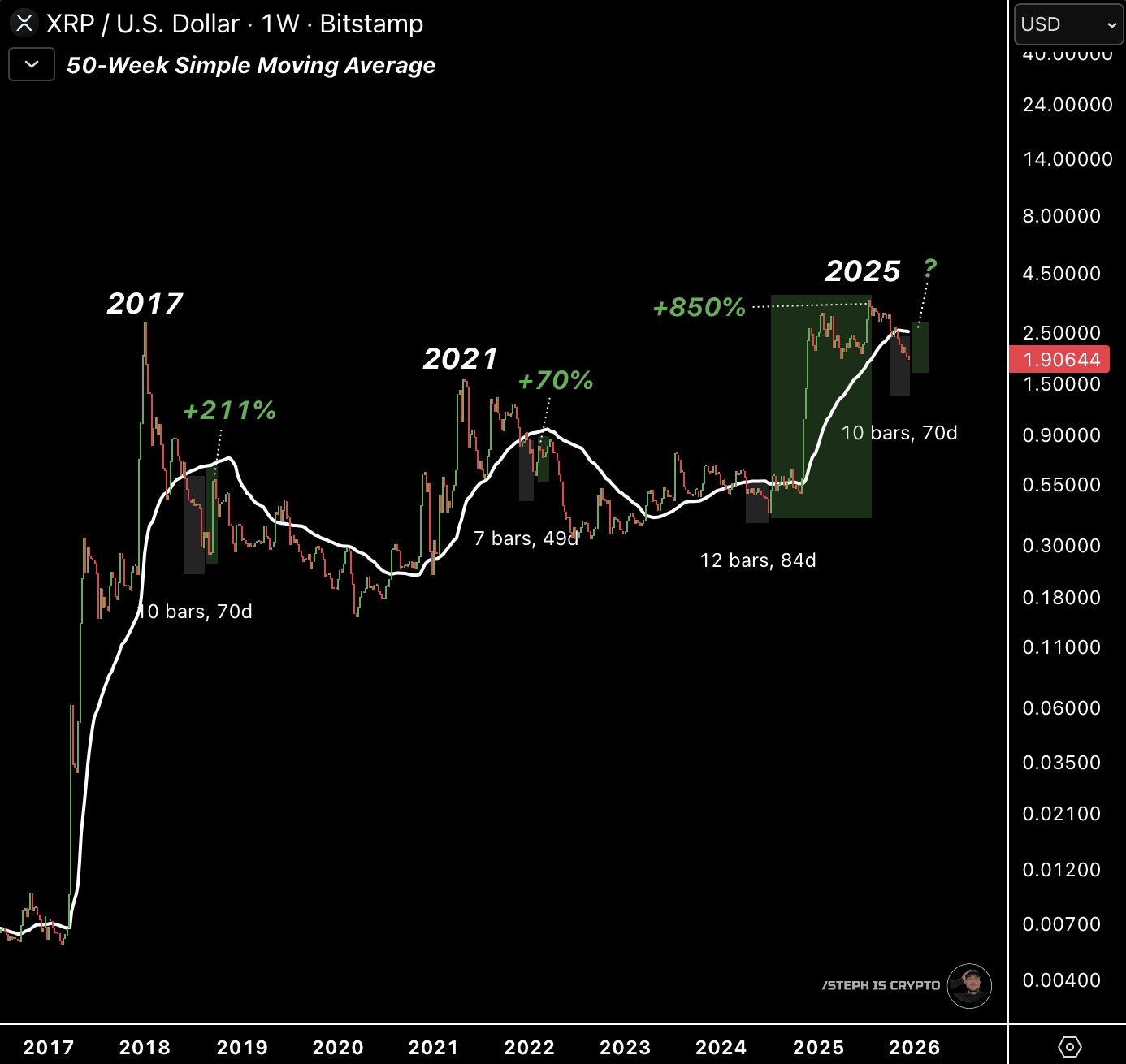
In his latest analysis, Steph confirmed that XRP has been trading below the crucial 50-week simple moving average (SMA) since this downward push began. While this indicates intense bearish pressure, XRP often stages impressive explosive rallies after spending an elongated period of time, specifically 50 to 84 days, below this moving average.

A Persistent Trend

Data from Steph’s weekly XRP chart confirms that this pattern has played out three times since 2018. Notably, after XRP collapsed from the $3.31 peak in January 2018, it entered a bearish phase.

As the downward push persisted, XRP eventually broke below the 50W SMA in early June 2018 and remained underneath it for 10 weekly bars or 70 days, with its lowest price being $0.2450 during this period. After this, it soared to $0.764 in September 2018, representing a 211.8% rise from the $0.2450 low.
XRP 1W Chart StephXRP 1W Chart | Steph

In 2021, a similar trend played out. Specifically, XRP slumped below the 50W SMA in December 2021 and traded underneath the moving average for 49 days. After it recovered, what followed was a spike to $0.9127 by February 2022, representing a 68% rise from the $0.5461 floor price during the downtrend.

The last time this pattern occurred was in 2024. Again, XRP dropped below the 50W SMA in April 2024 and stayed below the mark for 84 days. The recovery that ensued on the back of Donald Trump’s election victory pushed prices to the $3.66 peak in July 2025. This marked an 857% rise from the $0.3824 bottom within the downtrend.

XRP Repeating History?

After maintaining a price above the 50W SMA for most of this year, XRP slumped below it again in October 2025 and has now spent 10 weekly bars under it. This translates to 66 days, with four more days left before the close of this week. If XRP replicates the duration of the 2024 trend, it could continue to underperform until the end of December 2024, aligning with 84 days.

However, if the pattern repeats, another 857% explosion would push the XRP price to $17.3 from the $1.81 floor price during the ongoing downtrend. Even if XRP only managed to record half of the 2024/2025 run, amounting to a 428% increase, this would still lead to a $9.55 peak, representing a new all-time high. Nonetheless, there’s no guarantee history will repeat.

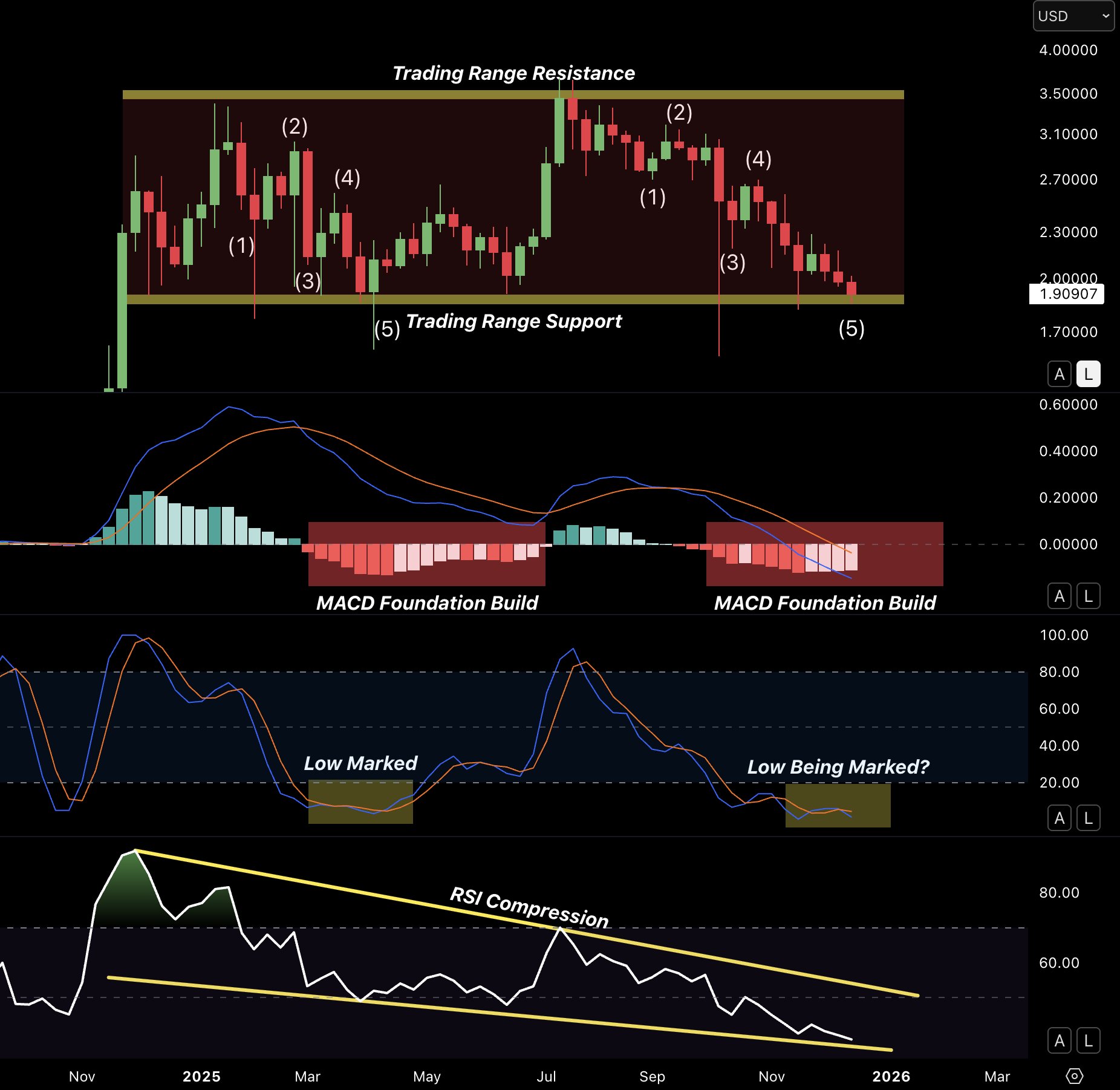
Meanwhile, analyst Chart Nerd pointed out that most XRP indicators now point to a potential bottom, indicating that a recovery could be imminent. Specifically, the RSI has moved to an oversold position, and the MACD has built a firm foundation. In addition, the RSI is compressing, with the 5-wave structure completed.
XRP Indicators Suggesting Bottom Chart NerdXRP Indicators Suggesting Bottom | Chart Nerd
Market Opportunity
XRP Logo
XRP Price(XRP)
$1.8566
$1.8566$1.8566
-0.70%
USD
XRP (XRP) Live Price Chart
Disclaimer: The articles reposted on this site are sourced from public platforms and are provided for informational purposes only. They do not necessarily reflect the views of MEXC. All rights remain with the original authors. If you believe any content infringes on third-party rights, please contact [email protected] for removal. MEXC makes no guarantees regarding the accuracy, completeness, or timeliness of the content and is not responsible for any actions taken based on the information provided. The content does not constitute financial, legal, or other professional advice, nor should it be considered a recommendation or endorsement by MEXC.

You May Also Like

The Channel Factories We’ve Been Waiting For

The Channel Factories We’ve Been Waiting For

The post The Channel Factories We’ve Been Waiting For appeared on BitcoinEthereumNews.com. Visions of future technology are often prescient about the broad strokes while flubbing the details. The tablets in “2001: A Space Odyssey” do indeed look like iPads, but you never see the astronauts paying for subscriptions or wasting hours on Candy Crush.  Channel factories are one vision that arose early in the history of the Lightning Network to address some challenges that Lightning has faced from the beginning. Despite having grown to become Bitcoin’s most successful layer-2 scaling solution, with instant and low-fee payments, Lightning’s scale is limited by its reliance on payment channels. Although Lightning shifts most transactions off-chain, each payment channel still requires an on-chain transaction to open and (usually) another to close. As adoption grows, pressure on the blockchain grows with it. The need for a more scalable approach to managing channels is clear. Channel factories were supposed to meet this need, but where are they? In 2025, subnetworks are emerging that revive the impetus of channel factories with some new details that vastly increase their potential. They are natively interoperable with Lightning and achieve greater scale by allowing a group of participants to open a shared multisig UTXO and create multiple bilateral channels, which reduces the number of on-chain transactions and improves capital efficiency. Achieving greater scale by reducing complexity, Ark and Spark perform the same function as traditional channel factories with new designs and additional capabilities based on shared UTXOs.  Channel Factories 101 Channel factories have been around since the inception of Lightning. A factory is a multiparty contract where multiple users (not just two, as in a Dryja-Poon channel) cooperatively lock funds in a single multisig UTXO. They can open, close and update channels off-chain without updating the blockchain for each operation. Only when participants leave or the factory dissolves is an on-chain transaction…
Share
BitcoinEthereumNews2025/09/18 00:09
BFX Presale Raises $7.5M as Solana Holds $243 and Avalanche Eyes $1B Treasury — Best Cryptos to Buy in 2025

BFX Presale Raises $7.5M as Solana Holds $243 and Avalanche Eyes $1B Treasury — Best Cryptos to Buy in 2025

BFX presale hits $7.5M with tokens at $0.024 and 30% bonus code BLOCK30, while Solana holds $243 and Avalanche builds a $1B treasury to attract institutions.
Share
Blockchainreporter2025/09/18 01:07
XRP Price Prediction: XRP to Soar as This Top Crypto Under $0.05 Eyes 5000% Rally

XRP Price Prediction: XRP to Soar as This Top Crypto Under $0.05 Eyes 5000% Rally

While the sentiment grows with regard to a possible positive breakout in the XRP pricing, expert investors continue to turn their attention to the best cryptocurrency
Share
Cryptopolitan2025/12/29 01:30