

SharpLink Reports $734M Loss Despite Growing ETH Holdings
SharpLink reported a $734 million net loss for 2025 even as the company rapidly expanded its Ethereum treasury and increased staking revenue.
Key Takeaways
- SharpLink reported a $734.6 million net loss in 2025, mainly due to unrealized losses tied to falling Ethereum prices.
- The company raised about $3.2 billion and accumulated nearly 868,699 ETH, making it one of the largest public holders of Ethereum.
- Staking operations generated 14,516 ETH in rewards, contributing to revenue growth.
- Institutional ownership of SharpLink shares jumped from 6 percent to 46 percent during 2025.
What Happened?
SharpLink released its full year 2025 financial results, revealing a sharp accounting loss despite strong growth in Ethereum holdings and staking revenue. The company said most of the losses came from accounting adjustments caused by declining Ethereum prices during the second half of the year.
Management emphasized that these losses were largely unrealized and reflected standard accounting rules rather than actual sales of Ethereum assets.
Ethereum Treasury Expansion Drives Strategy
SharpLink has positioned itself as an institutional grade Ethereum treasury company. During 2025, the firm raised approximately $3.2 billion in capital and significantly expanded its digital asset holdings.
By the end of the year, the company held 864,597 ETH, and more recent figures show total holdings reaching around 868,699 ETH. This made SharpLink one of the largest publicly traded corporate holders of Ethereum.
The company also reported holding $28.5 million in cash and $1.9 million in USDC stablecoins on its balance sheet. Chief Executive Officer Joseph Chalom described 2025 as a pivotal moment for the company.
Joseph Chalom, Chief Executive Officer said:
Revenue and Staking Income Rise
Despite the large net loss, SharpLink recorded strong revenue growth during the year. Total revenue reached $28.1 million in 2025, compared with $3.7 million in 2024.
A major contributor to that growth was the company’s staking program. Since launching its Ethereum treasury strategy in June 2025, SharpLink generated 14,516 ETH in staking rewards through native staking and liquid staking initiatives.
Fourth quarter staking revenue alone reached $15.3 million, representing nearly 50 percent growth from the previous quarter.
The company also doubled its internal metric known as ETH per share, increasing the figure from 2.0 to just over 4.0 during the year. This metric measures the amount of Ethereum backing each diluted share of stock.
Accounting Loss Tied to Ethereum Price Decline
SharpLink’s $734.6 million net loss was primarily linked to accounting adjustments required under Generally Accepted Accounting Principles.
The company reported $616.2 million in unrealized losses due to Ethereum price declines during the second half of 2025. It also recorded a $140.2 million impairment charge related to the LsETH liquid staking token.
However, SharpLink clarified that these figures do not represent realized economic losses because the Ethereum holdings were not sold. Instead, the losses reflect the requirement to record digital assets at their market value during reporting periods.
Institutional Interest Surges
One notable development during the year was the sharp rise in institutional participation in SharpLink stock.
Institutional ownership increased from approximately 6 percent to 46 percent by the end of 2025. The company believes this growth reflects rising institutional interest in Ethereum based financial infrastructure.
Joseph Lubin, chairman of SharpLink and founder of Consensys, said the trend reflects broader adoption across the financial sector.
Market Volatility Raises Questions for Corporate Crypto Treasuries
SharpLink’s results highlight the challenges faced by public companies that hold large cryptocurrency reserves. Accounting rules require firms to record crypto holdings based on market prices, which can create large swings in earnings even if operational performance remains strong.
The company’s report has also sparked discussion among analysts about risk management frameworks for corporations holding digital assets on their balance sheets.
Shares of SharpLink were trading around $7.50, down significantly from about $30 last June when the company first began aggressively accumulating Ethereum.
Ethereum itself recently traded near $2,013, after dropping to a near one year low of $1,750 last month.
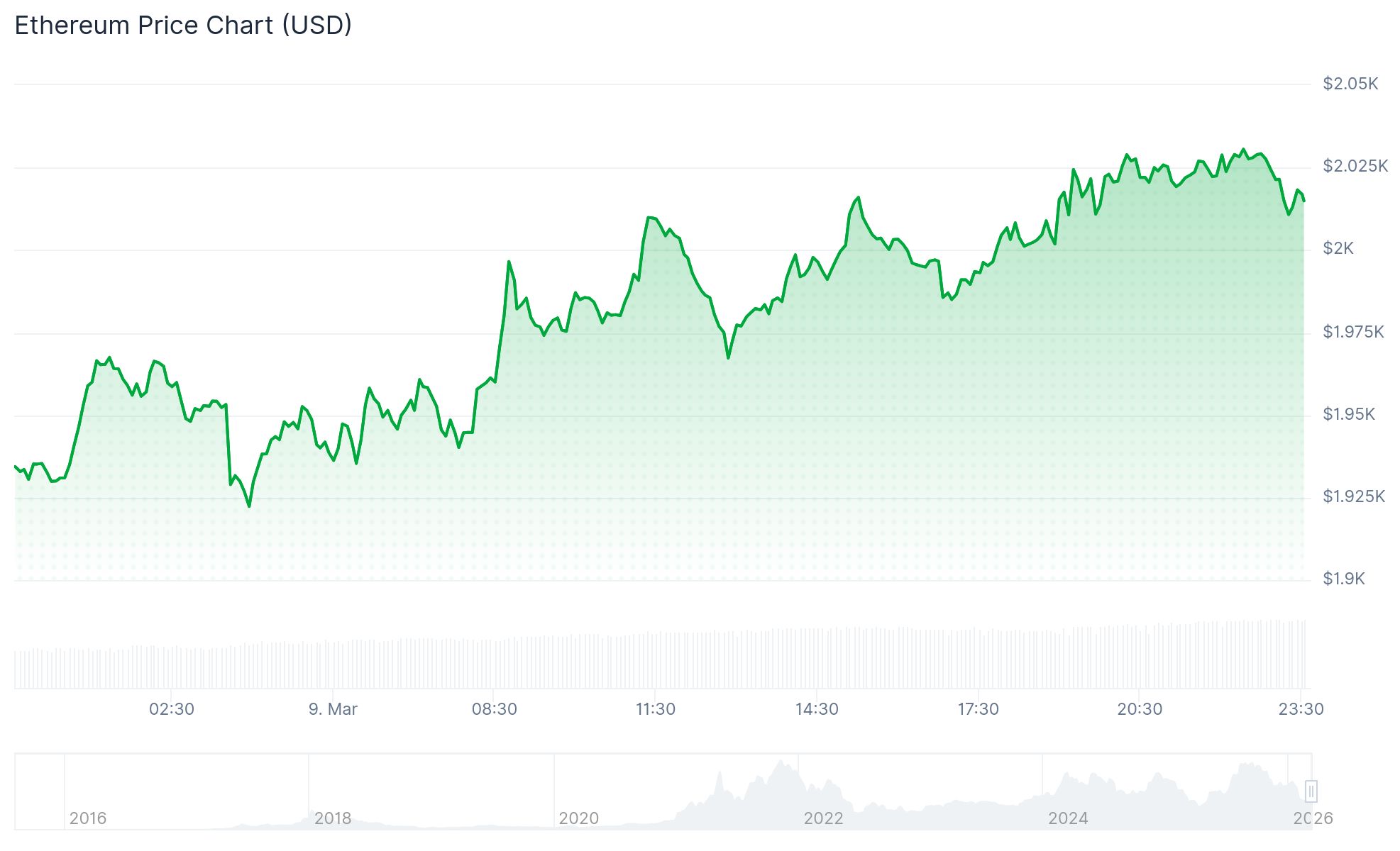 Image Credit – CoinGecko.com
CoinLaw’s Takeaway
In my experience covering crypto treasury companies, SharpLink’s results clearly show both the opportunity and the risk of holding digital assets on a corporate balance sheet. The company is aggressively building one of the largest Ethereum treasuries in public markets, and its staking operations are already generating meaningful revenue.
However, I found that market volatility can completely dominate financial results, even when the underlying strategy remains intact. For investors, this means evaluating these companies requires looking beyond traditional earnings metrics and focusing on long term asset accumulation and treasury strategy.
The post SharpLink Reports $734M Loss Despite Growing ETH Holdings appeared first on CoinLaw.
You May Also Like

Stablecoin market hits $312B as banks, card networks embrace onchain dollars
Copy linkX (Twitter)LinkedInFacebookEmail

How to earn from cloud mining: IeByte’s upgraded auto-cloud mining platform unlocks genuine passive earnings
