New analysis by trader Plan C argues that using the Genesis block as Bitcoin’s model origin point has produced two miscalibrations, and that switching to April New analysis by trader Plan C argues that using the Genesis block as Bitcoin’s model origin point has produced two miscalibrations, and that switching to April

Why the Genesis Block Might be the Wrong Starting Point for Bitcoin Price Models

2026/03/10 19:29
4 min read
For feedback or concerns regarding this content, please contact us at [email protected]

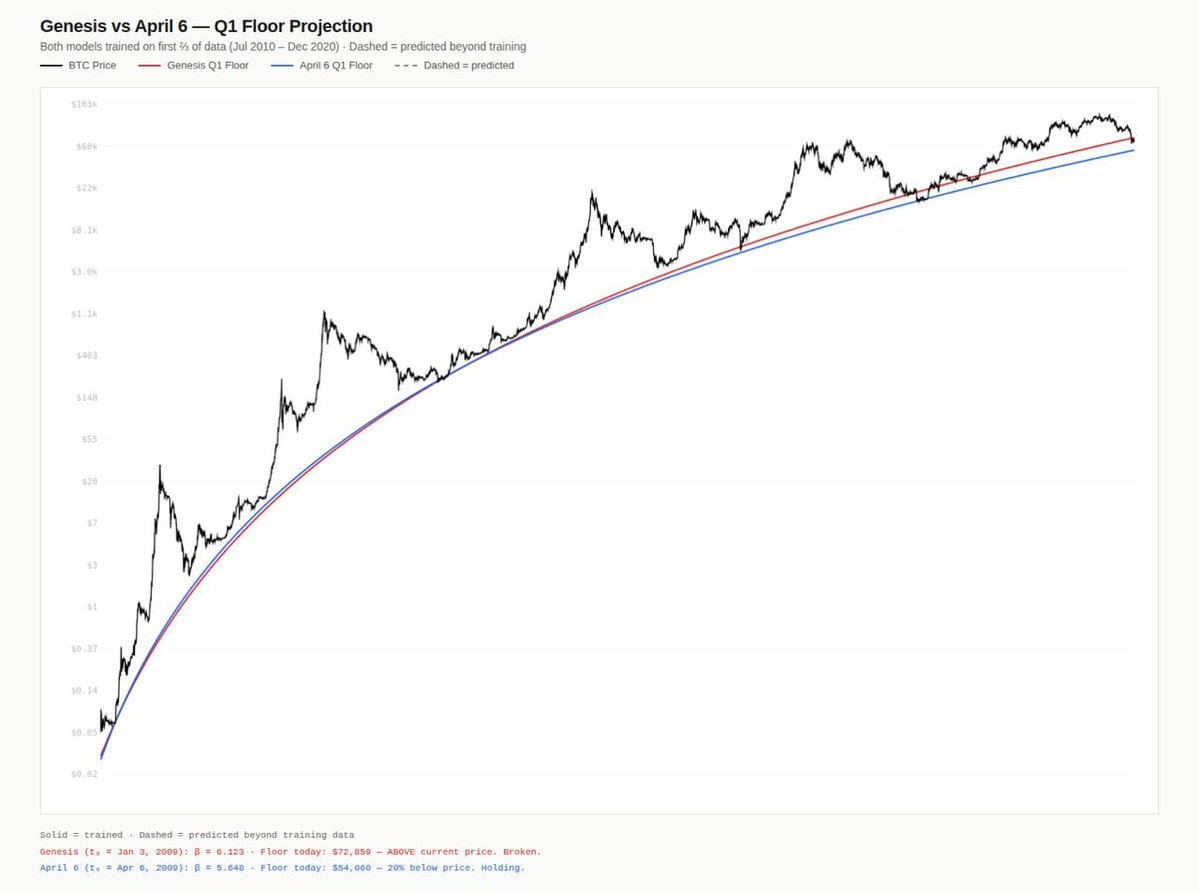
New analysis by trader Plan C argues that using the Genesis block as Bitcoin’s model origin point has produced two miscalibrations, and that switching to April 6, 2009 resolves both without any slope drift.

What the Model Comparison Actually Tests

Plan C, the analyst behind this research, trained two separate quantile floor projection models on the first two-thirds of Bitcoin’s price history, from July 2010 through December 2020, then measured how accurately each model predicted the remaining one-third of the data. The only variable that differs between them is the start date. One model anchors to the Genesis block, January 3, 2009. The other anchors to April 6, 2009.
Source: https://x.com/TheRealPlanC/status/2031241250586677287

The results are not close. The April 6 model nailed the FTX crash low, stayed completely stable throughout, and currently projects Bitcoin’s first quantile floor at approximately $55,000. The Genesis block model spent 12% of the time during the test period below its own first quantile, meaning it repeatedly predicted a floor that Bitcoin’s actual price broke through. To compensate, the model’s slope drifted down to approximately $59,000 before recalibrating.

That drift is the technical failure. A model that requires its slope to adjust after the fact is not predicting. It is following.

Why Start Dates Matter in Power Law Models

Bitcoin price models built on power law regression are highly sensitive to the anchor point because the entire curve extrapolates from it. Moving the start date by a few months on a logarithmic scale shifts every subsequent projection. The Genesis block is an intuitive starting point because it is Bitcoin’s literal beginning. But the Genesis block period includes months of zero price discovery and essentially no market activity, data points that introduce noise rather than signal into the regression.

April 6, 2009 represents a different kind of anchor, though Plan C does not specify precisely why that date produces superior results in the post. The implication is that it captures the beginning of meaningful network activity rather than the ceremonial launch, giving the model a cleaner foundation to extrapolate from.

The Two Failures and What They Mean

The Genesis block model failed during FTX. Bitcoin’s collapse to approximately $15,500 in November 2022 broke below the model’s predicted floor, which should have been a support level. A model floor that does not hold is not a floor.

The same model would have failed again during the current pullback from $100,000 toward $60,000 if the slope had not drifted downward to accommodate the breach. The drift is the model saving itself from a second public failure by quietly moving the goalposts. Plan C is pointing out that the goalpost movement is happening and that it indicates miscalibration rather than accuracy.

$4.58 Billion in Token Unlocks Are Coming This Week

The April 6 model requires no such adjustment. It held during FTX, it held during the current correction, and its projected floor sits at $55,000 without any post-hoc slope correction.

What $55,000 as a Floor Actually Implies

Bitcoin currently trades around $67,000 to $69,000. A first quantile floor of $55,000 means the model considers prices below that level to represent the bottom 25% of historical Bitcoin valuations relative to its long-term growth curve. It is not a prediction that Bitcoin will fall to $55,000. It is a statement about where the model considers the lower bound of normal price behavior to sit.

Whether that boundary holds depends on whether Bitcoin’s long-term growth curve continues following the same power law trajectory it has traced since 2009. Every cycle has tested that assumption. So far it has held. The question the model raises without answering is whether the next test breaks it or confirms it again.

The post Why the Genesis Block Might be the Wrong Starting Point for Bitcoin Price Models appeared first on ETHNews.

Market Opportunity
Blockstreet Logo
Blockstreet Price(BLOCK)
$0.005877
$0.005877$0.005877
-1.72%
USD
Blockstreet (BLOCK) Live Price Chart
Disclaimer: The articles reposted on this site are sourced from public platforms and are provided for informational purposes only. They do not necessarily reflect the views of MEXC. All rights remain with the original authors. If you believe any content infringes on third-party rights, please contact [email protected] for removal. MEXC makes no guarantees regarding the accuracy, completeness, or timeliness of the content and is not responsible for any actions taken based on the information provided. The content does not constitute financial, legal, or other professional advice, nor should it be considered a recommendation or endorsement by MEXC.

You May Also Like

Is Doge Losing Steam As Traders Choose Pepeto For The Best Crypto Investment?

Is Doge Losing Steam As Traders Choose Pepeto For The Best Crypto Investment?

The post Is Doge Losing Steam As Traders Choose Pepeto For The Best Crypto Investment? appeared on BitcoinEthereumNews.com. Crypto News 17 September 2025 | 17:39 Is dogecoin really fading? As traders hunt the best crypto to buy now and weigh 2025 picks, Dogecoin (DOGE) still owns the meme coin spotlight, yet upside looks capped, today’s Dogecoin price prediction says as much. Attention is shifting to projects that blend culture with real on-chain tools. Buyers searching “best crypto to buy now” want shipped products, audits, and transparent tokenomics. That frames the true matchup: dogecoin vs. Pepeto. Enter Pepeto (PEPETO), an Ethereum-based memecoin with working rails: PepetoSwap, a zero-fee DEX, plus Pepeto Bridge for smooth cross-chain moves. By fusing story with tools people can use now, and speaking directly to crypto presale 2025 demand, Pepeto puts utility, clarity, and distribution in front. In a market where legacy meme coin leaders risk drifting on sentiment, Pepeto’s execution gives it a real seat in the “best crypto to buy now” debate. First, a quick look at why dogecoin may be losing altitude. Dogecoin Price Prediction: Is Doge Really Fading? Remember when dogecoin made crypto feel simple? In 2013, DOGE turned a meme into money and a loose forum into a movement. A decade on, the nonstop momentum has cooled; the backdrop is different, and the market is far more selective. With DOGE circling ~$0.268, the tape reads bearish-to-neutral for the next few weeks: hold the $0.26 shelf on daily closes and expect choppy range-trading toward $0.29–$0.30 where rallies keep stalling; lose $0.26 decisively and momentum often bleeds into $0.245 with risk of a deeper probe toward $0.22–$0.21; reclaim $0.30 on a clean daily close and the downside bias is likely neutralized, opening room for a squeeze into the low-$0.30s. Source: CoinMarketcap / TradingView Beyond the dogecoin price prediction, DOGE still centers on payments and lacks native smart contracts; ZK-proof verification is proposed,…
Share
BitcoinEthereumNews2025/09/18 00:14
Wormhole launches reserve tying protocol revenue to token

Wormhole launches reserve tying protocol revenue to token

The post Wormhole launches reserve tying protocol revenue to token appeared on BitcoinEthereumNews.com. Wormhole is changing how its W token works by creating a new reserve designed to hold value for the long term. Announced on Wednesday, the Wormhole Reserve will collect onchain and offchain revenues and other value generated across the protocol and its applications (including Portal) and accumulate them into W, locking the tokens within the reserve. The reserve is part of a broader update called W 2.0. Other changes include a 4% targeted base yield for tokenholders who stake and take part in governance. While staking rewards will vary, Wormhole said active users of ecosystem apps can earn boosted yields through features like Portal Earn. The team stressed that no new tokens are being minted; rewards come from existing supply and protocol revenues, keeping the cap fixed at 10 billion. Wormhole is also overhauling its token release schedule. Instead of releasing large amounts of W at once under the old “cliff” model, the network will shift to steady, bi-weekly unlocks starting October 3, 2025. The aim is to avoid sharp periods of selling pressure and create a more predictable environment for investors. Lockups for some groups, including validators and investors, will extend an additional six months, until October 2028. Core contributor tokens remain under longer contractual time locks. Wormhole launched in 2020 as a cross-chain bridge and now connects more than 40 blockchains. The W token powers governance and staking, with a capped supply of 10 billion. By redirecting fees and revenues into the new reserve, Wormhole is betting that its token can maintain value as demand for moving assets and data between chains grows. This is a developing story. This article was generated with the assistance of AI and reviewed by editor Jeffrey Albus before publication. Get the news in your inbox. Explore Blockworks newsletters: Source: https://blockworks.co/news/wormhole-launches-reserve
Share
BitcoinEthereumNews2025/09/18 01:55
Cryptos Signal Divergence Ahead of Fed Rate Decision

Cryptos Signal Divergence Ahead of Fed Rate Decision

The post Cryptos Signal Divergence Ahead of Fed Rate Decision appeared on BitcoinEthereumNews.com. Crypto assets send conflicting signals ahead of the Federal Reserve’s September rate decision. On-chain data reveals a clear decrease in Bitcoin and Ethereum flowing into centralized exchanges, but a sharp increase in altcoin inflows. The findings come from a Tuesday report by CryptoQuant, an on-chain data platform. The firm’s data shows a stark divergence in coin volume, which has been observed in movements onto centralized exchanges over the past few weeks. Bitcoin and Ethereum Inflows Drop to Multi-Month Lows Sponsored Sponsored Bitcoin has seen a dramatic drop in exchange inflows, with the 7-day moving average plummeting to 25,000 BTC, its lowest level in over a year. The average deposit per transaction has fallen to 0.57 BTC as of September. This suggests that smaller retail investors, rather than large-scale whales, are responsible for the recent cash-outs. Ethereum is showing a similar trend, with its daily exchange inflows decreasing to a two-month low. CryptoQuant reported that the 7-day moving average for ETH deposits on exchanges is around 783,000 ETH, the lowest in two months. Other Altcoins See Renewed Selling Pressure In contrast, other altcoin deposit activity on exchanges has surged. The number of altcoin deposit transactions on centralized exchanges was quite steady in May and June of this year, maintaining a 7-day moving average of about 20,000 to 30,000. Recently, however, that figure has jumped to 55,000 transactions. Altcoins: Exchange Inflow Transaction Count. Source: CryptoQuant CryptoQuant projects that altcoins, given their increased inflow activity, could face relatively higher selling pressure compared to BTC and ETH. Meanwhile, the balance of stablecoins on exchanges—a key indicator of potential buying pressure—has increased significantly. The report notes that the exchange USDT balance, around $273 million in April, grew to $379 million by August 31, marking a new yearly high. CryptoQuant interprets this surge as a reflection of…
Share
BitcoinEthereumNews2025/09/18 01:01