

Bitcoin Price Shows ‘Signs of Improvement’ as Iran Conflict Fears Ease
The price of Bitcoin (BTC) is showing early signs of stabilizing around the $70,000 level as fears of an escalating conflict involving Iran begin to ease.
The market recovery remains tentative following a brutal multi-week selloff that strongly correlated with a massive spike in global oil prices and deteriorating macro sentiment.
Traders are now watching closely to see if returning institutional ETF momentum and shifting on-chain supply metrics can push the asset past heavy structural resistance.
Discover: The best meme coins around
Iran Deescalation Rhetoric Eases Bitcoin Price Pressure
Just a fortnight ago, escalating tensions in the Middle East drove the price of Bitcoin rapidly down through the $66,000 pressure zone and eventually toward $63,000 as geopolitical panic gripped traditional markets.
Brent crude briefly spiked to $119.50 a barrel on fears of supply disruptions through the Strait of Hormuz.
That overarching macro pressure is rapidly retreating. Oil then fell again on Monday after President Donald Trump suggested the war involving Iran might soon de-escalate.
Risk assets reacted immediately to the softening war rhetoric. The S&P 500 closed 0.83% higher, while Bitcoin forcefully decoupled from struggling indices, climbing around 4% overnight on the daily chart.
Investors are now reassessing the forces driving crypto pricing as global stress metrics begin to wind down and policy momentum shifts back to the forefront.
Technical Price Analysis: The Bitcoin Price Levels That Change Everything
Bitcoin is currently trading near $68,800, still battling strong bearish dominance across short-term structures.
The asset remains roughly 42% below its October all-time high ($126,080), making the current local consolidation highly critical for any trend continuation.
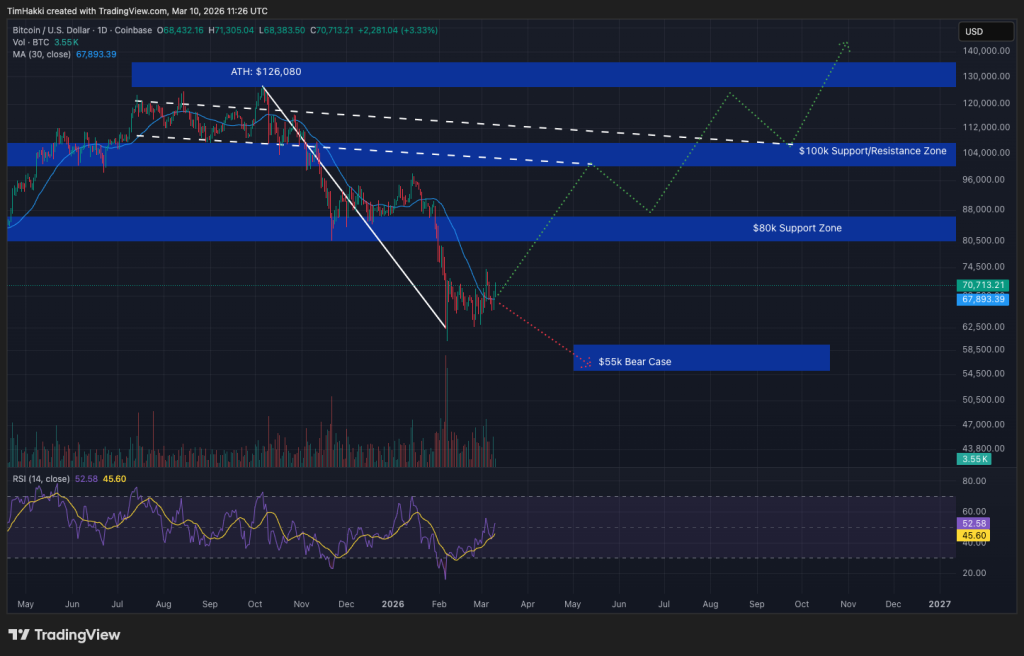
From here, the next upside target sits around $75,000. Reaching that threshold requires sustained volume and a major shift in the Fear & Greed Index, which is currently stuck at an Extreme Fear reading of 13.
Traders analyzing recent market structure bottoms are eyeing the $65,000 mark as the primary line of defense. If this support level fails in the short term, bears will likely re-target the February floor of $63,000.
A deeper breakdown below the $60,000 floor signals a massive institutional wipeout. Anything above it keeps the tentative recovery thesis active.
Is Spot and Derivatives Demand Confirming the Recovery?
On-chain internal metrics suggest the worst of the recent market stress may actually be easing.
According to a new market note from Glassnode, overall condition signals are stabilizing as momentum, ETF demand, and profitability metrics improve.
The analytics firm notes that while price momentum has firmed modestly, it still lacks the raw strength required to confirm a decisive bullish pivot. Sustaining the current bounce relies heavily on continuous ETF inflows to absorb trapped sellers.
Macroeconomist Henrik Zeberg remains optimistic, forecasting that strong institutional ETF demand could eventually fuel a massive risk-on rally between $110,000 and $120,000 as geopolitical headwinds vanish completely.
However, short-term derivatives data present a sharper reality. Analysts warn that negative funding rates and cascading short liquidations drove the violent March 4 surge to $73,247, rather than pure spot accumulation. That implies the current floor relies more on futures positioning than genuine retail buying pressure.
What Traders Are Watching Next
Ultimately, for Bitcoin, holding the psychological fort at $70,000 for a sustained length of time clears the path toward upper breakout targets by mid-month.
Downside support at $65,000 must be rigorously defended by spot buyers heading into the US trading session.
The true macro trigger altering this price action remains crude oil futures and further ceasefire updates out of the Middle East.
If institutional momentum holds steady despite the recent macro shock, Bitcoin could close the week by firmly rejecting the sub-$60,000 narrative altogether.
Discover: The best pre-launch crypto sales
You May Also Like

VAT reductions seen viable with exemption crackdown
U.S. SEC chief Atkins said bond with sister agency CFTC to include joint meetings, exams
Copy linkX (Twitter)LinkedInFacebookEmail

