Over 40% of Americans express willingness to use decentralized finance (DeFi) protocols once regulatory clarity on crypto privacy emerges, according to a recent survey from crypto advocacy organization the DeFi Education Fund (DEF). The survey, released on September 18, revealed that many Americans feel frustrated with traditional financial institutions and seek greater control over their financial assets and data. Respondents believe DeFi innovations can deliver this change by providing affordability, equity, and consumer protection. The survey was conducted with Ipsos on KnowledgePanel and included supplementary in-depth interviews in the Bronx and Queens between August 18 and 21, polling 1,321 US adults. Survey Results Show Americans Ready to Adopt DeFi Protocols The findings demonstrate that many Americans are curious about DeFi despite its early stage. 42% of Americans indicated they would likely try DeFi if proposed legislation becomes law (9% extremely/very likely and 33% somewhat likely). 84% said they would use it to “make purchases online,” while 78% would use it to “pay bills.” According to the survey, 77% would use DeFi protocols to “save money,” and 12% of Americans are “extremely” and “very” interested in learning about DeFi. Moreover, nearly 4 in 10 Americans believe that DeFi can address high transaction and service fees found in traditional finance (39%). Consistent with other probability-based sample surveys, the Ipsos x DEF research shows that almost 1 in 5 Americans (18%) have owned or used crypto at some point in their lifetime. Nearly a quarter of Americans (22%) said they’re interested in learning more about nontraditional forms of finance, such as blockchain, crypto, or decentralized finance.Source: DEF The research shows that more than half (56%) of Americans want to reclaim control of their finances. Americans are interested in having control over their money at all times, and many seek ways to send or receive money without intermediaries. One Bronx, NY resident shared his experience of needing to transfer money between accounts, but the bank required him to certify the transfer and visit in person because he couldn’t move the amount he needed remotely. He expressed frustration about the situation because “it was my money… I didn’t understand why I was given a hard time.“ More than half of surveyed Americans agree there should be a way to digitally send money to people without third-party involvement, and this number rises notably for foreign-born Americans (66%). The researchers concluded that Americans are interested in DeFi and believe DeFi can reduce friction points in today’s financial system. Regulatory Developments on DeFi Adoption in the U.S Last month, DeFi Education Fund called on the US Senate Banking Committee to rethink how it plans to regulate the decentralized finance industry after reviewing its recently published discussion draft on a key crypto market-structure bill. The response, signed on behalf of DeFi Education Fund (DEF) members including a16z Crypto, Uniswap Labs, and Paradigm, argued the Responsible Financial Innovation Act of 2025 (RFA) bill should be crafted in a more tech-neutral manner. The group also emphasized that crypto developers should be protected from “inappropriate regulation meant for intermediaries,” and that self-custody rights for all Americans are “essential.” The banking committee is now working on the discussion draft to help ensure it builds on the Digital Asset Market Clarity Act of 2025. The goal is to promote innovation in the $162 billion DeFi industry without compromising consumer protections or financial stability. On September 5, US Federal Reserve Governor Christopher Waller said there was “nothing to be afraid of” about crypto payments operating outside the traditional banking system. This statement has raised hopes among many that DeFi would soon become the new financial infrastructure for Americans and the worldOver 40% of Americans express willingness to use decentralized finance (DeFi) protocols once regulatory clarity on crypto privacy emerges, according to a recent survey from crypto advocacy organization the DeFi Education Fund (DEF). The survey, released on September 18, revealed that many Americans feel frustrated with traditional financial institutions and seek greater control over their financial assets and data. Respondents believe DeFi innovations can deliver this change by providing affordability, equity, and consumer protection. The survey was conducted with Ipsos on KnowledgePanel and included supplementary in-depth interviews in the Bronx and Queens between August 18 and 21, polling 1,321 US adults. Survey Results Show Americans Ready to Adopt DeFi Protocols The findings demonstrate that many Americans are curious about DeFi despite its early stage. 42% of Americans indicated they would likely try DeFi if proposed legislation becomes law (9% extremely/very likely and 33% somewhat likely). 84% said they would use it to “make purchases online,” while 78% would use it to “pay bills.” According to the survey, 77% would use DeFi protocols to “save money,” and 12% of Americans are “extremely” and “very” interested in learning about DeFi. Moreover, nearly 4 in 10 Americans believe that DeFi can address high transaction and service fees found in traditional finance (39%). Consistent with other probability-based sample surveys, the Ipsos x DEF research shows that almost 1 in 5 Americans (18%) have owned or used crypto at some point in their lifetime. Nearly a quarter of Americans (22%) said they’re interested in learning more about nontraditional forms of finance, such as blockchain, crypto, or decentralized finance.Source: DEF The research shows that more than half (56%) of Americans want to reclaim control of their finances. Americans are interested in having control over their money at all times, and many seek ways to send or receive money without intermediaries. One Bronx, NY resident shared his experience of needing to transfer money between accounts, but the bank required him to certify the transfer and visit in person because he couldn’t move the amount he needed remotely. He expressed frustration about the situation because “it was my money… I didn’t understand why I was given a hard time.“ More than half of surveyed Americans agree there should be a way to digitally send money to people without third-party involvement, and this number rises notably for foreign-born Americans (66%). The researchers concluded that Americans are interested in DeFi and believe DeFi can reduce friction points in today’s financial system. Regulatory Developments on DeFi Adoption in the U.S Last month, DeFi Education Fund called on the US Senate Banking Committee to rethink how it plans to regulate the decentralized finance industry after reviewing its recently published discussion draft on a key crypto market-structure bill. The response, signed on behalf of DeFi Education Fund (DEF) members including a16z Crypto, Uniswap Labs, and Paradigm, argued the Responsible Financial Innovation Act of 2025 (RFA) bill should be crafted in a more tech-neutral manner. The group also emphasized that crypto developers should be protected from “inappropriate regulation meant for intermediaries,” and that self-custody rights for all Americans are “essential.” The banking committee is now working on the discussion draft to help ensure it builds on the Digital Asset Market Clarity Act of 2025. The goal is to promote innovation in the $162 billion DeFi industry without compromising consumer protections or financial stability. On September 5, US Federal Reserve Governor Christopher Waller said there was “nothing to be afraid of” about crypto payments operating outside the traditional banking system. This statement has raised hopes among many that DeFi would soon become the new financial infrastructure for Americans and the world

Regulatory Clarity Could Drive 40% of Americans to Adopt DeFi Protocols, Survey Shows

2025/09/18 21:29
4 min read

Over 40% of Americans express willingness to use decentralized finance (DeFi) protocols once regulatory clarity on crypto privacy emerges, according to a recent survey from crypto advocacy organization the DeFi Education Fund (DEF).

The survey, released on September 18, revealed that many Americans feel frustrated with traditional financial institutions and seek greater control over their financial assets and data.

Respondents believe DeFi innovations can deliver this change by providing affordability, equity, and consumer protection.

The survey was conducted with Ipsos on KnowledgePanel and included supplementary in-depth interviews in the Bronx and Queens between August 18 and 21, polling 1,321 US adults.

Survey Results Show Americans Ready to Adopt DeFi Protocols

The findings demonstrate that many Americans are curious about DeFi despite its early stage.

42% of Americans indicated they would likely try DeFi if proposed legislation becomes law (9% extremely/very likely and 33% somewhat likely).

84% said they would use it tomake purchases online,” while 78% would use it to pay bills.”

According to the survey, 77% would use DeFi protocols to save money,” and 12% of Americans are “extremely” and “very” interested in learning about DeFi.

Moreover, nearly 4 in 10 Americans believe that DeFi can address high transaction and service fees found in traditional finance (39%).

Consistent with other probability-based sample surveys, the Ipsos x DEF research shows that almost 1 in 5 Americans (18%) have owned or used crypto at some point in their lifetime.

Nearly a quarter of Americans (22%) said they’re interested in learning more about nontraditional forms of finance, such as blockchain, crypto, or decentralized finance.
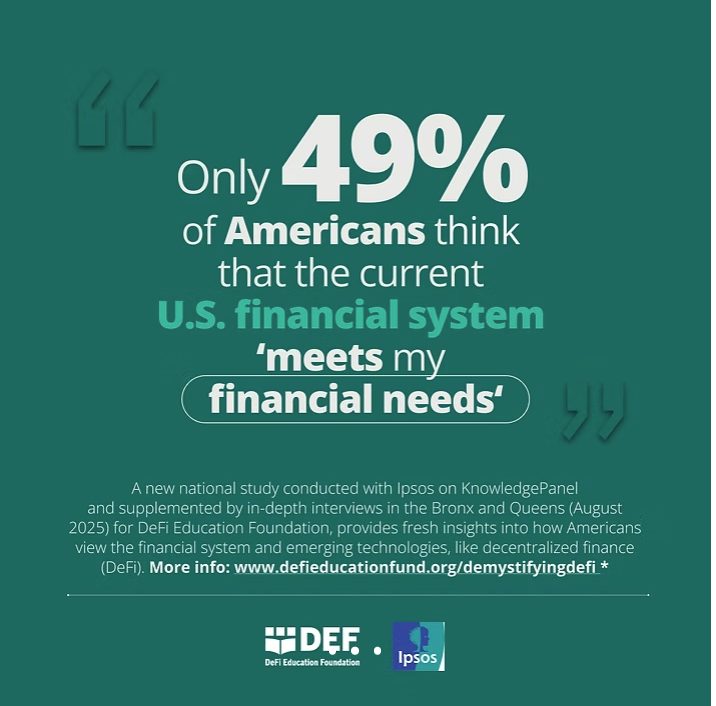
Regulatory Clarity Could Drive 40% of Americans to Adopt DeFi Protocols, Survey ShowsSource: DEF

The research shows that more than half (56%) of Americans want to reclaim control of their finances.

Americans are interested in having control over their money at all times, and many seek ways to send or receive money without intermediaries.

One Bronx, NY resident shared his experience of needing to transfer money between accounts, but the bank required him to certify the transfer and visit in person because he couldn’t move the amount he needed remotely.

He expressed frustration about the situation because “it was my money… I didn’t understand why I was given a hard time.

More than half of surveyed Americans agree there should be a way to digitally send money to people without third-party involvement, and this number rises notably for foreign-born Americans (66%).

The researchers concluded that Americans are interested in DeFi and believe DeFi can reduce friction points in today’s financial system.

Regulatory Developments on DeFi Adoption in the U.S

Last month, DeFi Education Fund called on the US Senate Banking Committee to rethink how it plans to regulate the decentralized finance industry after reviewing its recently published discussion draft on a key crypto market-structure bill.

The response, signed on behalf of DeFi Education Fund (DEF) members including a16z Crypto, Uniswap Labs, and Paradigm, argued the Responsible Financial Innovation Act of 2025 (RFA) bill should be crafted in a more tech-neutral manner.

The group also emphasized that crypto developers should be protected from “inappropriate regulation meant for intermediaries,” and that self-custody rights for all Americans are “essential.”

The banking committee is now working on the discussion draft to help ensure it builds on the Digital Asset Market Clarity Act of 2025.

The goal is to promote innovation in the $162 billion DeFi industry without compromising consumer protections or financial stability.

On September 5, US Federal Reserve Governor Christopher Waller said there was “nothing to be afraid of” about crypto payments operating outside the traditional banking system.

This statement has raised hopes among many that DeFi would soon become the new financial infrastructure for Americans and the world.

Market Opportunity
DeFi Logo
DeFi Price(DEFI)
$0,000374
$0,000374$0,000374
+9,35%
USD
DeFi (DEFI) Live Price Chart
Disclaimer: The articles reposted on this site are sourced from public platforms and are provided for informational purposes only. They do not necessarily reflect the views of MEXC. All rights remain with the original authors. If you believe any content infringes on third-party rights, please contact [email protected] for removal. MEXC makes no guarantees regarding the accuracy, completeness, or timeliness of the content and is not responsible for any actions taken based on the information provided. The content does not constitute financial, legal, or other professional advice, nor should it be considered a recommendation or endorsement by MEXC.

You May Also Like

Is Doge Losing Steam As Traders Choose Pepeto For The Best Crypto Investment?

Is Doge Losing Steam As Traders Choose Pepeto For The Best Crypto Investment?

The post Is Doge Losing Steam As Traders Choose Pepeto For The Best Crypto Investment? appeared on BitcoinEthereumNews.com. Crypto News 17 September 2025 | 17:39 Is dogecoin really fading? As traders hunt the best crypto to buy now and weigh 2025 picks, Dogecoin (DOGE) still owns the meme coin spotlight, yet upside looks capped, today’s Dogecoin price prediction says as much. Attention is shifting to projects that blend culture with real on-chain tools. Buyers searching “best crypto to buy now” want shipped products, audits, and transparent tokenomics. That frames the true matchup: dogecoin vs. Pepeto. Enter Pepeto (PEPETO), an Ethereum-based memecoin with working rails: PepetoSwap, a zero-fee DEX, plus Pepeto Bridge for smooth cross-chain moves. By fusing story with tools people can use now, and speaking directly to crypto presale 2025 demand, Pepeto puts utility, clarity, and distribution in front. In a market where legacy meme coin leaders risk drifting on sentiment, Pepeto’s execution gives it a real seat in the “best crypto to buy now” debate. First, a quick look at why dogecoin may be losing altitude. Dogecoin Price Prediction: Is Doge Really Fading? Remember when dogecoin made crypto feel simple? In 2013, DOGE turned a meme into money and a loose forum into a movement. A decade on, the nonstop momentum has cooled; the backdrop is different, and the market is far more selective. With DOGE circling ~$0.268, the tape reads bearish-to-neutral for the next few weeks: hold the $0.26 shelf on daily closes and expect choppy range-trading toward $0.29–$0.30 where rallies keep stalling; lose $0.26 decisively and momentum often bleeds into $0.245 with risk of a deeper probe toward $0.22–$0.21; reclaim $0.30 on a clean daily close and the downside bias is likely neutralized, opening room for a squeeze into the low-$0.30s. Source: CoinMarketcap / TradingView Beyond the dogecoin price prediction, DOGE still centers on payments and lacks native smart contracts; ZK-proof verification is proposed,…
Share
BitcoinEthereumNews2025/09/18 00:14
Cashing In On University Patents Means Giving Up On Our Innovation Future

Cashing In On University Patents Means Giving Up On Our Innovation Future

The post Cashing In On University Patents Means Giving Up On Our Innovation Future appeared on BitcoinEthereumNews.com. “It’s a raid on American innovation that would deliver pennies to the Treasury while kneecapping the very engine of our economic and medical progress,” writes Pipes. Getty Images Washington is addicted to taxing success. Now, Commerce Secretary Howard Lutnick is floating a plan to skim half the patent earnings from inventions developed at universities with federal funding. It’s being sold as a way to shore up programs like Social Security. In reality, it’s a raid on American innovation that would deliver pennies to the Treasury while kneecapping the very engine of our economic and medical progress. Yes, taxpayer dollars support early-stage research. But the real payoff comes later—in the jobs created, cures discovered, and industries launched when universities and private industry turn those discoveries into real products. By comparison, the sums at stake in patent licensing are trivial. Universities collectively earn only about $3.6 billion annually in patent income—less than the federal government spends on Social Security in a single day. Even confiscating half would barely register against a $6 trillion federal budget. And yet the damage from such a policy would be anything but trivial. The true return on taxpayer investment isn’t in licensing checks sent to Washington, but in the downstream economic activity that federally supported research unleashes. Thanks to the bipartisan Bayh-Dole Act of 1980, universities and private industry have powerful incentives to translate early-stage discoveries into real-world products. Before Bayh-Dole, the government hoarded patents from federally funded research, and fewer than 5% were ever licensed. Once universities could own and license their own inventions, innovation exploded. The result has been one of the best returns on investment in government history. Since 1996, university research has added nearly $2 trillion to U.S. industrial output, supported 6.5 million jobs, and launched more than 19,000 startups. Those companies pay…
Share
BitcoinEthereumNews2025/09/18 03:26
Pi Network Poised for a Bullish Surge: What Pioneers Should Know About PiCoin and PiDEX

Pi Network Poised for a Bullish Surge: What Pioneers Should Know About PiCoin and PiDEX

The anticipation within the Pi Network community is reaching a fever pitch. With PiCoin steadily gaining adoption and PiDEX—the native decentralized exchang
Share
Hokanews2026/02/28 14:28