Agentic AI in CX Strategy: Why Ramco Systems’ Chia Signals a Turning Point for Enterprise Experience Ever watched a customer repeat the same issue three times—chatbotAgentic AI in CX Strategy: Why Ramco Systems’ Chia Signals a Turning Point for Enterprise Experience Ever watched a customer repeat the same issue three times—chatbot

Chia: How Agentic AI Is Redefining Enterprise Customer Experience

2026/02/13 10:44
6 min read

Agentic AI in CX Strategy: Why Ramco Systems’ Chia Signals a Turning Point for Enterprise Experience

Ever watched a customer repeat the same issue three times—chatbot, email, agent—only to abandon the journey in frustration?

That moment is not a tooling failure.
It is a design failure.

CX leaders know this scene too well. AI answers questions. Humans fix problems. Journeys fall through the cracks in between. What breaks is not intent—but execution across systems, teams, and policies.

This is where agentic AI enters the conversation—not as hype, but as a structural shift.

With the launch of Chia, an enterprise-grade conversational AI agent platform, is making a deliberate move into that gap. Not to replace humans. But to redesign how work flows through CX.

This article explores what agentic AI really means for CX, why it matters now, and how platforms like Chia are changing the economics and architecture of experience delivery.


What Is Agentic AI and Why CX Teams Need It Now?

Agentic AI refers to systems that can reason, decide, and act across workflows—not just respond to prompts.

Unlike traditional chatbots, agentic systems execute multi-step tasks across enterprise tools, within defined guardrails, and escalate only when exceptions arise.

For CX leaders, this matters because most customer pain does not live in questions.
It lives in unfinished work.

Refunds that stall.
Bookings that fail validation.
Policies that require interpretation, not retrieval.

Agentic AI addresses that operational middle ground.


Why Traditional Conversational AI Breaks at Scale

Conventional CX automation fails when journeys cross system boundaries.

Most bots excel at intent detection and FAQ deflection. They struggle when resolution requires orchestration—CRM updates, ERP actions, policy checks, and compliance logging.

This creates three systemic CX problems:

  • Fragmented accountability across tools and teams
  • Over-escalation to humans, driving costs up
  • Inconsistent outcomes, eroding trust

CX teams then compensate with more scripts, more handoffs, and more agents.

Agentic AI flips this model by embedding decision logic into the workflow itself.


How Chia Reframes Enterprise CX Automation

Chia is designed to act, not just converse.

Positioned as part of Ramco’s AI-driven task automation suite, rTask, Chia enables enterprises to deploy production-grade AI agents that execute end-to-end workflows across systems.

What differentiates Chia is not conversation quality—but operational depth.

Key capabilities include:

  • Natural Language Workflow (NLW) logic defined in plain English
  • Multi-step workflow orchestration across enterprise systems
  • Omnichannel presence across chat, email, and messaging
  • Real-time integrations with CRM, ERP, ITSM, and HRIS platforms
  • Explainability and workflow logs for audit and compliance

For CX leaders, this shifts automation from deflection metrics to resolution integrity.


Why No-Code Agent Design Changes CX Governance

Chia’s no-code AI Agent Foundry enables CX teams to design agents without engineering bottlenecks.

This matters more than it sounds.

In most enterprises, CX logic lives in documents, not systems. Policy teams define rules. Ops teams interpret them. Engineers encode them—often months later.

Chia collapses this cycle.

Using natural language instructions, non-technical teams can define logic like:

  • Refund eligibility
  • Booking validation
  • Policy enforcement

The platform converts this into deterministic behavior, reducing hallucination risks and accelerating deployment timelines.

The result is not faster bots—but faster CX governance.


What “Human-in-the-Loop” Becomes in an Agentic Model

Agentic CX does not remove humans. It repositions them.

Instead of humans handling every interaction, they intervene only when:

  • Policies conflict
  • Exceptions arise
  • Emotional escalation occurs

This is a shift from human-in-the-loop to human-on-exception.

According to , this reflects a broader transformation:

For CX leaders, this reframes workforce strategy. Agents focus on judgment, empathy, and complexity—not repetition.


Which Industries Stand to Gain the Most?

Agentic CX delivers the highest value where volume, variability, and compliance intersect.

Chia is positioned for industries where journeys are both frequent and fragile:

  • E-commerce: Orders, returns, refunds at peak scale
  • Travel and Hospitality: Booking changes and seasonal spikes
  • Financial Services: High-volume queries with regulatory constraints
  • Technology and SaaS: Onboarding and lifecycle support
  • Telecom: Billing, service, and technical orchestration

In these environments, speed without accuracy destroys trust.
Accuracy without speed destroys loyalty.

Agentic AI balances both.
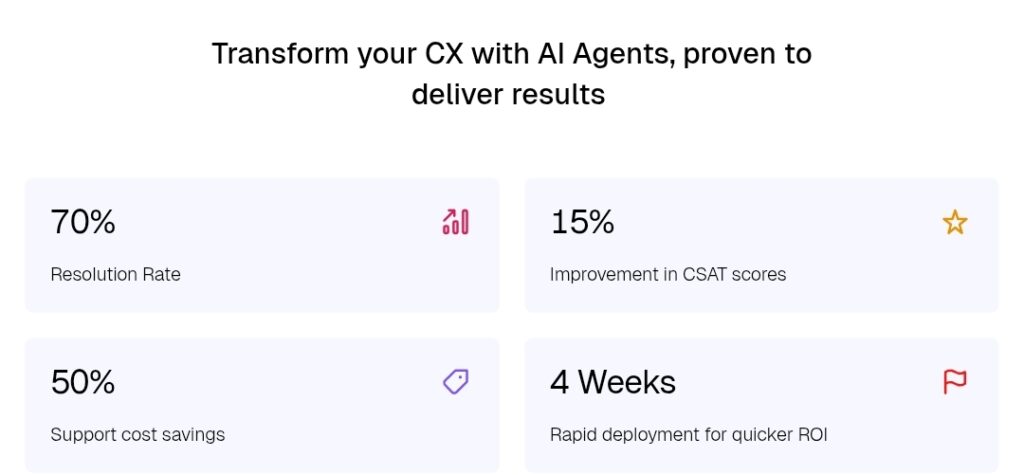
Chia: How Agentic AI Is Redefining Enterprise Customer Experience

How Agentic AI Solves the CX Silo Problem

Silos persist because systems don’t share accountability.

CX leaders often inherit disconnected stacks—CRM for context, ERP for action, ITSM for tickets, analytics elsewhere.

Agentic AI introduces a control layer that sits above systems, not inside them.

This enables:

  • Unified decision logic
  • Cross-system task execution
  • Centralized audit trails

Instead of stitching journeys together post-failure, CX teams design resolution paths upfront.


Common Pitfalls CX Leaders Must Avoid

Agentic AI fails when treated as a chatbot upgrade.

Based on early enterprise deployments, three mistakes recur:

  • Automating broken processes without redesign
  • Overloading agents with ambiguous policies
  • Ignoring explainability and compliance logs

Agentic systems amplify design quality. Poor governance scales faster than good intent.

CX leaders must lead with clarity, not capability.


Key Insights for CX Strategy Leaders

  • Conversation is not resolution
  • Automation without action is noise
  • Governance defines trust at scale
  • Agentic AI is an operating model shift, not a feature

As notes:

Agentic AI aligns CX delivery with that expectation.


How CX Teams Should Evaluate Agentic AI Platforms

Before adopting any agentic solution, CX leaders should ask:

  • Can it execute across systems, not just respond?
  • Does it support deterministic workflows?
  • Is logic auditable and explainable?
  • Can CX teams own change without engineering delays?

If the answer is no, automation debt will follow.


Frequently Asked Questions

How is agentic AI different from chatbots in CX?

Agentic AI executes tasks across systems, not just conversations. It resolves issues end-to-end.

Is agentic AI safe for regulated industries?

Yes, when designed with deterministic workflows, audit logs, and role-based controls.

How long does enterprise deployment typically take?

Platforms like Chia aim for weeks, not months, by eliminating heavy coding cycles.

Does agentic AI replace CX agents?

No. It reduces repetitive workload and escalates exceptions to humans with full context.

What CX metrics improve most with agentic AI?

First-contact resolution, average handling time, and operational cost efficiency.


Actionable Takeaways for CX Leaders

  1. Map journeys by resolution, not channels
  2. Identify tasks that require system-to-system execution
  3. Define CX policies in plain language first
  4. Design exception paths before automation
  5. Demand explainability from every AI action
  6. Shift agents toward judgment-heavy interactions
  7. Pilot in high-volume, rule-based workflows
  8. Treat agentic AI as a CX operating layer

Final Thought

The future of CX is not more empathetic scripts or smarter prompts.
It is systems that finish the work customers start.

Agentic AI platforms like Chia signal that CX is moving from conversation design to outcome architecture.

For leaders ready to make that shift, the opportunity is not incremental—it is structural.

The post Chia: How Agentic AI Is Redefining Enterprise Customer Experience appeared first on CX Quest.

Market Opportunity
Notcoin Logo
Notcoin Price(NOT)
$0.0004096
$0.0004096$0.0004096
+1.41%
USD
Notcoin (NOT) Live Price Chart
Disclaimer: The articles reposted on this site are sourced from public platforms and are provided for informational purposes only. They do not necessarily reflect the views of MEXC. All rights remain with the original authors. If you believe any content infringes on third-party rights, please contact [email protected] for removal. MEXC makes no guarantees regarding the accuracy, completeness, or timeliness of the content and is not responsible for any actions taken based on the information provided. The content does not constitute financial, legal, or other professional advice, nor should it be considered a recommendation or endorsement by MEXC.

You May Also Like

Solid growth outlook supports Ringgit – Standard Chartered

Solid growth outlook supports Ringgit – Standard Chartered

The post Solid growth outlook supports Ringgit – Standard Chartered appeared on BitcoinEthereumNews.com. Standard Chartered’s Edward Lee and Jonathan Koh highlight
Share
BitcoinEthereumNews2026/02/14 03:14
IP Hits $11.75, HYPE Climbs to $55, BlockDAG Surpasses Both with $407M Presale Surge!

IP Hits $11.75, HYPE Climbs to $55, BlockDAG Surpasses Both with $407M Presale Surge!

The post IP Hits $11.75, HYPE Climbs to $55, BlockDAG Surpasses Both with $407M Presale Surge! appeared on BitcoinEthereumNews.com. Crypto News 17 September 2025 | 18:00 Discover why BlockDAG’s upcoming Awakening Testnet launch makes it the best crypto to buy today as Story (IP) price jumps to $11.75 and Hyperliquid hits new highs. Recent crypto market numbers show strength but also some limits. The Story (IP) price jump has been sharp, fueled by big buybacks and speculation, yet critics point out that revenue still lags far behind its valuation. The Hyperliquid (HYPE) price looks solid around the mid-$50s after a new all-time high, but questions remain about sustainability once the hype around USDH proposals cools down. So the obvious question is: why chase coins that are either stretched thin or at risk of retracing when you could back a network that’s already proving itself on the ground? That’s where BlockDAG comes in. While other chains are stuck dealing with validator congestion or outages, BlockDAG’s upcoming Awakening Testnet will be stress-testing its EVM-compatible smart chain with real miners before listing. For anyone looking for the best crypto coin to buy, the choice between waiting on fixes or joining live progress feels like an easy one. BlockDAG: Smart Chain Running Before Launch Ethereum continues to wrestle with gas congestion, and Solana is still known for network freezes, yet BlockDAG is already showing a different picture. Its upcoming Awakening Testnet, set to launch on September 25, isn’t just a demo; it’s a live rollout where the chain’s base protocols are being stress-tested with miners connected globally. EVM compatibility is active, account abstraction is built in, and tools like updated vesting contracts and Stratum integration are already functional. Instead of waiting for fixes like other networks, BlockDAG is proving its infrastructure in real time. What makes this even more important is that the technology is operational before the coin even hits exchanges. That…
Share
BitcoinEthereumNews2025/09/18 00:32
Facts Vs. Hype: Analyst Examines XRP Supply Shock Theory

Facts Vs. Hype: Analyst Examines XRP Supply Shock Theory

Prominent analyst Cheeky Crypto (203,000 followers on YouTube) set out to verify a fast-spreading claim that XRP’s circulating supply could “vanish overnight,” and his conclusion is more nuanced than the headline suggests: nothing in the ledger disappears, but the amount of XRP that is truly liquid could be far smaller than most dashboards imply—small enough, in his view, to set the stage for an abrupt liquidity squeeze if demand spikes. XRP Supply Shock? The video opens with the host acknowledging his own skepticism—“I woke up to a rumor that XRP supply could vanish overnight. Sounds crazy, right?”—before committing to test the thesis rather than dismiss it. He frames the exercise as an attempt to reconcile a long-standing critique (“XRP’s supply is too large for high prices”) with a rival view taking hold among prominent community voices: that much of the supply counted as “circulating” is effectively unavailable to trade. His first step is a straightforward data check. Pulling public figures, he finds CoinMarketCap showing roughly 59.6 billion XRP as circulating, while XRPScan reports about 64.7 billion. The divergence prompts what becomes the video’s key methodological point: different sources count “circulating” differently. Related Reading: Analyst Sounds Major XRP Warning: Last Chance To Get In As Accumulation Balloons As he explains it, the higher on-ledger number likely includes balances that aggregators exclude or treat as restricted, most notably Ripple’s programmatic escrow. He highlights that Ripple still “holds a chunk of XRP in escrow, about 35.3 billion XRP locked up across multiple wallets, with a nominal schedule of up to 1 billion released per month and unused portions commonly re-escrowed. Those coins exist and are accounted for on-ledger, but “they aren’t actually sitting on exchanges” and are not immediately available to buyers. In his words, “for all intents and purposes, that escrow stash is effectively off of the market.” From there, the analysis moves from headline “circulating supply” to the subtler concept of effective float. Beyond escrow, he argues that large strategic holders—banks, fintechs, or other whales—may sit on material balances without supplying order books. When you strip out escrow and these non-selling stashes, he says, “the effective circulating supply… is actually way smaller than the 59 or even 64 billion figure.” He cites community estimates in the “20 or 30 billion” range for what might be truly liquid at any given moment, while emphasizing that nobody has a precise number. That effective-float framing underpins the crux of his thesis: a potential supply shock if demand accelerates faster than fresh sell-side supply appears. “Price is a dance between supply and demand,” he says; if institutional or sovereign-scale users suddenly need XRP and “the market finds that there isn’t enough XRP readily available,” order books could thin out and prices could “shoot on up, sometimes violently.” His phrase “circulating supply could collapse overnight” is presented not as a claim that tokens are destroyed or removed from the ledger, but as a market-structure scenario in which available inventory to sell dries up quickly because holders won’t part with it. How Could The XRP Supply Shock Happen? On the demand side, he anchors the hypothetical to tokenization. He points to the “very early stages of something huge in finance”—on-chain tokenization of debt, stablecoins, CBDCs and even gold—and argues the XRP Ledger aims to be “the settlement layer” for those assets.He references Ripple CTO David Schwartz’s earlier comments about an XRPL pivot toward tokenized assets and notes that an institutional research shop (Bitwise) has framed XRP as a way to play the tokenization theme. In his construction, if “trillions of dollars in value” begin settling across XRPL rails, working inventories of XRP for bridging, liquidity and settlement could rise sharply, tightening effective float. Related Reading: XRP Bearish Signal: Whales Offload $486 Million In Asset To illustrate, he offers two analogies. First, the “concert tickets” model: you think there are 100,000 tickets (100B supply), but 50,000 are held by the promoter (escrow) and 30,000 by corporate buyers (whales), leaving only 20,000 for the public; if a million people want in, prices explode. Second, a comparison to Bitcoin’s halving: while XRP has no programmatic halving, he proposes that a sudden adoption wave could function like a de facto halving of available supply—“XRP’s version of a halving could actually be the adoption event.” He also updates the narrative context that long dogged XRP. Once derided for “too much supply,” he argues the script has “totally flipped.” He cites the current cycle’s optics—“XRP is sitting above $3 with a market cap north of around $180 billion”—as evidence that raw supply counts did not cap price as tightly as critics claimed, and as a backdrop for why a scarcity narrative is gaining traction. Still, he declines to publish targets or timelines, repeatedly stressing uncertainty and risk. “I’m not a financial adviser… cryptocurrencies are highly volatile,” he reminds viewers, adding that tokenization could take off “on some other platform,” unfold more slowly than enthusiasts expect, or fail to get to “sudden shock” scale. The verdict he offers is deliberately bound. The theory that “XRP supply could vanish overnight” is imprecise on its face; the ledger will not erase coins. But after examining dashboard methodologies, escrow mechanics and the behavior of large holders, he concludes that the effective float could be meaningfully smaller than headline supply figures, and that a fast-developing tokenization use case could, under the right conditions, stress that float. “Overnight is a dramatic way to put it,” he concedes. “The change could actually be very sudden when it comes.” At press time, XRP traded at $3.0198. Featured image created with DALL.E, chart from TradingView.com
Share
NewsBTC2025/09/18 11:00