TLDR The Dow, S&P 500, and Nasdaq all fell on Friday, with the Nasdaq down 1% and deeper in correction territory Oil prices surged over 2%, with Brent crude aboveTLDR The Dow, S&P 500, and Nasdaq all fell on Friday, with the Nasdaq down 1% and deeper in correction territory Oil prices surged over 2%, with Brent crude above

Why are Stocks Down Today? March 27

2026/03/28 00:15
3 min read
For feedback or concerns regarding this content, please contact us at [email protected]

TLDR

  • The Dow, S&P 500, and Nasdaq all fell on Friday, with the Nasdaq down 1% and deeper in correction territory
  • Oil prices surged over 2%, with Brent crude above $103 a barrel, as Middle East conflict continued
  • Trump extended his Iran strike deadline by 10 days to April 6, but markets did not respond positively
  • The S&P 500 is on track for its fifth straight weekly decline, the longest losing streak since spring 2022
  • The VIX fear gauge spiked to around 30, signaling traders expect more volatility ahead

US stocks dropped again on Friday as oil prices climbed and investors showed little confidence that the Iran conflict would end soon.

The Nasdaq Composite fell 1%, pushing further into correction territory. The Dow Jones Industrial Average dropped around 500 points, or 1.1%. The S&P 500 fell close to 1%.
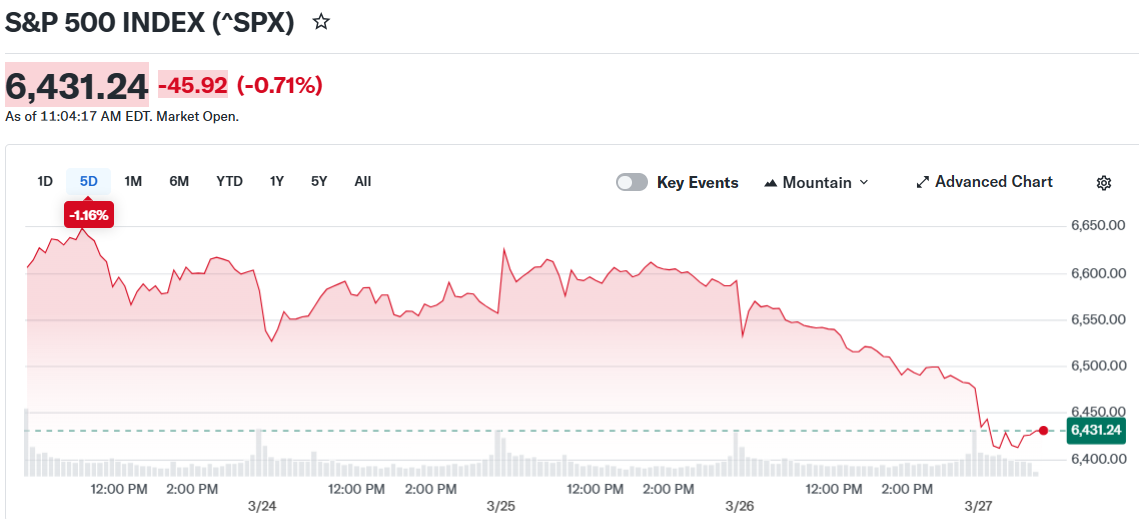
S&P 500 INDEX (^SPX)S&P 500 INDEX (^SPX)

The S&P 500 is now on pace for its fifth straight weekly decline. That would be its longest losing streak since spring 2022.

Oil was a major driver of the selloff. Brent crude climbed above $103 a barrel. West Texas Intermediate topped $97. Both benchmarks were up more than 2% on the day.

The rise in oil came despite President Trump extending his deadline for Iran. He had previously said the US would strike Iran’s energy infrastructure if a deal was not reached by Friday. Late Thursday, he pushed that deadline to April 6 at Iran’s request.

Markets did not treat the extension as good news. Traders remained worried that the pause simply gives higher oil prices more time to weigh on the global economy.

Strait of Hormuz traffic has been halted due to the conflict, adding pressure to energy markets. Iran has so far rejected US attempts to reach a deal.

Fear Gauge Spikes

The CBOE Volatility Index jumped 2.6 points to around 30, a level that signals traders expect rough conditions in the weeks ahead.

Hickey noted that the Nasdaq is heading for its 10th down week in the last 11. He said that kind of consistent decline has only appeared in a small number of periods in the index’s entire history.

Consumer sentiment data released Friday also pointed to growing pessimism among American households.

Treasury yields were mixed on the day. Ten-year yields hit an eight-month high earlier in the week, with some analysts saying bond market pressure could push Trump toward ending the conflict sooner.

Shutdown Bill Passes Senate

The Senate passed a bill early Friday to fund the TSA and other Department of Homeland Security operations, though it excluded funding for ICE. The vote moves toward ending a partial federal shutdown that has disrupted airports and raised concerns about economic damage.

Gold faced extra pressure from central bank reserve sales, according to market reports from Friday morning.

As of midday Friday, the Dow was down over 500 points, the S&P 500 was off about 1%, and the Nasdaq had fallen 1.3%.

The post Why are Stocks Down Today? March 27 appeared first on CoinCentral.

Market Opportunity
Notcoin Logo
Notcoin Price(NOT)
$0.0003486
$0.0003486$0.0003486
-1.07%
USD
Notcoin (NOT) Live Price Chart
Disclaimer: The articles reposted on this site are sourced from public platforms and are provided for informational purposes only. They do not necessarily reflect the views of MEXC. All rights remain with the original authors. If you believe any content infringes on third-party rights, please contact [email protected] for removal. MEXC makes no guarantees regarding the accuracy, completeness, or timeliness of the content and is not responsible for any actions taken based on the information provided. The content does not constitute financial, legal, or other professional advice, nor should it be considered a recommendation or endorsement by MEXC.

You May Also Like

OpenVPP accused of falsely advertising cooperation with the US government; SEC commissioner clarifies no involvement

OpenVPP accused of falsely advertising cooperation with the US government; SEC commissioner clarifies no involvement

PANews reported on September 17th that on-chain sleuth ZachXBT tweeted that OpenVPP ( $OVPP ) announced this week that it was collaborating with the US government to advance energy tokenization. SEC Commissioner Hester Peirce subsequently responded, stating that the company does not collaborate with or endorse any private crypto projects. The OpenVPP team subsequently hid the response. Several crypto influencers have participated in promoting the project, and the accounts involved have been questioned as typical influencer accounts.
Share
PANews2025/09/17 23:58
China Blocks Nvidia’s RTX Pro 6000D as Local Chips Rise

China Blocks Nvidia’s RTX Pro 6000D as Local Chips Rise

The post China Blocks Nvidia’s RTX Pro 6000D as Local Chips Rise appeared on BitcoinEthereumNews.com. China Blocks Nvidia’s RTX Pro 6000D as Local Chips Rise China’s internet regulator has ordered the country’s biggest technology firms, including Alibaba and ByteDance, to stop purchasing Nvidia’s RTX Pro 6000D GPUs. According to the Financial Times, the move shuts down the last major channel for mass supplies of American chips to the Chinese market. Why Beijing Halted Nvidia Purchases Chinese companies had planned to buy tens of thousands of RTX Pro 6000D accelerators and had already begun testing them in servers. But regulators intervened, halting the purchases and signaling stricter controls than earlier measures placed on Nvidia’s H20 chip. Image: Nvidia An audit compared Huawei and Cambricon processors, along with chips developed by Alibaba and Baidu, against Nvidia’s export-approved products. Regulators concluded that Chinese chips had reached performance levels comparable to the restricted U.S. models. This assessment pushed authorities to advise firms to rely more heavily on domestic processors, further tightening Nvidia’s already limited position in China. China’s Drive Toward Tech Independence The decision highlights Beijing’s focus on import substitution — developing self-sufficient chip production to reduce reliance on U.S. supplies. “The signal is now clear: all attention is focused on building a domestic ecosystem,” said a representative of a leading Chinese tech company. Nvidia had unveiled the RTX Pro 6000D in July 2025 during CEO Jensen Huang’s visit to Beijing, in an attempt to keep a foothold in China after Washington restricted exports of its most advanced chips. But momentum is shifting. Industry sources told the Financial Times that Chinese manufacturers plan to triple AI chip production next year to meet growing demand. They believe “domestic supply will now be sufficient without Nvidia.” What It Means for the Future With Huawei, Cambricon, Alibaba, and Baidu stepping up, China is positioning itself for long-term technological independence. Nvidia, meanwhile, faces…

Share
BitcoinEthereumNews2025/09/18 01:37
Top 10 Meme Coins 2026 Investors Can’t Ignore: How Early Crypto Presales Are Driving the Next Bull Run

Top 10 Meme Coins 2026 Investors Can’t Ignore: How Early Crypto Presales Are Driving the Next Bull Run

Market excitement is intensifying as momentum builds around Pudgy Penguins ($PENGU), SPX6900 ($SPX), Cheems ($CHEEMS), Official Trump ($TRUMP), Apeing ($APEING),
Share
Timestabloid2026/03/28 01:15
