Exploring how the costs of a pandemic can lead to a self-enforcing lockdown in a networked economy, analyzing the resulting changes in network structure and the existence of stable equilibria.Exploring how the costs of a pandemic can lead to a self-enforcing lockdown in a networked economy, analyzing the resulting changes in network structure and the existence of stable equilibria.

The Economics of Self-Isolation: A Game-Theoretic Analysis of Contagion in a Free Economy

2025/09/17 23:00
3 min read
For feedback or concerns regarding this content, please contact us at [email protected]

Abstract and 1. Introduction

  1. A free and fair economy: definition, existence and uniqueness

    2.1 A free economy

    2.2 A free and fair economy

  2. Equilibrium existence in a free and fair economy

    3.1 A free and fair economy as a strategic form game

    3.2 Existence of an equilibrium

  3. Equilibrium efficiency in a free and fair economy

  4. A free economy with social justice and inclusion

    5.1 Equilibrium existence and efficiency in a free economy with social justice

    5.2 Choosing a reference point to achieve equilibrium efficiency

  5. Some applications

    6.1 Teamwork: surplus distribution in a firm

    6.2 Contagion and self-enforcing lockdown in a networked economy

    6.3 Bias in academic publishing

    6.4 Exchange economies

  6. Contributions to the closely related literature

  7. Conclusion and References

Appendix

6.2 Contagion and self-enforcing lockdown in a networked economy

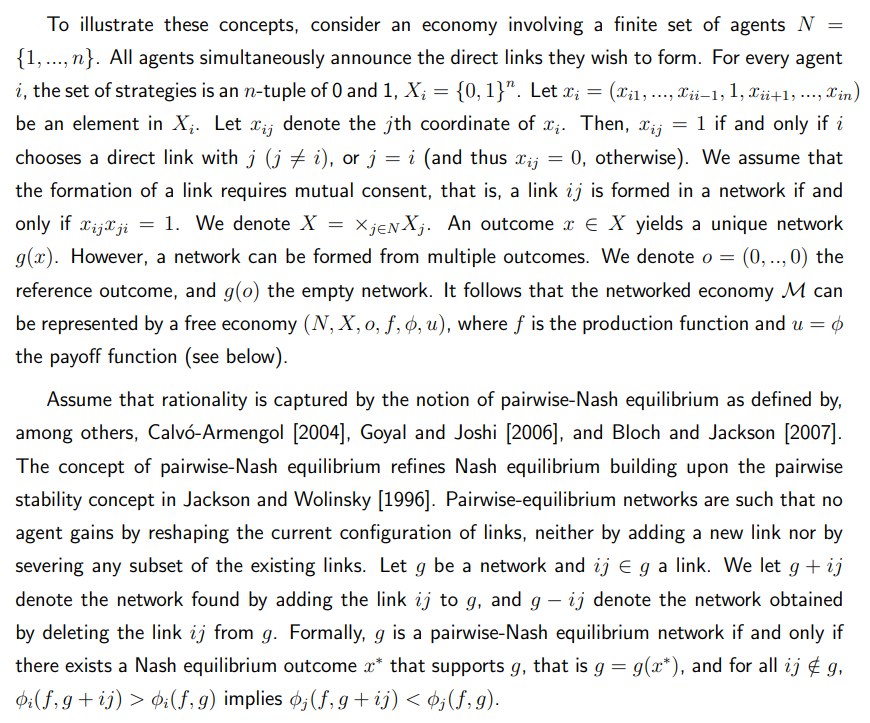
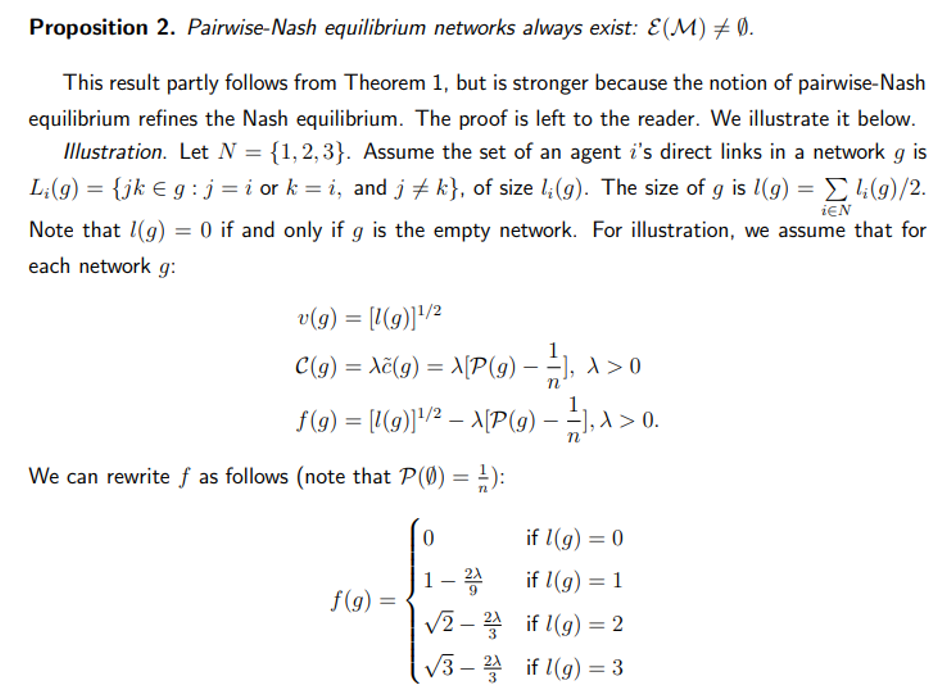
In this section, we provide an application of a free and fair economy to contagion and selfenforcing lockdown in a networked economy. We show how the costs of a pandemic from a virus outbreak can affect agents’ decisions to form and sever bilateral relationships in the economy. Specifically, we illustrate this application by using the contagion potential of a network [Pongou, 2010, Pongou and Serrano, 2013, 2016, Pongou and Tondji, 2018].

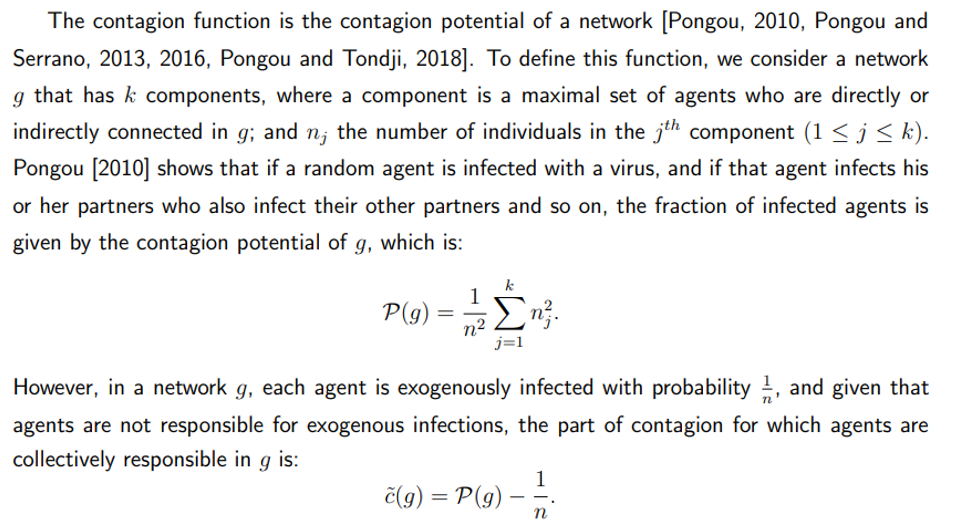
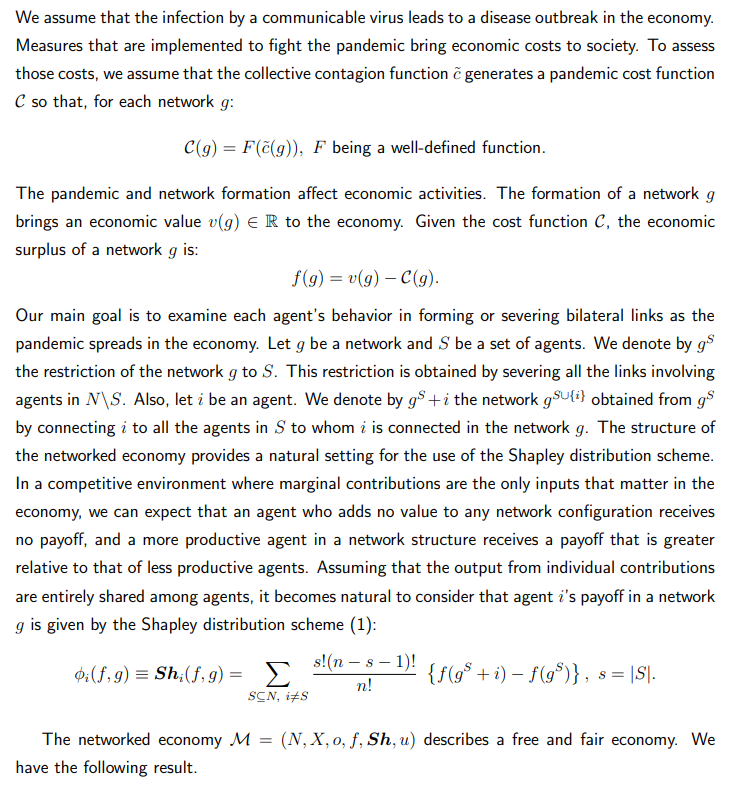
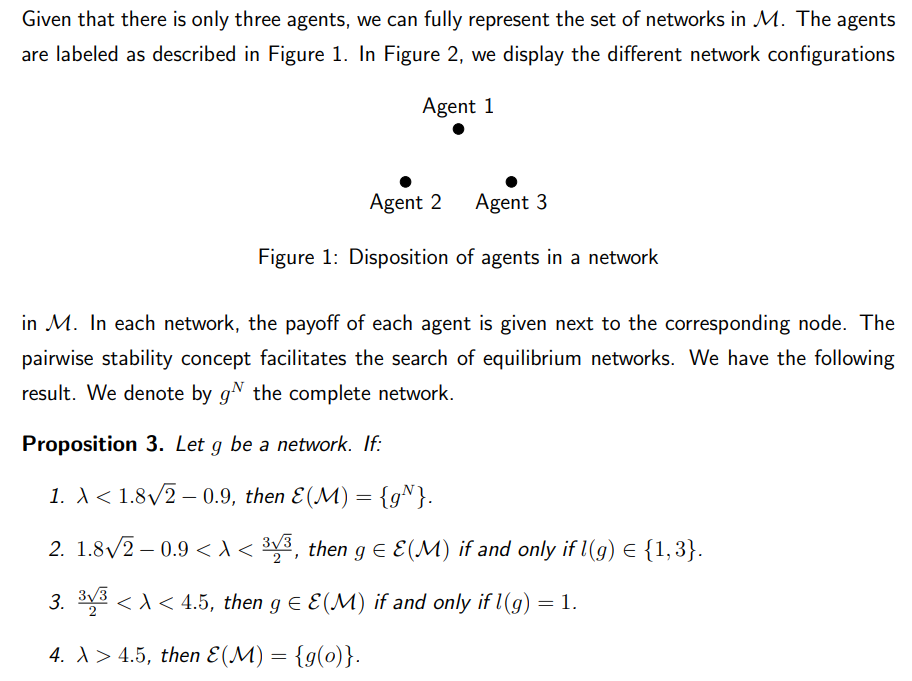
\ Consider an economy M involving agents who freely form and sever bilateral links according to their preferences. Agents’ choices lead to a network, defined as a set of bilateral links. Assume that rational behavior is captured by a certain equilibrium notion (for example, Nash equilibrium, pairwise-Nash equilibrium, etc.). Such an economy may have multiple equilibria. Denote by E(M) the set of its equilibria. Our main goal is to assess agent’s decisions in response to the spread of a random infection (for example, COVID-19) that might hit the economy. As the pandemic evolves in the economy, will some agents decide to sever existing links and self-isolate themselves? How does network structure depend on the infection cost?

\
\
\
\
\
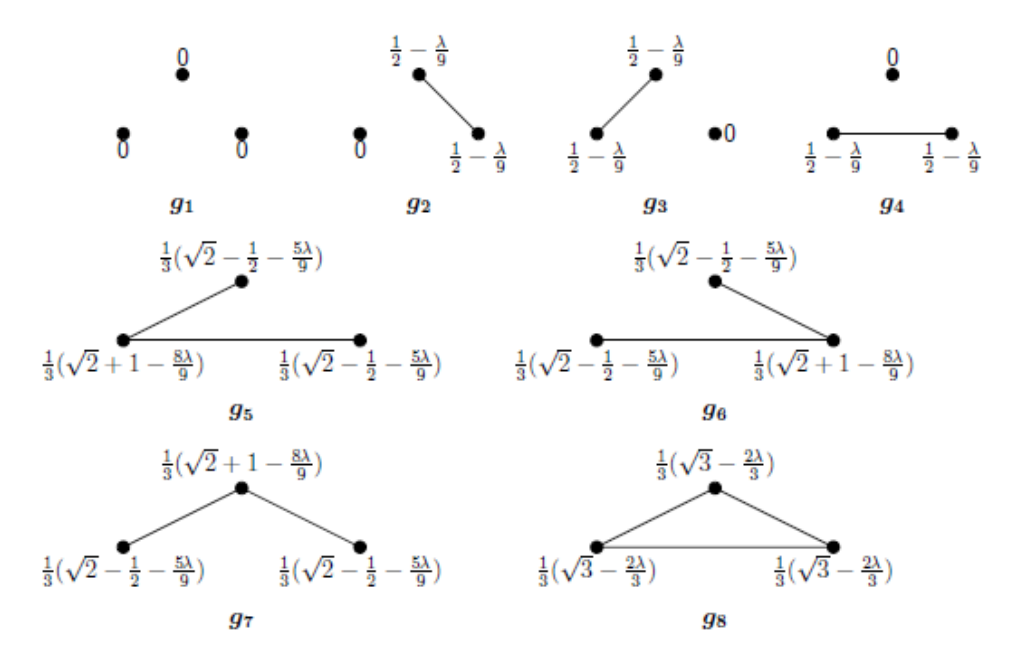
\ Figure 2: Possible network formation in M
\

\ Interestingly, the value of λ depends on the nature of the virus. Viruses induce different severity levels. For example, COVID-19 and the flu virus have different values, inducing different network configurations in equilibrium. The different network configurations in Figure 2 can therefore be interpreted as the networks that will arise in different scenarios regarding the nature of the virus.

\

:::info Authors:

(1) Ghislain H. Demeze-Jouatsa, Center for Mathematical Economics, University of Bielefeld (demeze [email protected]);

(2) Roland Pongou, Department of Economics, University of Ottawa ([email protected]);

(3) Jean-Baptiste Tondji, Department of Economics and Finance, The University of Texas Rio Grande Valley ([email protected]).

:::


:::info This paper is available on arxiv under CC BY 4.0 DEED license.

:::

\

Market Opportunity
SQUID MEME Logo
SQUID MEME Price(GAME)
$32.0287
$32.0287$32.0287
-3.01%
USD
SQUID MEME (GAME) Live Price Chart
Disclaimer: The articles reposted on this site are sourced from public platforms and are provided for informational purposes only. They do not necessarily reflect the views of MEXC. All rights remain with the original authors. If you believe any content infringes on third-party rights, please contact [email protected] for removal. MEXC makes no guarantees regarding the accuracy, completeness, or timeliness of the content and is not responsible for any actions taken based on the information provided. The content does not constitute financial, legal, or other professional advice, nor should it be considered a recommendation or endorsement by MEXC.

You May Also Like

Why It Could Outperform Pepe Coin And Tron With Over $7m Already Raised
Why It Could Outperform Pepe Coin And Tron With Over $7m Already Raised

The post Why It Could Outperform Pepe Coin And Tron With Over $7m Already Raised appeared on BitcoinEthereumNews.com. Crypto News 17 September 2025 | 20:26 While meme tokens like Pepe Coin and established networks such as Tron attract headlines, many investors are now searching for projects that combine innovation, revenue-sharing and real-world utility. BlockchainFX ($BFX), currently in presale at $0.024 ahead of an expected $0.05 launch, is quickly becoming one of the best cryptos to buy today. With $7m already secured and a unique model spanning multiple asset classes, it is positioning itself as a decentralised super app and a contender to surpass older altcoins. Early Presale Pricing Creates A Rare Entry Point BlockchainFX’s presale pricing structure has been designed to reward early participants. At $0.024, buyers secure a lower entry price than later rounds, locking in a cost basis more than 50% below the projected $0.05 launch price. As sales continue to climb beyond $7m, each new stage automatically increases the token price. This built-in mechanism creates a clear advantage for early investors and explains why the project is increasingly cited in “best presales to buy now” discussions across the crypto space. High-Yield Staking Model Shares Platform Revenue Beyond its presale appeal, BlockchainFX is creating a high-yield staking model that gives holders a direct share of platform revenue. Every time a trade occurs on its platform, 70% of trading fees flow back into the $BFX ecosystem: 50% of collected fees are automatically distributed to stakers in both BFX and USDT. 20% is allocated to daily buybacks of $BFX, adding demand and price support. Half of the bought-back tokens are permanently burned, steadily reducing supply. Rewards are based on the size of each member’s BFX holdings and capped at $25,000 USDT per day to ensure sustainability. This structure transforms token ownership from a speculative bet into an income-generating position, a rare feature among today’s altcoins. A Multi-Asset Platform…
Share
BitcoinEthereumNews2025/09/18 03:35
Trump sets stage for a 'post-America world': NYT reporter

Trump sets stage for a 'post-America world': NYT reporter

When Joe Biden was elected president, he frequently asserted that “America was back” and collaborating with allies again. But the fact that the United States would
Share
Alternet2026/03/24 23:03
Forward Industries zet $4 miljard in om Solana bezit uit te breiden

Forward Industries zet $4 miljard in om Solana bezit uit te breiden

Forward Industries gooit het roer om met een flinke financiële zet: het bedrijf lanceert een zogeheten “At The Market” aandelenprogramma van maar liefst $4 miljard. Het programma geeft het bedrijf flexibiliteit om op elk gewenst moment aandelen te verkopen, wat vooral handig is voor het uitbreiden van hun Solana treasury... Het bericht Forward Industries zet $4 miljard in om Solana bezit uit te breiden verscheen het eerst op Blockchain Stories.
Share
Coinstats2025/09/18 01:31