

Robinhood Stock Forecast as SEC Ends the Pattern Day Trader Rule
Key Insights
- Robinhood stock will be a key beneficiary after the SEC ended the Pattern Day Trader Rule.
- The rule barred traders with less than $25,000 in assets from executing more trades.
- HOOD has exited the falling wedge pattern, pointing to more gains.
Robinhood stock price has staged a strong comeback this week. This mirrored the performance of the broader US equity market.
The rally accelerated after the SEC approved a plan to remove the pattern day trader rule. It jumped to $83, its highest level since March 5 this year and 32% above the year-to-date low.
SEC Approves the Elimination of the Pattern Day Trader Rule
Robinhood and other trading platforms in the US may soon benefit from elevated volume after the SEC approved the elimination of the Pattern Day Trader (PDT) rule, which places limits on the number of trades that traders can execute in a day.
Ideally, the rule bans traders from executing four trades in a five-day period if their margin account has less than $25,000 in assets.
The SEC will implement a new margin standard that requires traders to have adequate equity to cover the risks. This rule will apply to all investors and not just retail traders.
The implication of this change is that a company like Robinhood will see more trading activity on the platform, making money. While Robinhood does not charge a commission, the company makes money by taking the Payment for Order Flow (PFOF) from market makers. As such, a higher trading volume means that the company will be making more money.
The announcement came as the bank earnings season started, with the biggest companies in the industry reporting strong trading revenue as traders benefited from the volatility brought by the ongoing Iran war. Goldman Sachs made over $12.7 billion in trading volume in Q1, up by 19% YoY, while JP Morgan made $11.6 billion, up by 20% YoY.
Therefore, there is a likelihood that Robinhood also experienced higher trading volume in the last quarter, with the only laggard being its crypto business, which has struggled in the past few months as Bitcoin and most altcoins have dropped.
Analysts Expect Robinhood’s Growth to Continue
Wall Street analysts are optimistic that Robinhood’s business continued doing well despite the weakness in the crypto industry. This growth will be because of the company’s work to diversify its business, including by launching numerous services like its prediction market and its banking solutions.
The average estimate among analysts is that Robinhood’s revenue rose by 25% YoY in the first quarter to 1.16 billion. Its earnings per share (EPS) is expected to come in at $43 cents, moderately higher than the 37 cents it made in the same period last year. Robinhood has a long track record of doing better than estimates, meaning that its results will be better than these.
Meanwhile, there are signs that Robinhood has become an undervalued company based on various metrics. For example, the forward P/E ratio is 33, which is much lower than its five-year average of 40.
Robinhood has a net profit margin of 43% and a forward revenue growth rate of 25%, giving it a rule-of-40 metric of 68%, which is much higher than the key metric of 40%. More metrics like the EV-to-EBITDA show that the company is a bargain.
Robinhood Stock Price Technical Analysis
The three-day chart shows that the HOOD stock has rebounded in the past few days and is now at its highest level since February 6. On the positive side, it has moved above the falling wedge pattern that started forming a few months ago. A wedge is a common bullish reversal sign in technical analysis.
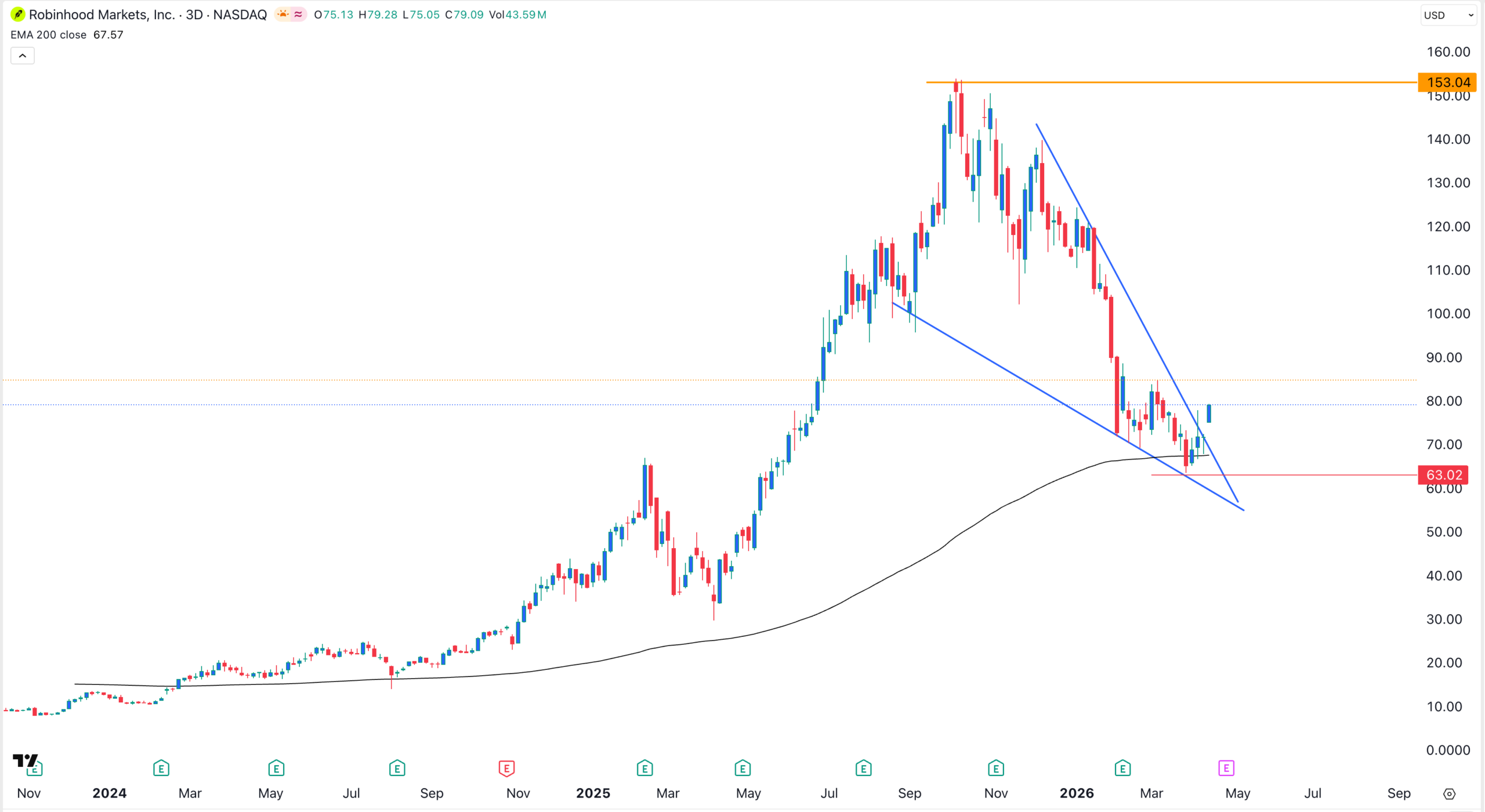 HOOD stock chart | Source: TradingView
This rebound happened as the stock settled above the 200-day Exponential Moving Average (EMA), which has provided it with substantial support. Therefore, the stock will likely continue rising as bulls target the psychological level of $100. A move above that price will raise the possibility that it will jump to $150. This view will be canceled if it drops below the support at $63.
The post Robinhood Stock Forecast as SEC Ends the Pattern Day Trader Rule appeared first on The Market Periodical.


You May Also Like

X Cashtags Add Real-Time Crypto Market Data

Iran Nuclear Deal Bitcoin: The 20-Year Offer




