Charles Hoskinson used a March 19 livestream to deliver a defense of crypto as a response to political dysfunction, market weakness, and what he described as aCharles Hoskinson used a March 19 livestream to deliver a defense of crypto as a response to political dysfunction, market weakness, and what he described as a

Cardano Founder Says The Old System Is Breaking Down

2026/03/24 07:30
4 min read
For feedback or concerns regarding this content, please contact us at [email protected]

Charles Hoskinson used a March 19 livestream to deliver a defense of crypto as a response to political dysfunction, market weakness, and what he described as a broader collapse in institutional legitimacy.

Broadcasting from Colorado, the Cardano founder framed the current macro backdrop in apocalyptic terms, citing war, layoffs, inflationary pressure tied to energy costs, and a growing sense of social pessimism. Markets, he argued, are reacting to that broader stress rather than suffering from a crypto-specific failure.

“The markets are down a little bit. They should be,” Hoskinson said. “The world is literally on fire and we’re trying to douse the flames by pouring money on the fire, thinking somehow that’ll make the fire go out.” In his telling, weak market conditions across crypto, real estate, and other asset classes are symptoms of a deeper problem: a legacy system losing coherence.

A Bigger Future For Cardano And Crypto

That was the core thesis of the livestream. Hoskinson argued that monetary systems, governance systems, and even shared social meaning are all being contested at once, creating a more structural crisis than a single recession or geopolitical conflict. Against that backdrop, he positioned crypto as infrastructure for whatever replaces the current order.

“If we win, we will bank the unbanked. Everybody will own their own identity and we will for the first time in human history have fair markets for everyone everywhere,” he said. “The billionaires, the three comma club gets the same marketplace as the poorest people in the world.”

The remarks were also a defense of persistence during a weaker market cycle. Hoskinson repeatedly pushed back against what he called cynicism inside and outside crypto, arguing that falling token prices have not invalidated the sector’s long-term purpose. He cast the industry as a toolset for censorship-resistant money, non-custodial ownership, alternative governance, and digital identity, all themes long associated with Cardano’s broader positioning.

At several points, he linked that argument directly to AI. Hoskinson said crypto is not just a monetary alternative but potentially the framework that can regulate increasingly powerful machine systems. “Like has to regulate like,” he said. “It’s the single most important invention in the history of humanity.”

The stream also offered a window into how Hoskinson sees AI changing crypto development itself. He said he recently generated a 40-page internal paper in roughly 90 minutes using an agentic workflow built from Midnight and Sui source code, internal white papers, multiple language models, and adversarial testing agents. According to Hoskinson, the result condensed what would once have been six weeks of architecture analysis into a single afternoon.

That matters because Midnight, Cardano’s privacy-focused partner chain, is nearing launch. Hoskinson said he had been speaking with Shielded Technologies CEO Mike Ward and that “we’re launching at the end of the month,” placing the discussion in the context of active design decisions around consensus, performance, and architecture. The larger point was that AI is compressing research cycles and expanding what small teams can do.

Still, the livestream was less a product update than a manifesto. Hoskinson moved freely between macro history, US politics, AI optimism, and anti-establishment rhetoric, arguing that entrenched elites are less competent than they appear and that new systems will be built by younger, more adaptive actors.

He closed by returning to crypto’s social function. “It’s the control layer for those who cannot control themselves. It’s the trust layer for those who cannot trust each other,” he said. “It is the mirror that keeps the dishonest honest. And it’s the thing that enables everyone to play, not just a few people to play in the global economy.”

At press time, Cardano traded at $0.2494.
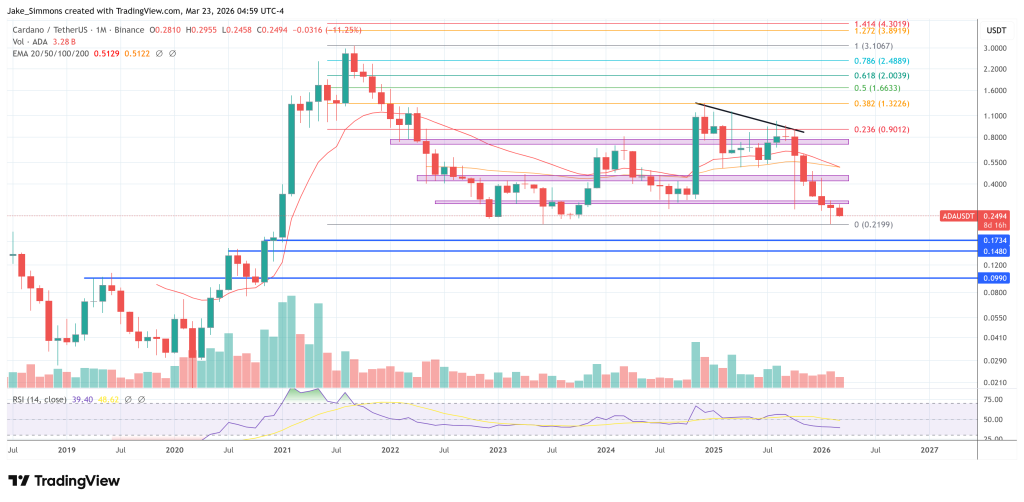
Cardano price chart
Disclaimer: The articles reposted on this site are sourced from public platforms and are provided for informational purposes only. They do not necessarily reflect the views of MEXC. All rights remain with the original authors. If you believe any content infringes on third-party rights, please contact [email protected] for removal. MEXC makes no guarantees regarding the accuracy, completeness, or timeliness of the content and is not responsible for any actions taken based on the information provided. The content does not constitute financial, legal, or other professional advice, nor should it be considered a recommendation or endorsement by MEXC.

You May Also Like

Coinbase Slams ‘Patchwork’ State Crypto Laws, Calls for Federal Preemption

Coinbase Slams ‘Patchwork’ State Crypto Laws, Calls for Federal Preemption

The post Coinbase Slams ‘Patchwork’ State Crypto Laws, Calls for Federal Preemption appeared on BitcoinEthereumNews.com. In brief Coinbase has filed a letter with the DOJ urging federal preemption of state crypto laws, citing Oregon’s securities suit, New York’s ETH stance, and staking bans. Chief Legal Officer Paul Grewal called state actions “government run amok,” warning that patchwork enforcement “slows innovation and harms consumers.” A legal expert told Decrypt that states risk violating interstate commerce rules and due process, and DOJ support for preemption may mark a potential turning point. Coinbase has gone on the offensive against state regulators, petitioning the Department of Justice that a patchwork of lawsuits and licensing schemes is tearing America’s crypto market apart. “When Oregon can sue us for services that are legal under federal law, something’s broken,” Chief Legal Officer Paul Grewal tweeted on Tuesday. “This isn’t federalism—this is government run amok.” When Oregon can sue us for services that are legal under federal law, something’s broken. This isn’t federalism–this is government run amok. We just sent a letter to @TheJusticeDept urging federal action on crypto market structure to remedy this. 1/3 — paulgrewal.eth (@iampaulgrewal) September 16, 2025 Coinbase’s filing says that states are “expansively interpreting their securities laws in ways that undermine federal law” and violate the dormant Commerce Clause by projecting regulatory preferences beyond state borders. “The current patchwork of state laws isn’t just inefficient – it slows innovation and harms consumers” and demands “federal action on crypto market structure,” Grewal said.  States vs. Coinbase It pointed to Oregon’s securities lawsuit against the exchange, New York’s bid to classify Ethereum as a security, and cease-and-desist orders on staking as proof that rogue states are trying to resurrect the SEC’s discredited “regulation by enforcement” playbook. Oregon Attorney General Dan Rayfield sued Coinbase in April for promoting unregistered securities, and in July asked a federal judge to return the…
Share
BitcoinEthereumNews2025/09/18 11:52
Time Management For Entrepreneurs

Time Management For Entrepreneurs

When you’re managing everything on your own, time is your biggest asset. Yet while most entrepreneurs focus on leadership, growth and networking, they often overlook
Share
Techbullion2026/03/24 20:21
UK Looks to US to Adopt More Crypto-Friendly Approach

UK Looks to US to Adopt More Crypto-Friendly Approach

The post UK Looks to US to Adopt More Crypto-Friendly Approach appeared on BitcoinEthereumNews.com. The UK and US are reportedly preparing to deepen cooperation on digital assets, with Britain looking to copy the Trump administration’s crypto-friendly stance in a bid to boost innovation.  UK Chancellor Rachel Reeves and US Treasury Secretary Scott Bessent discussed on Tuesday how the two nations could strengthen their coordination on crypto, the Financial Times reported on Tuesday, citing people familiar with the matter.  The discussions also involved representatives from crypto companies, including Coinbase, Circle Internet Group and Ripple, with executives from the Bank of America, Barclays and Citi also attending, according to the report. The agreement was made “last-minute” after crypto advocacy groups urged the UK government on Thursday to adopt a more open stance toward the industry, claiming its cautious approach to the sector has left the country lagging in innovation and policy.  Source: Rachel Reeves Deal to include stablecoins, look to unlock adoption Any deal between the countries is likely to include stablecoins, the Financial Times reported, an area of crypto that US President Donald Trump made a policy priority and in which his family has significant business interests. The Financial Times reported on Monday that UK crypto advocacy groups also slammed the Bank of England’s proposal to limit individual stablecoin holdings to between 10,000 British pounds ($13,650) and 20,000 pounds ($27,300), claiming it would be difficult and expensive to implement. UK banks appear to have slowed adoption too, with around 40% of 2,000 recently surveyed crypto investors saying that their banks had either blocked or delayed a payment to a crypto provider.  Many of these actions have been linked to concerns over volatility, fraud and scams. The UK has made some progress on crypto regulation recently, proposing a framework in May that would see crypto exchanges, dealers, and agents treated similarly to traditional finance firms, with…
Share
BitcoinEthereumNews2025/09/18 02:21
