Bitcoin didn’t reach a $2.2T market cap without providing some incredible advantages for investors, namely security, decentralization, and the blockchain itself.Bitcoin didn’t reach a $2.2T market cap without providing some incredible advantages for investors, namely security, decentralization, and the blockchain itself.

Whales Bought $418K Bitcoin Hyper in 18 Days: Hype Builds to Over $16.9M in Presale

Whales Bought $418K Bitcoin Hyper in 18 Days: Hype Builds to Over $16.9M in Presale

However, it still has limitations when it comes to scaling and programmability.

And as the crypto economy has grown and smart contracts have developed ever-more-complicated applications and utility, Bitcoin risks being left behind, or pigeonholed as a mere store of value.

Bitcoin Hyper Presale

But Bitcoin Hyper could just change the game entirely with a blazing-fast Bitcoin Layer 2 – here’s how.

Bitcoin’s Built-In Restrictions

Bitcoin’s architecture intentionally limited some of the blockchain’s flexibility, prioritizing security and stability with simple smart contracts.
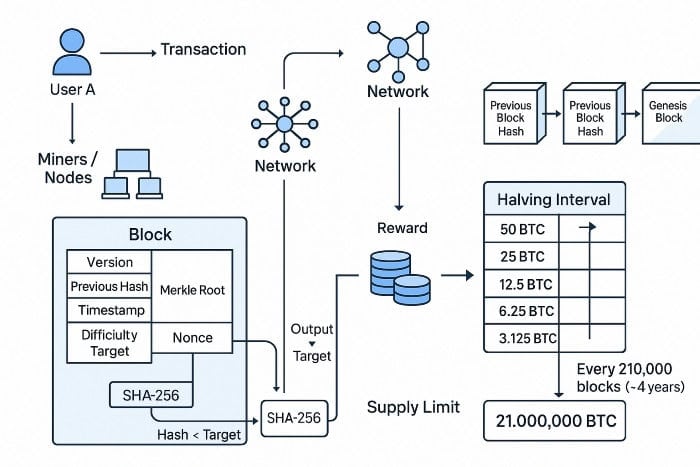
Bitcoin Architecture Illustration

While elegant, that architecture leads to some natural restrictions:

Transaction Throughput, Speed

Bitcoin’s base layer (Layer 1) can manage only 3-7 transactions per second (TPS) in normal conditions. Block confirmation times are slow (on average 10 minutes per block), which means delays during congested periods.

High Fees During Congestion

As demand increases, transaction fees rise since blocks are limited in size. This makes small or micro-transactions economically impractical.

Lack of Smart Contract and Programmability Support

Bitcoin’s native scripting is limited; many advanced DeFi, NFT, dApp use-cases need more expressive and flexible smart contracts. Other blockchains, such as Solana, Base, and Ethereum, have ecosystems built around that flexibility.

Scalability to Modern Demand

With growing demand arising from NFTs, ordinals, BRC-20 tokens, possible DeFi activity, and more global usage, the base Bitcoin network struggles to keep up.

Users want near-instant, low-fee transactions and interoperable use cases – and that’s where Bitcoin Hyper ($HYPER) comes in.

Hyper’s Hybrid Solution

Bitcoin Hyper ($HYPER) is a Layer-2 (L2) network built on top of Bitcoin, designed to overcome Bitcoin’s inherent limitations. Key features include:

  • Layer-2 scaling: Create a secondary chain or network (Layer 2) where many transactions happen off the Bitcoin mainnet, but final settlement happens on Bitcoin’s base layer. The structure provides much higher throughput, lower latency, and lower fees.
  • Canonical Bridge: A canonical bridge means that when you deposit $BTC, it’s locked on Bitcoin L1, and an equivalent wrapped $BTC (or token representing that $BTC) is minted on the Hyper L2. Withdrawals reverse the process. Users can move value into the L2 to transact, then back to L1, ensuring liquidity and trust that value is preserved 1:1.
  • Solana Virtual Machine (SVM) Integration: Hyper uses Solana’s VM for the L2 environment to enable fast and programmable smart contracts. This allows developers to build dApps, DeFi, NFTs, etc., more easily and with better performance.
  • Decentralized Validator: The L2 will run its own validator network rather than Bitcoin’s proof-of-work. Final settlement on the L1 periodically will preserve Bitcoin’s security guarantees.
  • Lower Fees and Faster Transactions: Because operations happen off the main chain, fees should be lower and transactions much faster. Batching of transactions and bridging help reduce cost overhead. The end result is a better user experience that’s more feasible for smaller payments and more usable as everyday money.
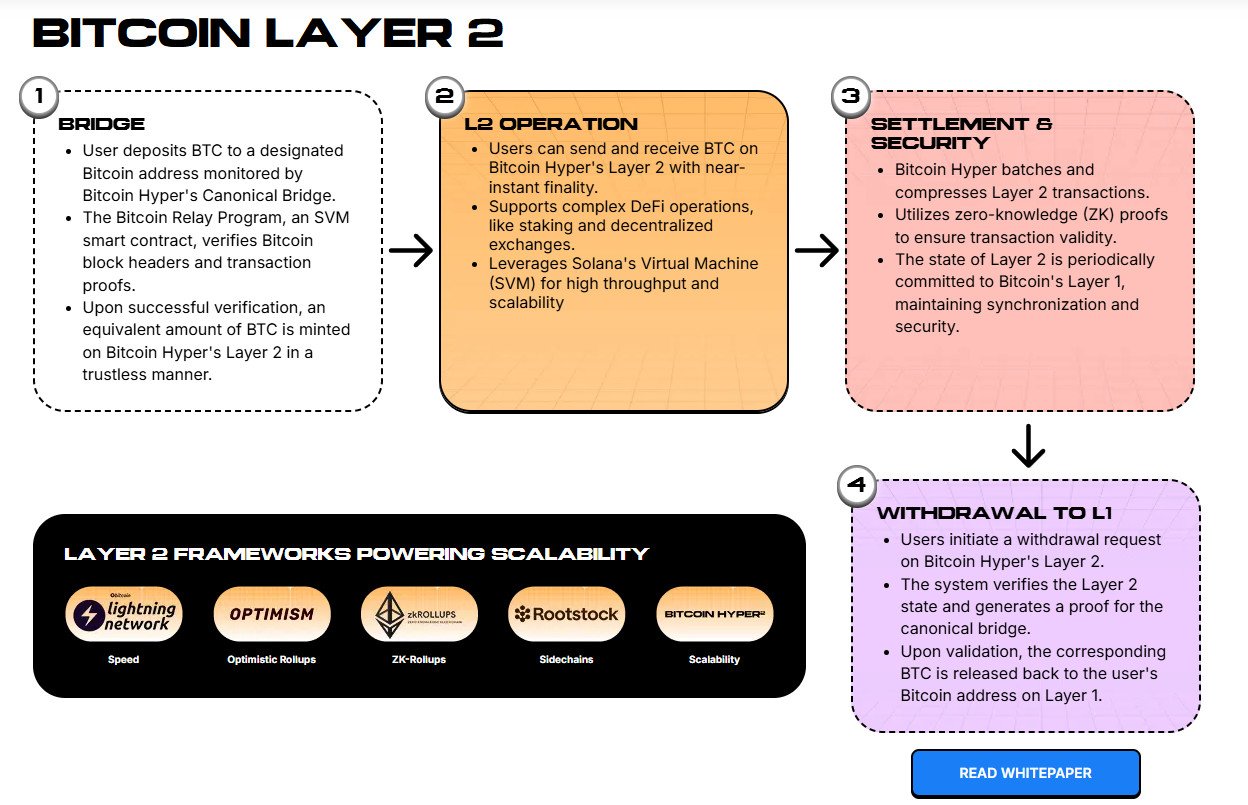
Bitcoin Hyper Layer 2

How Hyper’s Layer-2 Could Help Bitcoin Rise Even More

Faster, cheaper transactions mean more use cases, including micropayments and remittances, which are currently limited by fees and speed. This helps Bitcoin move beyond being just a digital gold and store of value.

And with smart contract capabilities, developers can build financial services, games, and NFTs directly tied to Bitcoin (via the L2). That could attract new users, capital, and innovation, reinforcing Bitcoin’s utility.

If the L2 commits to Bitcoin’s Layer-1 regularly, then Bitcoin’s rock-solid security and reliability can protect the L2 operations. If more apps and users use Bitcoin via Hyper, more value flows through Bitcoin, increasing its relevance, not just as a speculative asset but as infrastructure.

$HYPER Presale Enters Overdrive

One way to judge the project’s utility is to examine how investors have responded to the ongoing token presale. And so far, that response has been overwhelmingly positive:

  • Total funds raised: $16.9M
  • $418K in whale buys in September alone:
    • $85K on 17th September
    • $18.2K on 17th September
    • $31.5K on 15th September
    • $50K on 4 September
  • Token price: $0.012945

The token price will continue to increase as the presale progresses, making now the best time to buy $HYPER.

Bitcoin Hyper’s premise seems a little outlandish – why fix what isn’t broken? Bitcoin is already massive and secure. But Bitcoin Hyper looks beyond what Bitcoin is now, to see what Bitcoin Hyper could unlock for Bitcoin’s next state of evolution.

Bitcoin Hyper is a bridge in more ways than one. Positioning itself between Bitcoin’s strength and modern blockchain demands for speed, programmability, and low fees, Hyper could help push Bitcoin’s dominance into a new phase.

Market Opportunity
Threshold Logo
Threshold Price(T)
$0.0094
$0.0094$0.0094
-0.52%
USD
Threshold (T) Live Price Chart
Disclaimer: The articles reposted on this site are sourced from public platforms and are provided for informational purposes only. They do not necessarily reflect the views of MEXC. All rights remain with the original authors. If you believe any content infringes on third-party rights, please contact [email protected] for removal. MEXC makes no guarantees regarding the accuracy, completeness, or timeliness of the content and is not responsible for any actions taken based on the information provided. The content does not constitute financial, legal, or other professional advice, nor should it be considered a recommendation or endorsement by MEXC.

You May Also Like

Kalshi Jumps to 62% Market Share While Polymarket Eyes $10B Valuation

Kalshi Jumps to 62% Market Share While Polymarket Eyes $10B Valuation

The post Kalshi Jumps to 62% Market Share While Polymarket Eyes $10B Valuation appeared on BitcoinEthereumNews.com. Fintech 19 September 2025 | 16:03 Event-based trading platforms are no longer niche experiments – they’re emerging as a major arena where finance, crypto, and information converge. After months of subdued activity, volumes are climbing again, and U.S.-regulated Kalshi has unexpectedly taken the lead. Betting on Everything From Rates to Sports Analysts at Bernstein describe prediction markets as a new “interface for information,” where users speculate not only on sports results but also on Federal Reserve decisions, quarterly earnings, and even crypto price moves. This year alone, more than $200 million changed hands on Polymarket contracts linked to the Fed’s recent 25 bps rate cut, while $85 million traded on Kalshi around the same decision. Mainstream brokers like Coinbase and Robinhood are watching closely, with ambitions to capture some of the momentum. With U.S. sports betting already worth tens of billions annually, the overlap is too big to ignore. Against that backdrop, Kalshi has delivered one of its strongest months since the 2024 elections. The platform reports $1.3 billion in trading volume so far in September, accounting for 62% of global prediction market activity. Just a year ago, Kalshi’s share stood at 3%. CEO Tarek Mansour called the growth “remarkable,” noting that the exchange still serves only U.S. clients. Polymarket’s Pushback Its main rival, Polymarket, has logged about $773 million in trades this month. While that trails Kalshi for now, Polymarket has unique advantages: as a crypto-native platform, it has carved out strong global demand and is working toward a formal U.S. relaunch via its acquisition of derivatives exchange QCEX. The two platforms now stand as the clear leaders of the sector, though they embody different philosophies — one regulated from the ground up, the other built around decentralization. Investors Take Notice The boom hasn’t escaped venture capital. Reports suggest…
Share
BitcoinEthereumNews2025/09/19 21:34
Visa Expands USDC Stablecoin Settlement For US Banks

Visa Expands USDC Stablecoin Settlement For US Banks

The post Visa Expands USDC Stablecoin Settlement For US Banks appeared on BitcoinEthereumNews.com. Visa Expands USDC Stablecoin Settlement For US Banks
Share
BitcoinEthereumNews2025/12/17 15:23
Bitcoin Lightning Network Capacity Surges to Historic Peak as Exchange Adoption Accelerates

Bitcoin Lightning Network Capacity Surges to Historic Peak as Exchange Adoption Accelerates

The Bitcoin Lightning Network has reached an all-time high in total network capacity, marking a significant milestone for the layer-2 scaling solution designed to enable fast and inexpensive Bitcoin transactions. The surge comes as major cryptocurrency exchanges increasingly integrate Lightning functionality, bringing the technology to millions of users who previously relied solely on slower, more expensive on-chain transactions. This capacity expansion reflects growing confidence in Lightning's reliability and utility after years of development and real-world testing. What began as an experimental protocol discussed primarily among technical enthusiasts has matured into infrastructure that some of the industry's largest platforms now consider essential to their operations.
Share
MEXC NEWS2025/12/17 17:14