The U.S. Commodity Futures Trading Commission (CFTC) is exploring a significant shift in how collateral is used within derivatives markets, by permitting tokenized assets, including stablecoins, as acceptable collateral. This move aims to modernize and expand the role of digital assets in regulated financial markets, aligning with recent legislative developments and industry support, potentially transforming [...]The U.S. Commodity Futures Trading Commission (CFTC) is exploring a significant shift in how collateral is used within derivatives markets, by permitting tokenized assets, including stablecoins, as acceptable collateral. This move aims to modernize and expand the role of digital assets in regulated financial markets, aligning with recent legislative developments and industry support, potentially transforming [...]

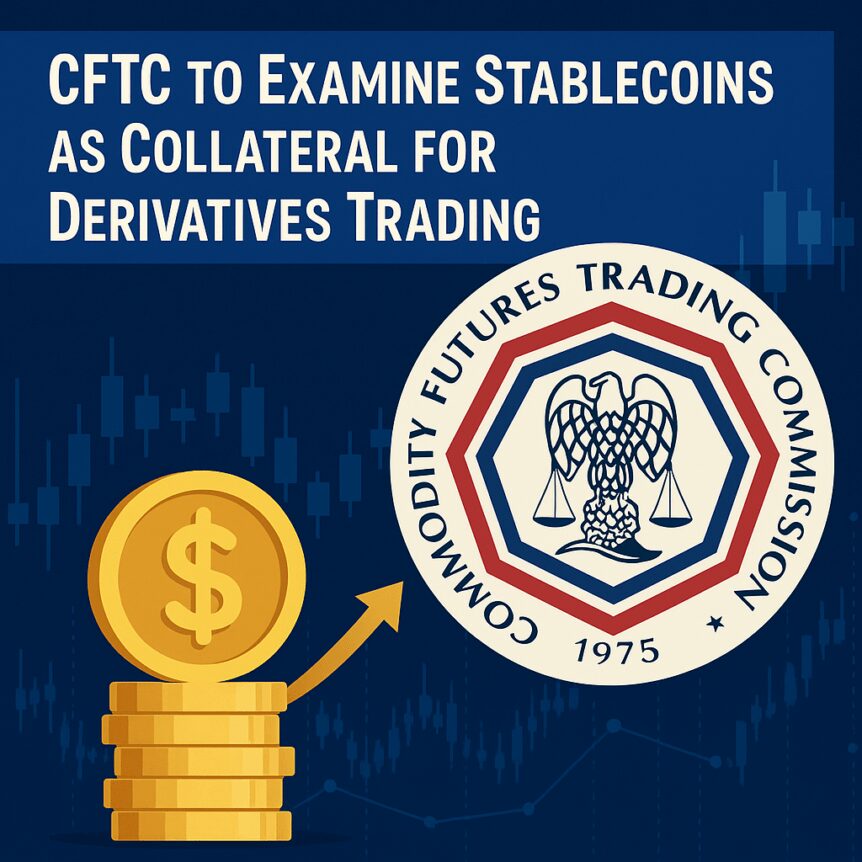
CFTC to Examine Stablecoins as Collateral for Derivatives Trading
4 min read
Cftc To Examine Stablecoins As Collateral For Derivatives Trading

The U.S. Commodity Futures Trading Commission (CFTC) is exploring a significant shift in how collateral is used within derivatives markets, by permitting tokenized assets, including stablecoins, as acceptable collateral. This move aims to modernize and expand the role of digital assets in regulated financial markets, aligning with recent legislative developments and industry support, potentially transforming the landscape of crypto-backed derivatives trading.

  • The CFTC is welcoming public feedback on using tokenized assets, such as stablecoins, as collateral in derivatives markets until October 20.
  • If adopted, stablecoins like USDC and USDT would be treated on par with traditional collateral such as cash or U.S. Treasurys.
  • Major crypto firms and stablecoin issuers are publicly supporting the proposed initiative, emphasizing benefits like reduced costs and enhanced liquidity.
  • The move is part of broader efforts to integrate stablecoins into regulated markets, following recent legislation like the GENIUS Act.
  • This initiative signals a broader evolution in U.S. crypto regulation, as agencies seek to establish clearer rules for digital assets in financial systems.

US Regulator Eyes Tokenized Assets for Derivatives Collateral

The U.S. Commodity Futures Trading Commission (CFTC) has announced it is actively considering permitting tokenized assets—such as stablecoins—to serve as collateral in derivatives markets. CFTC acting chair Caroline Pham emphasized that her agency would collaborate with industry stakeholders, inviting feedback until October 20 to shape the regulatory framework for tokenized collateral.

Under this proposed approach, stablecoins like USDC and Tether (USDT) could be treated similarly to traditional collateral such as cash or U.S. Treasurys, in a move that could significantly broaden their use in regulated derivatives trading. The legislation earlier this year provided a legal framework for stablecoins, encouraging their adoption among financial institutions amid growing mainstream interest.

Source: Caroline Pham

Crypto Industry Leaders Endorse the Initiative

Prominent figures from major crypto firms and stablecoin issuers have expressed support for the CFTC’s plans. Circle Internet Group president Heath Tarbert noted that the GENIUS Act facilitates a blockchain-based payment ecosystem, where licensed American stablecoins can be used as collateral in traditional financial markets, including derivatives.

“Using trusted stablecoins like USDC as collateral will lower costs, reduce risk, and unlock liquidity across global markets 24/7/365,” Tarbert remarked. The legislation, signed into law by President Donald Trump in July, is poised to clarify stablecoin regulations, pending final regulatory rules.

Meanwhile, Coinbase’s chief legal officer Paul Grewal underscored the strategic importance of tokenized collateral, stating, “Tokenized collateral and stablecoins can unlock U.S. derivatives markets and position us ahead of global competitors.”
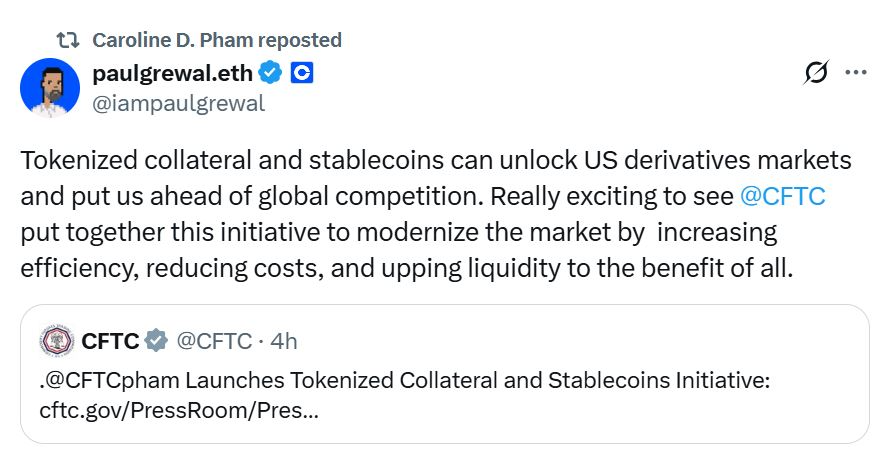
Source: Paul Grewal

Ripple’s senior vice president Jack McDonald also praised the effort, emphasizing that establishing clear rules and governance around stablecoins will foster greater trust, transparency, and resilience within the markets. “Establishing clear rules for valuation, custody, and settlement will give institutions the certainty they need,” he said.

Strategic Foundations and Future Directions

Acting Chair Pham highlighted that this tokenized asset initiative builds on earlier discussions from the CFTC’s Crypto CEO Forum and fits into broader efforts, including the recent crypto sprint to implement recommendations from the President’s Working Group on Digital Asset Markets.

The forum in February called for industry input on digital asset pilot programs and the use of tokenized non-cash collateral, with subsequent proposals emphasizing the potential of distributed ledger technology (DLT) to expand collateral options.

Changing Crypto Regulatory Landscape

Pham’s announcement coincides with broader regulatory shifts, as SEC Chair Paul Atkins revealed efforts to develop an innovation exemption—intended to temporarily shield crypto firms from older securities rules while new regulations are crafted. His agency is also advancing “Project Crypto,” aimed at modernizing securities rules and enabling onchain operations in U.S. markets.

This article was originally published as CFTC to Examine Stablecoins as Collateral for Derivatives Trading on Crypto Breaking News – your trusted source for crypto news, Bitcoin news, and blockchain updates.

Market Opportunity
Union Logo
Union Price(U)
$0.001648
$0.001648$0.001648
-11.30%
USD
Union (U) Live Price Chart
Disclaimer: The articles reposted on this site are sourced from public platforms and are provided for informational purposes only. They do not necessarily reflect the views of MEXC. All rights remain with the original authors. If you believe any content infringes on third-party rights, please contact [email protected] for removal. MEXC makes no guarantees regarding the accuracy, completeness, or timeliness of the content and is not responsible for any actions taken based on the information provided. The content does not constitute financial, legal, or other professional advice, nor should it be considered a recommendation or endorsement by MEXC.

You May Also Like

Which Altcoins Stand to Gain from the SEC’s New ETF Listing Standards?

Which Altcoins Stand to Gain from the SEC’s New ETF Listing Standards?

On Wednesday, the US SEC (Securities and Exchange Commission) took a landmark step in crypto regulation, approving generic listing standards for spot crypto ETFs (exchange-traded funds). This new framework eliminates the case-by-case 19b-4 approval process, streamlining the path for multiple digital asset ETFs to enter the market in the coming weeks. Grayscale’s Multi-Crypto Milestone Grayscale secured a first-mover advantage as its Digital Large Cap Fund (GDLC) received approval under the new listing standards. Products that will be traded under the ticker GDLC include Bitcoin, Ethereum, XRP, Solana, and Cardano. “Grayscale Digital Large Cap Fund $GDLC was just approved for trading along with the Generic Listing Standards. The Grayscale team is working expeditiously to bring the FIRST multi-crypto asset ETP to market with Bitcoin, Ethereum, XRP, Solana, and Cardano,” wrote Grayscale CEO Peter Mintzberg. The approval marks the US’s first diversified, multi-crypto ETP, signaling a shift toward broader portfolio products rather than single-asset ETFs. Bloomberg’s Eric Balchunas explained that around 12–15 cryptocurrencies now qualify for spot ETF consideration. However, this is contingent on the altcoins having established futures trading on Coinbase Derivatives for at least six months. This includes well-known altcoins like Dogecoin (DOGE), Litecoin (LTC), and Chainlink (LINK), alongside the majors already included in Grayscale’s GDLC. Altcoins in the Spotlight Amid New Era of ETF Eligibility Several assets have already met the key condition, regulated futures trading on Coinbase. For example, Solana futures launched in February 2024, making the token eligible as of August 19. “The SEC approved generic ETF listing standards. Assets with a regulated futures contract trading for 6 months qualify for a spot ETF. Solana met this criterion on Aug 19, 6 months after SOL futures launched on Coinbase Derivatives,” SolanaFloor indicated. Crypto investors and communities also identified which tokens stand to gain. Chainlink community liaison Zach Rynes highlighted that LINK could soon see its own ETF. He noted that both Bitwise and Grayscale have already filed applications. Meanwhile, the Litecoin Foundation indicated that the new standards provide the regulatory framework for LTC to be listed on US exchanges. Hedera is also in the spotlight, with digital asset investor Mark anticipating an HBAR ETF. Market observers see the decision as a potential turning point for broader adoption, bringing the much-needed clarity and accessibility for investors. At the same time, it boosts confidence in the market’s maturity. The general sentiment is that with the SEC’s approval, the next phase of crypto ETFs is no longer a question of ‘if,’ but ‘when.’ The shift to generic listing standards could expand the US-listed digital asset ETFs roster beyond Bitcoin and Ethereum. Such a move would usher in new investment vehicles covering a dozen or more altcoins. This represents the clearest path yet toward mainstream, regulated access to diversified crypto exposure. More importantly, it comes without the friction of direct custody. “We’re gonna be off to the races in a matter of weeks,” ETF analyst James Seyffart quipped.
Share
Coinstats2025/09/18 12:57
‘High Risk’ Projects Dominate Crypto Press Releases, Report Finds

‘High Risk’ Projects Dominate Crypto Press Releases, Report Finds

The post ‘High Risk’ Projects Dominate Crypto Press Releases, Report Finds appeared on BitcoinEthereumNews.com. More than six in 10 crypto press releases published
Share
BitcoinEthereumNews2026/02/04 13:09
Why Vitalik Says L2s Aren’t Ethereum Shards Now?

Why Vitalik Says L2s Aren’t Ethereum Shards Now?

The post Why Vitalik Says L2s Aren’t Ethereum Shards Now? appeared on BitcoinEthereumNews.com. Vitalik says Ethereum’s scaling and higher gas limits mean L2s no
Share
BitcoinEthereumNews2026/02/04 13:18