Bipartisan talks on a long-awaited U.S. crypto market regulation package, the CLARITY Act, have resumed in the Senate, even as Washington remains paralyzed by a government shutdown now in its 31st day, one of the longest in U.S. history. Lawmakers from both parties are racing to finalize the market structure bill that could reshape oversight of digital assets before election politics stall progress. The negotiations, led by key Senate committees, have accelerated in recent weeks despite the broader gridlock. Can the CLARITY Act pass by Thanksgiving? According to the report, Senate Agriculture Committee Chair John Boozman (R-Ark.) said he and Sen. Cory Booker (D-N.J.) are working “daily” to complete their section of the legislation, which would establish a regulatory framework for digital assets treated as commodities. Boozman said he expects a committee vote “before Thanksgiving,” adding, “We’re going to get it done this year.” Booker echoed that sentiment, saying the goal was to “get the policy right” rather than rush the timeline. Their work represents one part of a broader bipartisan effort spanning multiple committees, including Banking and Finance, to define how digital assets fit within U.S. regulations and the tax code. Talks within the Senate Banking Committee have also gained momentum. Senators Cynthia Lummis (R-Wyo.), Ruben Gallego (D-Ariz.), and Angela Alsobrooks (D-Md.) said discussions had resumed after weeks of delay. Notably, Committee Chair Tim Scott (R-S.C.) said he was “encouraged” by the progress and looks forward to advancing “meaningful legislation.” Still, some members caution that the bill is not yet ready. Sen. John Kennedy (R-La.) said the legislation requires a public hearing and that many lawmakers still need to understand the issue. The push for progress comes amid warnings that time is running out. Sen. Thom Tillis (R-N.C.) said Congress must act by early 2026 or risk losing momentum as election politics take over. “I’m not optimistic about us moving much further on anything around digital assets, stablecoins, or crypto in this Congress,” he said on Monday. Longest Shutdown in History Looms — What’s Next for America? The shutdown, now stretching into its fifth week, has added further strain. The Senate adjourned Thursday without progress on a continuing resolution, guaranteeing the shutdown will last at least 34 days, tying the longest lapse in U.S. history. As of October 20, 25% of Polymarket bettors predict that the shutdown will last until at least November 16 and may drag on for almost another month to become the longest in American history. Funding for food assistance under the Supplemental Nutrition Assistance Program (SNAP) is set to expire Saturday, threatening benefits for 42 million Americans. The closure, triggered by disputes over healthcare subsidies, has left 1.4 million federal workers without pay, including air traffic controllers and employees at key agencies. Despite the stalemate, Senate Democrats and Republicans are expected to meet separately with industry executives next week to keep crypto talks alive. U.S. Lawmakers Renew Crypto Talks, but Prediction Markets Cut Odds of 2025 Passage to 25% On October 20, Sen. Kirsten Gillibrand (D-N.Y.) hosted a closed-door roundtable with major industry figures, including Galaxy’s Mike Novogratz, Coinbase CEO Brian Armstrong, and Chainlink’s Sergey Nazarov. Armstrong told CNBC that roughly 90% of the bill’s issues had already been resolved and that Thanksgiving had been floated as a possible target for completion. The House-passed Digital Asset Market Clarity Act, approved in July by a 294–137 vote, remains stalled due to the shutdown. The measure defines which digital assets fall under the jurisdiction of the Commodity Futures Trading Commission (CFTC) and which are overseen by the Securities and Exchange Commission (SEC). Together with the GENIUS Act, signed by President Donald Trump earlier this year, it forms the foundation of the emerging U.S. crypto regulatory framework. White House AI and Crypto Czar David Sacks said the administration remains optimistic that bipartisan support could still deliver progress by the end of 2025.Source: Polymarket But prediction markets paint a different picture, with data from Polymarket showing just a 25% chance the CLARITY Act becomes law this year, down from 87% in mid-JulyBipartisan talks on a long-awaited U.S. crypto market regulation package, the CLARITY Act, have resumed in the Senate, even as Washington remains paralyzed by a government shutdown now in its 31st day, one of the longest in U.S. history. Lawmakers from both parties are racing to finalize the market structure bill that could reshape oversight of digital assets before election politics stall progress. The negotiations, led by key Senate committees, have accelerated in recent weeks despite the broader gridlock. Can the CLARITY Act pass by Thanksgiving? According to the report, Senate Agriculture Committee Chair John Boozman (R-Ark.) said he and Sen. Cory Booker (D-N.J.) are working “daily” to complete their section of the legislation, which would establish a regulatory framework for digital assets treated as commodities. Boozman said he expects a committee vote “before Thanksgiving,” adding, “We’re going to get it done this year.” Booker echoed that sentiment, saying the goal was to “get the policy right” rather than rush the timeline. Their work represents one part of a broader bipartisan effort spanning multiple committees, including Banking and Finance, to define how digital assets fit within U.S. regulations and the tax code. Talks within the Senate Banking Committee have also gained momentum. Senators Cynthia Lummis (R-Wyo.), Ruben Gallego (D-Ariz.), and Angela Alsobrooks (D-Md.) said discussions had resumed after weeks of delay. Notably, Committee Chair Tim Scott (R-S.C.) said he was “encouraged” by the progress and looks forward to advancing “meaningful legislation.” Still, some members caution that the bill is not yet ready. Sen. John Kennedy (R-La.) said the legislation requires a public hearing and that many lawmakers still need to understand the issue. The push for progress comes amid warnings that time is running out. Sen. Thom Tillis (R-N.C.) said Congress must act by early 2026 or risk losing momentum as election politics take over. “I’m not optimistic about us moving much further on anything around digital assets, stablecoins, or crypto in this Congress,” he said on Monday. Longest Shutdown in History Looms — What’s Next for America? The shutdown, now stretching into its fifth week, has added further strain. The Senate adjourned Thursday without progress on a continuing resolution, guaranteeing the shutdown will last at least 34 days, tying the longest lapse in U.S. history. As of October 20, 25% of Polymarket bettors predict that the shutdown will last until at least November 16 and may drag on for almost another month to become the longest in American history. Funding for food assistance under the Supplemental Nutrition Assistance Program (SNAP) is set to expire Saturday, threatening benefits for 42 million Americans. The closure, triggered by disputes over healthcare subsidies, has left 1.4 million federal workers without pay, including air traffic controllers and employees at key agencies. Despite the stalemate, Senate Democrats and Republicans are expected to meet separately with industry executives next week to keep crypto talks alive. U.S. Lawmakers Renew Crypto Talks, but Prediction Markets Cut Odds of 2025 Passage to 25% On October 20, Sen. Kirsten Gillibrand (D-N.Y.) hosted a closed-door roundtable with major industry figures, including Galaxy’s Mike Novogratz, Coinbase CEO Brian Armstrong, and Chainlink’s Sergey Nazarov. Armstrong told CNBC that roughly 90% of the bill’s issues had already been resolved and that Thanksgiving had been floated as a possible target for completion. The House-passed Digital Asset Market Clarity Act, approved in July by a 294–137 vote, remains stalled due to the shutdown. The measure defines which digital assets fall under the jurisdiction of the Commodity Futures Trading Commission (CFTC) and which are overseen by the Securities and Exchange Commission (SEC). Together with the GENIUS Act, signed by President Donald Trump earlier this year, it forms the foundation of the emerging U.S. crypto regulatory framework. White House AI and Crypto Czar David Sacks said the administration remains optimistic that bipartisan support could still deliver progress by the end of 2025.Source: Polymarket But prediction markets paint a different picture, with data from Polymarket showing just a 25% chance the CLARITY Act becomes law this year, down from 87% in mid-July

US Senators Push to Finalize Crypto Market Bill as Shutdown Standoff Deepens: Report

4 min read

Bipartisan talks on a long-awaited U.S. crypto market regulation package, the CLARITY Act, have resumed in the Senate, even as Washington remains paralyzed by a government shutdown now in its 31st day, one of the longest in U.S. history.

Lawmakers from both parties are racing to finalize the market structure bill that could reshape oversight of digital assets before election politics stall progress.

The negotiations, led by key Senate committees, have accelerated in recent weeks despite the broader gridlock.

Can the CLARITY Act pass by Thanksgiving?

According to the report, Senate Agriculture Committee Chair John Boozman (R-Ark.) said he and Sen. Cory Booker (D-N.J.) are working “daily” to complete their section of the legislation, which would establish a regulatory framework for digital assets treated as commodities.

Boozman said he expects a committee vote “before Thanksgiving,” adding, “We’re going to get it done this year.”

Booker echoed that sentiment, saying the goal was to “get the policy right” rather than rush the timeline.

Their work represents one part of a broader bipartisan effort spanning multiple committees, including Banking and Finance, to define how digital assets fit within U.S. regulations and the tax code.

Talks within the Senate Banking Committee have also gained momentum. Senators Cynthia Lummis (R-Wyo.), Ruben Gallego (D-Ariz.), and Angela Alsobrooks (D-Md.) said discussions had resumed after weeks of delay.

Notably, Committee Chair Tim Scott (R-S.C.) said he was “encouraged” by the progress and looks forward to advancing “meaningful legislation.”

Still, some members caution that the bill is not yet ready. Sen. John Kennedy (R-La.) said the legislation requires a public hearing and that many lawmakers still need to understand the issue.

The push for progress comes amid warnings that time is running out. Sen. Thom Tillis (R-N.C.) said Congress must act by early 2026 or risk losing momentum as election politics take over.

“I’m not optimistic about us moving much further on anything around digital assets, stablecoins, or crypto in this Congress,” he said on Monday.

Longest Shutdown in History Looms — What’s Next for America?

The shutdown, now stretching into its fifth week, has added further strain. The Senate adjourned Thursday without progress on a continuing resolution, guaranteeing the shutdown will last at least 34 days, tying the longest lapse in U.S. history.

As of October 20, 25% of Polymarket bettors predict that the shutdown will last until at least November 16 and may drag on for almost another month to become the longest in American history.

Funding for food assistance under the Supplemental Nutrition Assistance Program (SNAP) is set to expire Saturday, threatening benefits for 42 million Americans.

The closure, triggered by disputes over healthcare subsidies, has left 1.4 million federal workers without pay, including air traffic controllers and employees at key agencies.

Despite the stalemate, Senate Democrats and Republicans are expected to meet separately with industry executives next week to keep crypto talks alive.

U.S. Lawmakers Renew Crypto Talks, but Prediction Markets Cut Odds of 2025 Passage to 25%

On October 20, Sen. Kirsten Gillibrand (D-N.Y.) hosted a closed-door roundtable with major industry figures, including Galaxy’s Mike Novogratz, Coinbase CEO Brian Armstrong, and Chainlink’s Sergey Nazarov.

Armstrong told CNBC that roughly 90% of the bill’s issues had already been resolved and that Thanksgiving had been floated as a possible target for completion.

The House-passed Digital Asset Market Clarity Act, approved in July by a 294–137 vote, remains stalled due to the shutdown.

The measure defines which digital assets fall under the jurisdiction of the Commodity Futures Trading Commission (CFTC) and which are overseen by the Securities and Exchange Commission (SEC).

Together with the GENIUS Act, signed by President Donald Trump earlier this year, it forms the foundation of the emerging U.S. crypto regulatory framework.

White House AI and Crypto Czar David Sacks said the administration remains optimistic that bipartisan support could still deliver progress by the end of 2025.
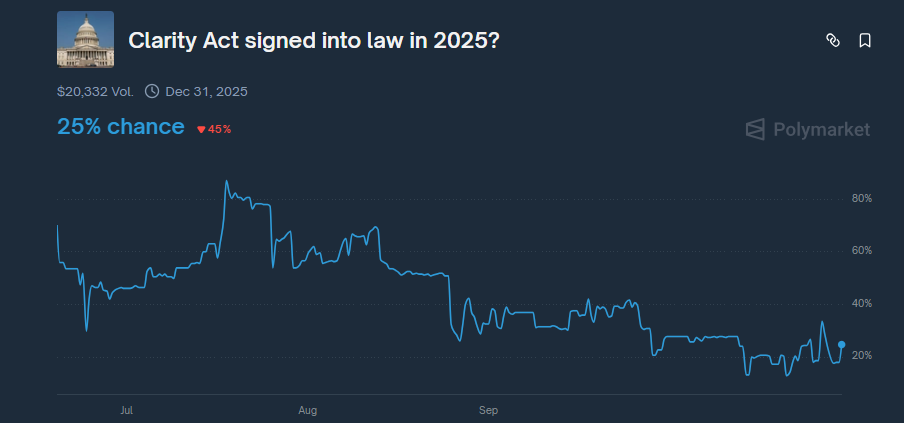
Source: Polymarket

But prediction markets paint a different picture, with data from Polymarket showing just a 25% chance the CLARITY Act becomes law this year, down from 87% in mid-July

Market Opportunity
EPNS Logo
EPNS Price(PUSH)
$0.013279
$0.013279$0.013279
-1.55%
USD
EPNS (PUSH) Live Price Chart
Disclaimer: The articles reposted on this site are sourced from public platforms and are provided for informational purposes only. They do not necessarily reflect the views of MEXC. All rights remain with the original authors. If you believe any content infringes on third-party rights, please contact [email protected] for removal. MEXC makes no guarantees regarding the accuracy, completeness, or timeliness of the content and is not responsible for any actions taken based on the information provided. The content does not constitute financial, legal, or other professional advice, nor should it be considered a recommendation or endorsement by MEXC.

You May Also Like

Marathon Digital BTC Transfers Highlight Miner Stress

Marathon Digital BTC Transfers Highlight Miner Stress

The post Marathon Digital BTC Transfers Highlight Miner Stress appeared on BitcoinEthereumNews.com. In a tense week for crypto markets, marathon digital has drawn
Share
BitcoinEthereumNews2026/02/06 15:16
This U.S. politician’s suspicious stock trade just returned over 200% in weeks

This U.S. politician’s suspicious stock trade just returned over 200% in weeks

The post This U.S. politician’s suspicious stock trade just returned over 200% in weeks appeared on BitcoinEthereumNews.com. United States Representative Cloe Fields has seen his stake in Opendoor Technologies (NASDAQ: OPEN) stock return over 200% in just a matter of weeks. According to congressional trade filings, the lawmaker purchased a stake in the online real estate company on July 21, 2025, investing between $1,001 and $15,000. At the time, the stock was trading around $2 and had been largely stagnant for months. Receive Signals on US Congress Members’ Stock Trades Stocks Stay up-to-date on the trading activity of US Congress members. The signal triggers based on updates from the House disclosure reports, notifying you of their latest stock transactions. Enable signal The trade has since paid off, with Opendoor surging to $10, a gain of nearly 220% in under two months. By comparison, the broader S&P 500 index rose less than 5% during the same period. OPEN one-week stock price chart. Source: Finbold Assuming he invested a minimum of $1,001, the purchase would now be worth about $3,200, while a $15,000 stake would have grown to nearly $48,000, generating profits of roughly $2,200 and $33,000, respectively. OPEN’s stock rally Notably, Opendoor’s rally has been fueled by major corporate shifts and market speculation. For instance, in August, the company named former Shopify COO Kaz Nejatian as CEO, while co-founders Keith Rabois and Eric Wu rejoined the board, moves seen as a return to the company’s early innovative spirit.  Outgoing CEO Carrie Wheeler’s resignation and sale of millions in stock reinforced the sense of a new chapter. Beyond leadership changes, Opendoor’s surge has taken on meme-stock characteristics. In this case, retail investors piled in as shares climbed, while short sellers scrambled to cover, pushing prices higher.  However, the stock is still not without challenges, where its iBuying model is untested at scale, margins are thin, and debt tied to…
Share
BitcoinEthereumNews2025/09/18 04:02
Apollo secures $50 million in backing to launch new tokenized credit fund

Apollo secures $50 million in backing to launch new tokenized credit fund

PANews reported on September 18 that according to CoinDesk, the blockchain-based RWA institution Centrifuge and Plume jointly launched the "Anemoy Tokenized Apollo Diversified Credit Fund (ACRDX)", which received a $50 million anchor investment from Grove, a credit infrastructure protocol within the Sky ecosystem. The fund enables blockchain investors to participate in Apollo's diversified global credit strategy, covering direct corporate loans, asset-backed loans, and mismatched credit. ACRDX will be issued through Plume's Nest Credit Vault with the token code nACRDX, enabling institutional investors to participate in the strategy on-chain. Chronicle will serve as the oracle provider, and Wormhole will be responsible for cross-chain connections. After approval, Anemoy will serve as the fund's manager.
Share
PANews2025/09/18 10:26