The US GENIUS stablecoin bill passed the Senate vote, but still needs the green light from the House of Representatives and the President. The Trump family stablecoin has become a controversial issue

Author: Weilin, PANews
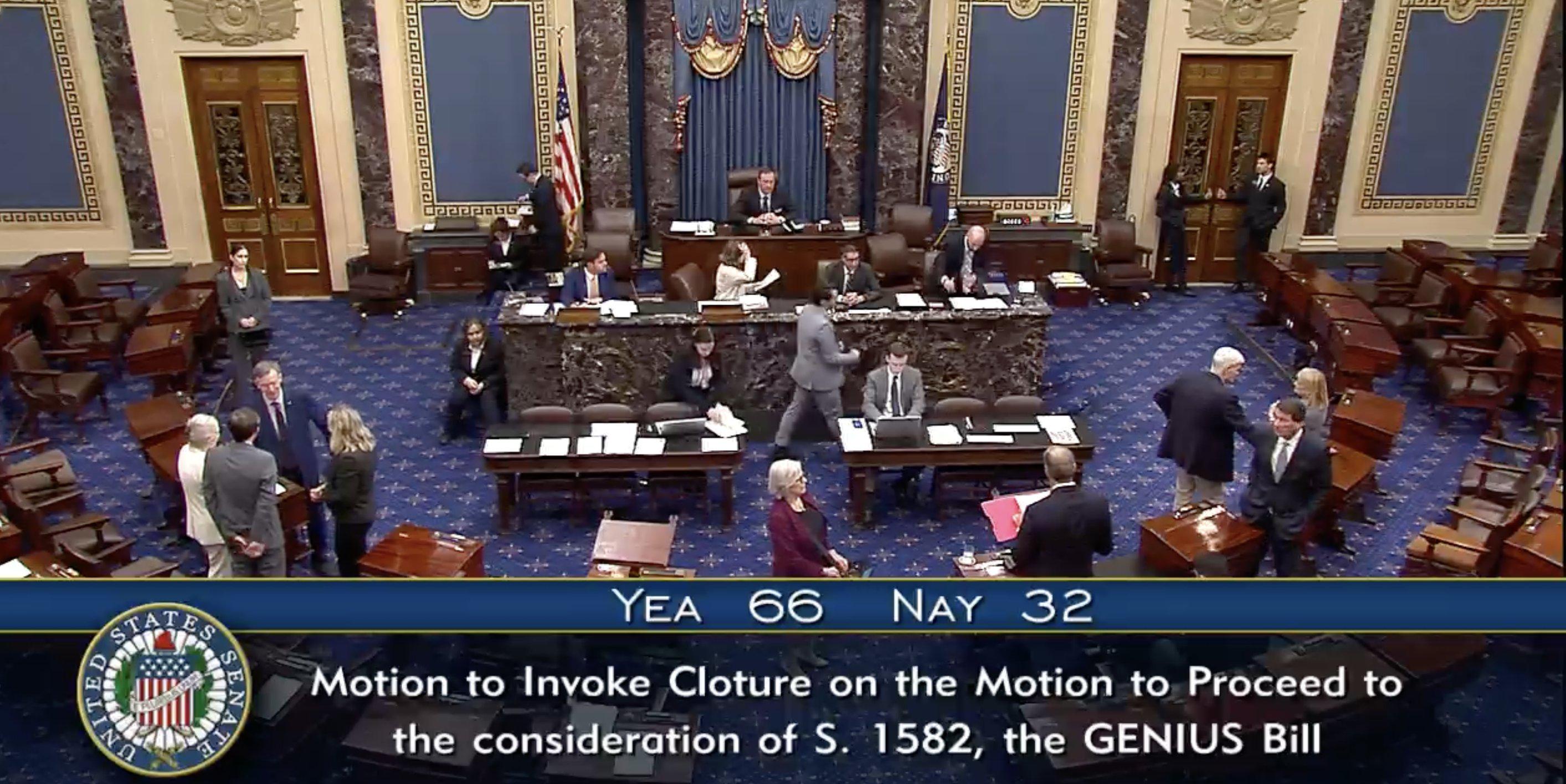
On the morning of May 20th, Beijing time, the U.S. Senate passed the cloture of the GENIUS Act stablecoin bill with 66 votes in favor and 32 votes against. Although the bill itself has not yet been passed and the GENIUS Act will next enter the Senate's full debate and amendment process, this result has cleared the stage obstacles for the final legislation.
Since Senator Bill Hagerty formally introduced the GENIUS Act on February 4, the bill has been revised several times, adding more anti-money laundering, consumer protection and custody clauses, while restricting technology giants from issuing stablecoins unless they implement robust financial risk control, strong consumer data privacy protection and other measures. The advancement of the bill also shows the key game between bipartisan legislators on the issue of stablecoins.
Earlier this year, US President Trump publicly stated that the regulatory framework for stablecoins and market institutions is expected to be introduced before the August congressional recess. If this important bill is eventually passed, it will become the first federal-level stablecoin legislation in the United States, and its far-reaching impact cannot be ignored.
With the Senate passing the bill, what are the hurdles for the GENIUS Act to become a formal law? What legislative procedures need to be completed? What clauses are the focus of debate among lawmakers? PANews sorted out its core links.
The bill version is constantly changing: adding more anti-money laundering and restrictions on technology giants
On May 8, the GENIUS Act unexpectedly failed in the Senate’s cloture vote with a vote of 48:49, failing to get 60 votes. But on the morning of May 20, the U.S. Senate voted again and passed the cloture motion for the GENIUS Act stablecoin bill with 66 votes in favor and 32 votes against.
A cloture vote is intended to end debate on an issue and prevent lawmakers from delaying or blocking a bill through filibuster.
Previously, the focus of the debate among lawmakers was on several aspects. The first was the possibility of technology giants like Meta issuing their own stablecoins. The second was President Trump’s business interests in the crypto industry. In addition, nine Democratic senators recently stated in a joint statement that the bill still has shortcomings in anti-money laundering, national security and accountability mechanisms.
As of May 19, by comparing the new and old versions of the publicly reported US Stablecoin Act GENIUS Act (the latest version has not yet been officially released), it can be found that the new version has added more provisions on anti-money laundering, consumer protection and custody. The new draft bill introduces an agency called the "Stablecoin Certification Review Committee", which is responsible for evaluating whether the regulatory systems of various states meet federal standards, replacing the relevant powers previously exercised by the Treasury Department, and setting conditions for foreign stablecoin issuers operating in the United States.
In addition, the bill will allow technology companies such as Meta to launch stablecoins and enter the stablecoin market only after implementing robust financial risk controls, strong consumer data privacy protections, and fair business practices.
In addition to these amendments, the core contents of the bill include:
1. The bill defines payment stablecoins as digital assets used for payment or settlement. Such assets are anchored to a fixed currency value and fully backed by U.S. dollars or other approved high-quality liquid assets as reserves at a 1:1 ratio .
2. Licenses and Regulation: The bill establishes a clear application process for issuing licenses and provides guidance for institutions seeking to issue stablecoins. A "dual regulatory framework" is introduced, allowing issuers to choose to register at the state or federal level . Issuers with a market value of more than $10 billion will be subject to federal regulation. Issuers with a market value of less than $10 billion may choose to continue operating under a state regulatory framework, provided that their state regulatory standards are substantially consistent with federal requirements.
3. Reserve requirements: Stablecoin issuers must maintain a 1:1 reserve ratio, with high-quality liquid assets such as cash, short-term U.S. Treasury bonds or central bank deposits as reserve assets . Reserve funds must be managed separately from operating funds and must be certified monthly.
4. Transparency: Issuers must publicly disclose their reserve assets and redemption policies.
5. Anti-Money Laundering (AML) Compliance: The bill classifies stablecoin issuers as financial institutions under the Bank Secrecy Act, and they are required to fulfill comprehensive anti-money laundering obligations, including consumer identification, due diligence, and suspicious activity reporting.
6. Consumer protection: If the issuer goes bankrupt, stablecoin holders will be paid before other creditors .
7. Regulatory jurisdiction definition: The bill clearly states that payment stablecoins are not considered securities, commodities, or investment companies under current federal law.
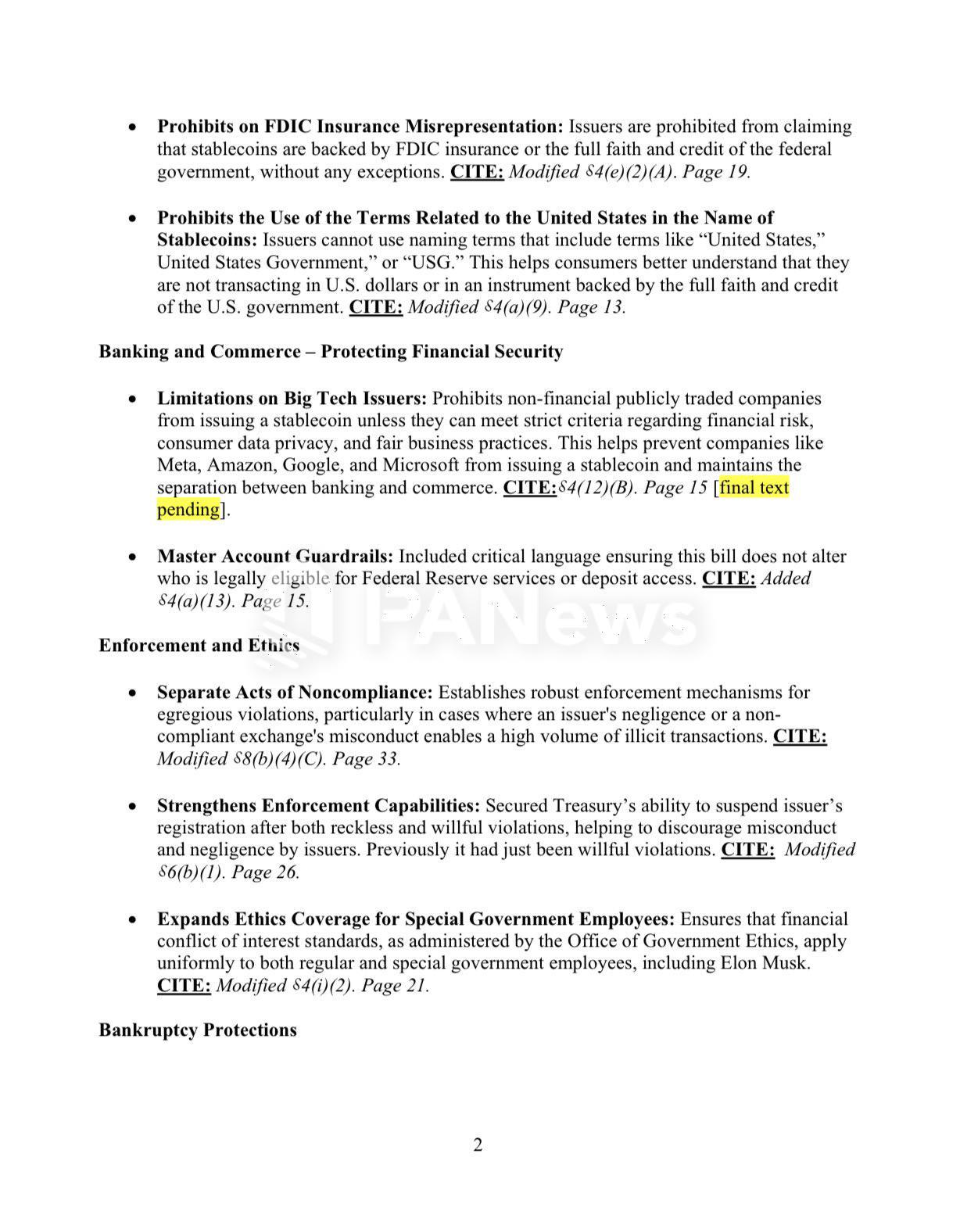
On May 15, according to the second page of the GENIUS Act draft disclosed by crypto journalist Eleanor Terrett, it is proposed to prohibit stablecoin issuers from misleadingly claiming to be FDIC insured or using terms related to the US government; prohibit non-financial technology companies such as Meta and Google from issuing stablecoins unless they comply with regulatory requirements, thereby strengthening the separation between banks and businesses; the draft also strengthens law enforcement capabilities against violations and expands the scope of ethical supervision of special government employees (including Elon Musk).
During the bill revision process, lawmakers from both parties also had a heated debate on the Trump family's stablecoin project.
Elizabeth Warren, the ranking member of the Senate Banking, Housing and Urban Affairs Committee, has publicly stated that President Trump and his associates have made hundreds of millions of dollars from his crypto business. Trump is also expected to earn hundreds of millions of dollars from his USD1 stablecoin every year. The latest draft of the GENIUS Act currently circulating online does not include any provisions to prevent Trump and his family from making a fortune through their allegedly corrupt cryptocurrency scheme. Instead, the bill will expand the stablecoin market, further boosting Trump's crypto gains.
Finally, during the process of advancement, according to a report on May 15, senators from both parties reached a consensus on this issue. Democratic Senator Kirsten Gillibrand said that the wording of the bill has been revised to delete clauses targeting Trump's cryptocurrency projects, such as Meme Coin . She emphasized that the revised bill has improvements in consumer protection and other aspects, and is not focused on Trump's moral issues, but is aimed at regulating the field of stablecoins .
The House of Representatives and the President need to give the green light
Some analysts pointed out that the GENIUS Act would take more time to pass in the Senate and would be easier to pass in the House of Representatives.
Generally speaking, when a bill is introduced, it will be assigned to a committee. Committee members will study, discuss and amend the bill. The GENIUS Act proposed by Senator Bill Hagerty was introduced on February 4 this year, and the committee assigned to it is the Banking, Housing and Urban Affairs Committee of the U.S. Senate.
The bill will then go to a vote in the chamber it belongs to. If the bill passes in one chamber of Congress, it will be sent to the other chamber for the same study, discussion, amendment, and voting process.
Once both chambers have voted to pass the bill, the two sides must reconcile the differences in the two versions. Then, both chambers will vote on the same version of the bill for the final time. If the bill passes, it will be sent to the President of the United States.
Once the president receives a bill, he or she will review it. The president can either approve the bill and sign it into law, or he or she can refuse to approve it, which is called a veto. If the president chooses to veto a bill, in most cases Congress can vote on the veto to overturn the president's decision and make the bill law. However, if the president does not sign a bill while Congress is not in session, the bill is automatically vetoed. This action is called a pocket veto, and Congress cannot override this type of veto.
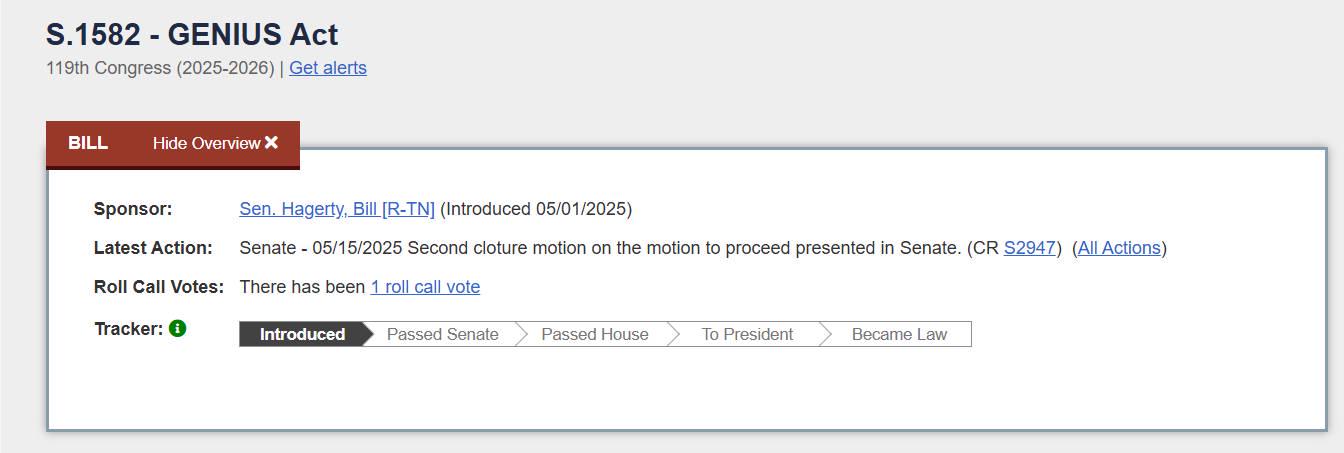
Judging from the current progress of the GENIUS Act, it will take time for the Senate to pass it, because filibusters are allowed to prevent the bill from entering the final vote. This time, the cloture motion requires a three-fifths supermajority (60 votes out of 100 votes). The current seats in the Senate are as follows: Republicans: 53 seats, Democrats: 45 seats, and independents: 2 seats (usually voting with the Democrats). In other words, in this vote, even if all Republican members vote in favor, they must get the support of Democratic members.
Now, after the Senate voted to pass the motion to end debate, the GENIUS Act will enter the Senate's full debate and amendment stage, and then will enter the House of Representatives.
However, legislation in the House of Representatives only needs a simple majority (218 out of 435 votes) to pass. Currently, the House of Representatives is controlled by the Republican majority (220-215), so the GENIUS Act will be relatively easy to pass in the House of Representatives.
If the GENIUS Act is successfully signed into law by the President, it will have a profound impact on the stablecoin market. For example, it will promote industry consolidation, and some small issuers may be forced to exit the market due to their inability to meet reserve requirements. Increased consumer trust is expected to promote the adoption of stablecoins. Strengthening reserve audits and anti-money laundering compliance measures is expected to increase market transparency and attract institutional investors. However, the issuance of stablecoins by non-financial technology companies may be restricted. The new provisions stipulate that non-financial companies must comply with regulatory rules when issuing stablecoins, which may bring more barriers to non-financial technology giants such as Meta and Google to get involved in stablecoins.
However, the question of whether the Trump family profited from USD1 through World Liberty Financial remains an unresolved issue. According to the latest public version, the bill does not explicitly restrict the president and his relatives from participating in crypto projects, and this loophole may become a focus of future debate .
On May 9, U.S. Treasury Secretary Scott Bessent said that the U.S. Senate’s failure to advance the GENIUS Act was a “missed generational opportunity to expand the dominance of the U.S. dollar and the influence of financial innovation.” He warned that in the absence of a unified federal regulatory framework, stablecoins will develop in the fragmentation of state regulations, which is not conducive to the United States maintaining its global leadership and may push digital asset innovation overseas.
At present, although the GENIUS Act stablecoin bill has not been officially signed into law, the success of the motion to end the debate has paved the way for legislation. If it can pass smoothly, the bill will not only become the first federal-level stablecoin regulatory framework in the United States, but may also reshape the entire stablecoin market.
You May Also Like

Unleash Potential: Flare Network’s FXRP Revolutionizes DeFi Access for XRP

Fed Lowers Rates By 25bps: How Bitcoin And Crypto Prices Responded And What’s Next