TLDR Chainlink price remains below the descending trendline, with $16–$17 acting as key resistance. The $12–$13 demand zone is holding, limiting downside risk inTLDR Chainlink price remains below the descending trendline, with $16–$17 acting as key resistance. The $12–$13 demand zone is holding, limiting downside risk in

Chainlink Price Under Pressure as Bears Defend Key Resistance Levels

TLDR

  • Chainlink price remains below the descending trendline, with $16–$17 acting as key resistance.
  • The $12–$13 demand zone is holding, limiting downside risk in the short term.
  • LINK-related ETFs show steady inflows, signaling consistent institutional demand.
  • Whale wallets have accumulated over 20M LINK, supporting a constructive long-term bias.

Chainlink price remains constrained below key technical resistance as short-term structure reflects ongoing seller control. While daily charts show continued weakness, growing ETF inflows and whale accumulation suggest improving longer-term fundamentals. The market is now weighing near-term downside risks against emerging demand signals that could influence a broader recovery toward the $18–$20 zone.

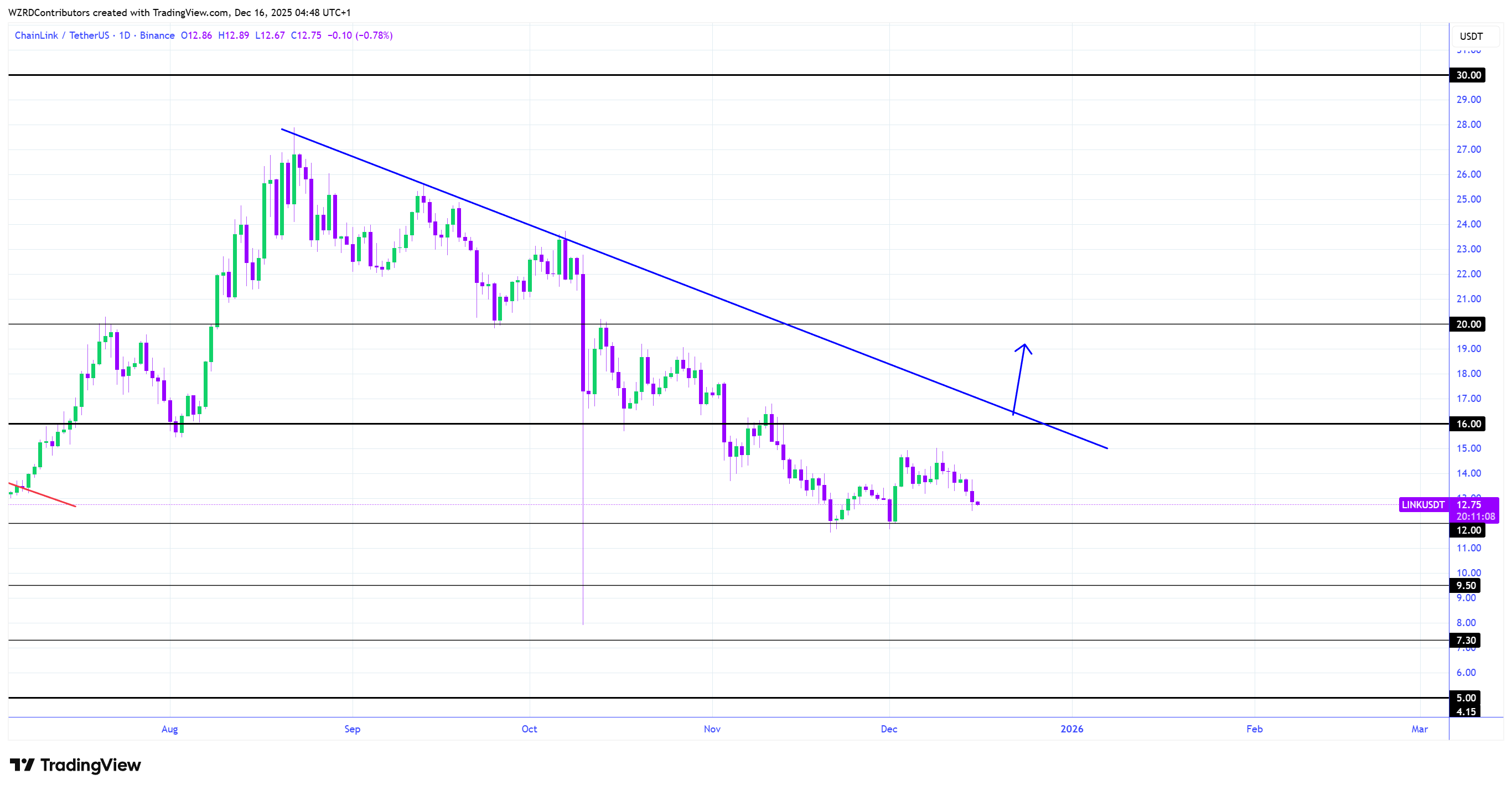
Analyst CRYPTOWZRD showed on the daily chart a bearish technical structure defined by a series of lower highs. A descending trendline from the September peak remains intact, capping upside attempts and reinforcing seller dominance near the $16–$17 resistance area. The latest daily close below this zone confirms that prior breakdown levels are still being defended, keeping price action compressed within a corrective range.
ImageSOURCE: X

Despite this pressure, LINK is holding above the $12–$13 demand zone, which has provided short-term stability throughout December. This zone represents a critical inflection point, as a breakdown would expose the market to a deeper retracement toward $10. For now, consolidation near support suggests selling momentum is easing. Analysts noted that a broader market catalyst, particularly from Bitcoin, may be required to trigger a decisive directional move.

ETF Inflows Signal Persistent Institutional Demand

On the other hand, data shared by Altcoin Buzz points to a constructive backdrop driven by sustained ETF inflows. Since LINK-related ETF activity began, there have been no recorded days of net outflows. As of December 15, cumulative inflows stood near $54.69 million, following a $2.02 million daily addition. This uninterrupted sequence highlights steady institutional participation.

SOURCE: X

Early December inflows were especially notable, including a single-day addition of $37.05 million on December 2. Subsequent contributions reinforced accumulation, even as some sessions recorded flat flows instead of withdrawals. Market investors view this pattern as indicative of stability, with regulated investment vehicles absorbing supply. Such behavior typically reflects longer-term positioning rather than short-term trading activity.

Whale Accumulation Supports Long-Term Outlook

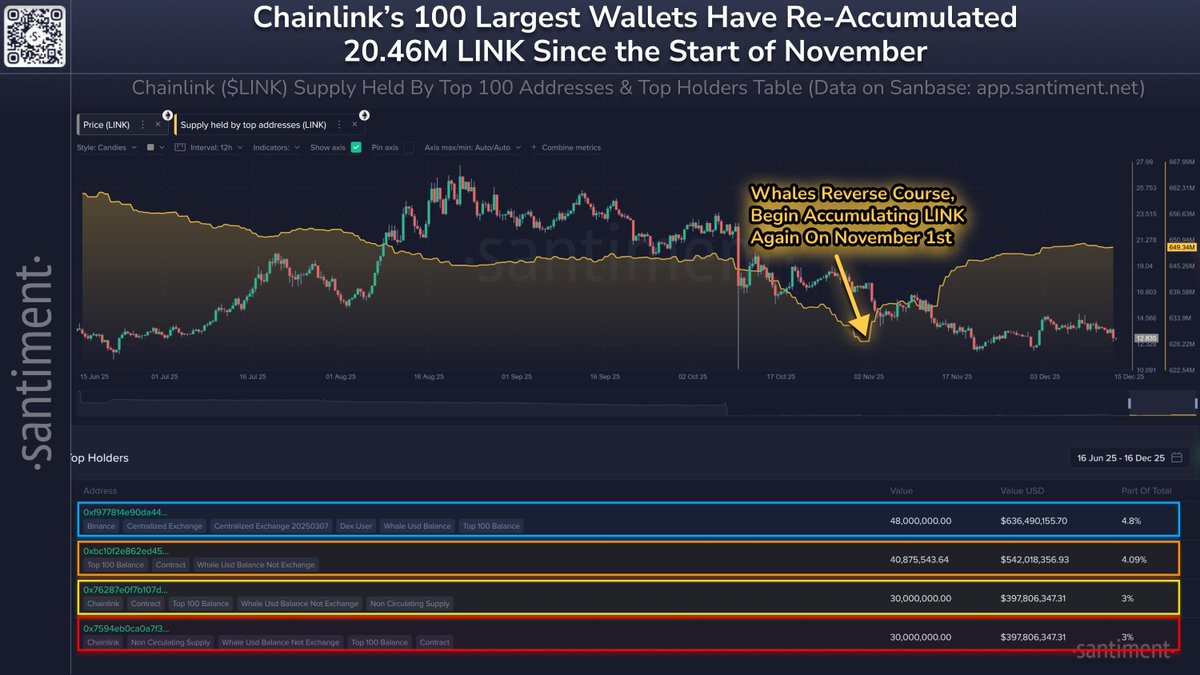
Additionally, on-chain data from Santiment reveals a shift in behavior among Chainlink’s largest holders. Since early November, the top 100 wallets have accumulated approximately 20.46 million LINK, valued at $263 million at the time of measurement. This marks a clear reversal from earlier distribution, with whale balances rising even as price trended lower.
ImageSOURCE: X

The divergence between declining price action and increasing whale holdings suggests strategic accumulation during weakness. Much of this supply is held in non-exchange wallets, including contracts and non-circulating addresses, reducing immediate sell-side pressure. Historically, such patterns have preceded medium-term trend improvements, particularly when paired with improving demand metrics.

Market Outlook Remains Data-Dependent

Taken together, technical structure and on-chain indicators present a mixed but evolving picture. Short-term charts continue to favor caution while price remains below the descending trendline and $16 resistance.

However, ETF inflows and whale accumulation provide a supportive backdrop that could influence future price discovery if momentum shifts.

As markets await confirmation from broader crypto conditions, the $12–$13 support zone remains pivotal. A sustained break above trend resistance would signal improving momentum, while failure to hold support could extend consolidation. For now, Chainlink sits at a technical crossroads, with institutional demand shaping the longer-term narrative.

The post Chainlink Price Under Pressure as Bears Defend Key Resistance Levels appeared first on CoinCentral.

Market Opportunity
Chainlink Logo
Chainlink Price(LINK)
$12.68
$12.68$12.68
-2.76%
USD
Chainlink (LINK) Live Price Chart
Disclaimer: The articles reposted on this site are sourced from public platforms and are provided for informational purposes only. They do not necessarily reflect the views of MEXC. All rights remain with the original authors. If you believe any content infringes on third-party rights, please contact [email protected] for removal. MEXC makes no guarantees regarding the accuracy, completeness, or timeliness of the content and is not responsible for any actions taken based on the information provided. The content does not constitute financial, legal, or other professional advice, nor should it be considered a recommendation or endorsement by MEXC.

You May Also Like

Kalshi Jumps to 62% Market Share While Polymarket Eyes $10B Valuation

Kalshi Jumps to 62% Market Share While Polymarket Eyes $10B Valuation

The post Kalshi Jumps to 62% Market Share While Polymarket Eyes $10B Valuation appeared on BitcoinEthereumNews.com. Fintech 19 September 2025 | 16:03 Event-based trading platforms are no longer niche experiments – they’re emerging as a major arena where finance, crypto, and information converge. After months of subdued activity, volumes are climbing again, and U.S.-regulated Kalshi has unexpectedly taken the lead. Betting on Everything From Rates to Sports Analysts at Bernstein describe prediction markets as a new “interface for information,” where users speculate not only on sports results but also on Federal Reserve decisions, quarterly earnings, and even crypto price moves. This year alone, more than $200 million changed hands on Polymarket contracts linked to the Fed’s recent 25 bps rate cut, while $85 million traded on Kalshi around the same decision. Mainstream brokers like Coinbase and Robinhood are watching closely, with ambitions to capture some of the momentum. With U.S. sports betting already worth tens of billions annually, the overlap is too big to ignore. Against that backdrop, Kalshi has delivered one of its strongest months since the 2024 elections. The platform reports $1.3 billion in trading volume so far in September, accounting for 62% of global prediction market activity. Just a year ago, Kalshi’s share stood at 3%. CEO Tarek Mansour called the growth “remarkable,” noting that the exchange still serves only U.S. clients. Polymarket’s Pushback Its main rival, Polymarket, has logged about $773 million in trades this month. While that trails Kalshi for now, Polymarket has unique advantages: as a crypto-native platform, it has carved out strong global demand and is working toward a formal U.S. relaunch via its acquisition of derivatives exchange QCEX. The two platforms now stand as the clear leaders of the sector, though they embody different philosophies — one regulated from the ground up, the other built around decentralization. Investors Take Notice The boom hasn’t escaped venture capital. Reports suggest…
Share
BitcoinEthereumNews2025/09/19 21:34
Visa Expands USDC Stablecoin Settlement For US Banks

Visa Expands USDC Stablecoin Settlement For US Banks

The post Visa Expands USDC Stablecoin Settlement For US Banks appeared on BitcoinEthereumNews.com. Visa Expands USDC Stablecoin Settlement For US Banks
Share
BitcoinEthereumNews2025/12/17 15:23
Bitcoin Lightning Network Capacity Surges to Historic Peak as Exchange Adoption Accelerates

Bitcoin Lightning Network Capacity Surges to Historic Peak as Exchange Adoption Accelerates

The Bitcoin Lightning Network has reached an all-time high in total network capacity, marking a significant milestone for the layer-2 scaling solution designed to enable fast and inexpensive Bitcoin transactions. The surge comes as major cryptocurrency exchanges increasingly integrate Lightning functionality, bringing the technology to millions of users who previously relied solely on slower, more expensive on-chain transactions. This capacity expansion reflects growing confidence in Lightning's reliability and utility after years of development and real-world testing. What began as an experimental protocol discussed primarily among technical enthusiasts has matured into infrastructure that some of the industry's largest platforms now consider essential to their operations.
Share
MEXC NEWS2025/12/17 17:14