Theoretical physicists said we could teleport data. I wanted to see if we could hold it long enough to actually use it. A qubit’s memory (coherence time) lasts Theoretical physicists said we could teleport data. I wanted to see if we could hold it long enough to actually use it. A qubit’s memory (coherence time) lasts

Quantum Oracles Have a Fatal Timing Problem — So I Built a “Parking Brake” for Qubits

2025/12/17 13:03
4 min read

Theoretical physicists said we could teleport data. I wanted to see if we could hold it long enough to actually use it.

Everyone in the blockchain space wants a “Quantum Oracle.” The dream is simple: a system that allows a smart contract on Ethereum to request a calculation from a Quantum Computer, get the result, and verify it cryptographically.

But there is a fatal flaw in this dream that most whitepapers ignore: The Speed Mismatch.

Blockchains are slow. A transaction takes seconds or minutes to finalize. Quantum computers are fast. A qubit’s memory (coherence time) lasts only about 100 microseconds before it decays into random noise.

This creates a “disconnect.” If a smart contract asks for data, the quantum state will dissolve and die long before the blockchain is ready to receive it. It is like trying to pour a gallon of water into a thimble — it just spills everywhere.

I realized that if we ever want a functional Quantum Notary, we don’t need better qubits. We need a Parking Brake.

The Engineering Challenge: Building an Async Adapter

I didn’t invent quantum teleportation, and I didn’t invent the blockchain. My goal was to build the Middleware that allows them to talk to each other.

I call this the “Async Adapter.”

The goal was to create a script that could:

  1. Generate a specific quantum state (the “contract”).
  2. Teleport it off the main processor to a “storage” qubit (the “Grid”).
  3. Hold it there — keeping it alive past its natural expiration date.
  4. Retrieve it only when verified.

To prove this was possible, I turned to the IBM Quantum Cloud and their latest Heron processor (ibm_fez).

The Solution: Active Preservation (The Hahn Echo)

In my initial tests, simply moving the data to storage wasn’t enough. The magnetic noise of the environment killed the qubit in about 90 to 100 microseconds. That is the hardware limit.

To break this limit, I implemented a technique from the 1950s called the Hahn Echo, but I applied it inside a modern Dynamic Circuit.

Think of a qubit like a spinning top. If you leave it on a table, friction slows it down and it falls over. But if you reach in halfway through the spin and “slap” it in the reverse direction, you can effectively cancel out the friction.

\ \ I wrote a script that:

  1. Teleports the data to Qubit 2 (The Grid).
  2. Waits for a specific delay (e.g., 75 microseconds).
  3. Applies an X gate (the "slap") to flip the qubit.
  4. Waits another 75 microseconds.
  5. Flips it back.

By doing this, I forced the environmental noise to cancel itself out. I wasn’t just storing data; I was putting it on “Life Support.”

The Results: Beating the Hardware Limit

I ran a stress test on the ibm_fez backend to see if this architecture could actually extend the life of the data.

The results were definitive.

  • At 0 microseconds (Baseline): The system had 91.0% fidelity. This is our “perfect” score.
  • At 50 microseconds: We retained 77.9% fidelity.
  • At 150 microseconds: We retained 61.9% fidelity.

This is the breakthrough. The natural “death” of a qubit on this chip usually happens around 100 microseconds. By using my active Echo protocol, I successfully retrieved a recognizable signal at 150 microseconds.

I extended the validity window of the data by roughly 50% beyond the hardware’s natural limit.

Why This Matters for Web3

To a human, 150 microseconds is nothing. But to a computer engineer, that extra time is the difference between a “glitch” and a “feature.”

That extra 50% is the buffer zone. It proves that we can engineer a system where a quantum state is held in Escrow — parked safely on a Grid qubit, actively stabilized by software, waiting for the verification logic to complete.

I have effectively built a prototype for Quantum RAM.

This validates the core thesis of my Quantum Notary concept: We don’t need to wait for “perfect” quantum computers to build Web3 Oracles. We just need better driver software that manages the chaos of the noise.

Open Source and Future Work

I am not hoarding this code. I believe this “Time Bridge” architecture is public infrastructure. The code verifies that we can utilize mid-circuit measurements and dynamic resets to create a “Swap Space” for quantum information.

You can find the full repository on my GitHub. I encourage other developers to take this “Memory Buffer” and integrate it into their own Oracle designs.

We have the ink (Qubits). Now we finally have the pen.

Want to see the proof? Here is the GitHub with the Notebook in it:

https://github.com/damianwgriggs/Quantum-Notary-/blob/main/Quantum_Notary_Experiment.ipynb

\

Market Opportunity
QUANTUM Logo
QUANTUM Price(QUANTUM)
$0.003479
$0.003479$0.003479
+3.88%
USD
QUANTUM (QUANTUM) Live Price Chart
Disclaimer: The articles reposted on this site are sourced from public platforms and are provided for informational purposes only. They do not necessarily reflect the views of MEXC. All rights remain with the original authors. If you believe any content infringes on third-party rights, please contact [email protected] for removal. MEXC makes no guarantees regarding the accuracy, completeness, or timeliness of the content and is not responsible for any actions taken based on the information provided. The content does not constitute financial, legal, or other professional advice, nor should it be considered a recommendation or endorsement by MEXC.

You May Also Like

XRP Buyers Defend Most Major 200-Week Price Average: Can It Be Bottom of 2026?

XRP Buyers Defend Most Major 200-Week Price Average: Can It Be Bottom of 2026?

The post XRP Buyers Defend Most Major 200-Week Price Average: Can It Be Bottom of 2026? appeared on BitcoinEthereumNews.com. XRP has returned to its 200-week moving
Share
BitcoinEthereumNews2026/02/08 19:49
Expert Tags Ethereum’s ERC-8004 Mainnet Launch An “iPhone Moment”, Here’s What It Means
Expert Tags Ethereum’s ERC-8004 Mainnet Launch An “iPhone Moment”, Here’s What It Means

Market analyst says Ethereum is having an “iPhone moment” as it approaches the ERC-8004 mainnet launch.
Share
Coinstats2026/02/08 19:56
Breaking: CME Group Unveils Solana and XRP Options

Breaking: CME Group Unveils Solana and XRP Options

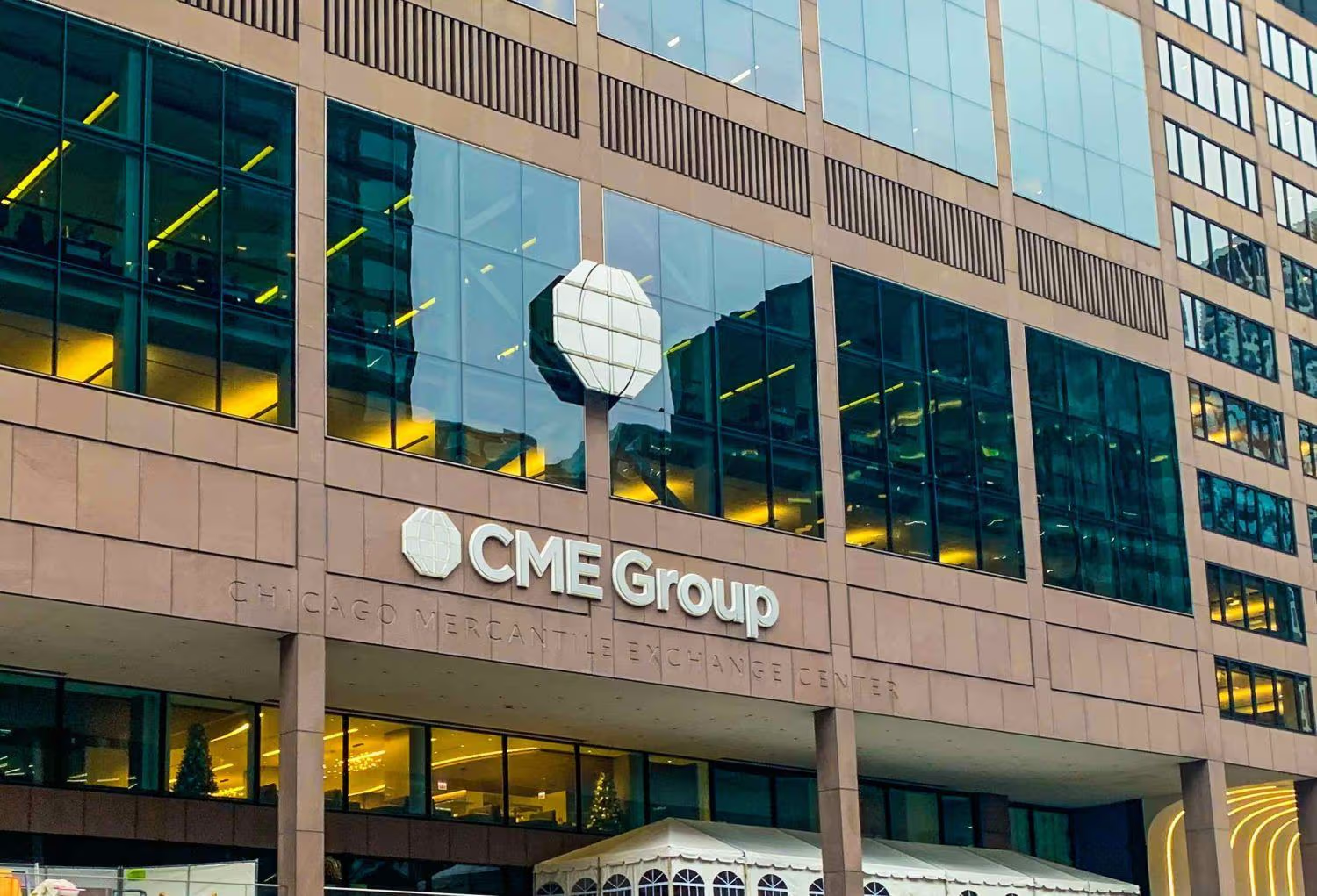
CME Group launches Solana and XRP options, expanding crypto offerings. SEC delays Solana and XRP ETF approvals, market awaits clarity. Strong institutional demand drives CME’s launch of crypto options contracts. In a bold move to broaden its cryptocurrency offerings, CME Group has officially launched options on Solana (SOL) and XRP futures. Available since October 13, 2025, these options will allow traders to hedge and manage exposure to two of the most widely traded digital assets in the market. The new contracts come in both full-size and micro-size formats, with expiration options available daily, monthly, and quarterly, providing flexibility for a diverse range of market participants. This expansion aligns with the rising demand for innovative products in the crypto space. Giovanni Vicioso, CME Group’s Global Head of Cryptocurrency Products, noted that the new options offer increased flexibility for traders, from institutions to active individual investors. The growing liquidity in Solana and XRP futures has made the introduction of these options a timely move to meet the needs of an expanding market. Also Read: Vitalik Buterin Reveals Ethereum’s Bold Plan to Stay Quantum-Secure and Simple! Rapid Growth in Solana and XRP Futures Trading CME Group’s decision to roll out options on Solana and XRP futures follows the substantial growth in these futures products. Since the launch of Solana futures in March 2025, more than 540,000 contracts, totaling $22.3 billion in notional value, have been traded. In August 2025, Solana futures set new records, with an average daily volume (ADV) of 9,000 contracts valued at $437.4 million. The average daily open interest (ADOI) hit 12,500 contracts, worth $895 million. Similarly, XRP futures, which launched in May 2025, have seen significant adoption, with over 370,000 contracts traded, totaling $16.2 billion. XRP futures also set records in August 2025, with an ADV of 6,600 contracts valued at $385 million and a record ADOI of 9,300 contracts, worth $942 million. Institutional Demand for Advanced Hedging Tools CME Group’s expansion into options is a direct response to growing institutional interest in sophisticated cryptocurrency products. Roman Makarov from Cumberland Options Trading at DRW highlighted the market demand for more varied crypto products, enabling more advanced risk management strategies. Joshua Lim from FalconX also noted that the new options products meet the increasing need for institutional hedging tools for assets like Solana and XRP, further cementing their role in the digital asset space. The launch of options on Solana and XRP futures marks another step toward the maturation of the cryptocurrency market, providing a broader range of tools for managing digital asset exposure. SEC’s Delay on Solana and XRP ETF Approvals While CME Group expands its offerings, the broader market is also watching the progress of Solana and XRP exchange-traded funds (ETFs). The U.S. Securities and Exchange Commission (SEC) has delayed its decisions on multiple crypto-related ETF filings, including those for Solana and XRP. Despite the delay, analysts anticipate approval may be on the horizon. This week, REX Shares and Osprey Funds are expected to launch an XRP ETF that will hold XRP directly and allocate at least 40% of its assets to other XRP-related ETFs. Despite the delays, some analysts believe that approval could come soon, fueling further interest in these assets. The delay by the SEC has left many crypto investors awaiting clarity, but approval of these ETFs could fuel further momentum in the Solana and XRP futures markets. Also Read: Tether CEO Breaks Silence on $117,000 Bitcoin Price – Market Reacts! The post Breaking: CME Group Unveils Solana and XRP Options appeared first on 36Crypto.
Share
Coinstats2025/09/18 02:35