Institutional money has changed how crypto trades. Bitcoin and Ethereum now respond to economic news in ways that mirror traditional assets. Reports on the CPI, inflation, and interest rates move prices. This shift means macroeconomic indicators are no longer optional for crypto traders. They are part of the core playbook. This article explains how official data on inflation, central bank rates, and crypto-specific indicators like Bitcoin dominance can help anticipate market trends. The analysis draws on macro releases, crypto charts, and research from large trading desks. The goal is not to predict exact moves but to offer a practical guide to understanding how broader economic trends shape crypto performance. Inflation and Bitcoin: CPI’s Growing Grip on Crypto Inflation started rising sharply in early 2022. The Consumer Price Index , reported by the Bureau of Labor Statistics, reached nine percent year-over-year in June. Bitcoin fell six percent within three days of that release. Investors moved out of risk assets, expecting tighter financial conditions. This pattern continued through 2023 and 2024. When CPI came in lower than forecasts, Bitcoin often rebounded. For example, in November 2022, the month-over-month print was 0.1 percent against a forecast of 0.3 percent. Bitcoin gained nearly four percent within two days. CPI for all items rises 0.1% in May; shelter up #BLSData https://t.co/dJyJeKmvth — BLS-Labor Statistics (@BLS_gov) June 11, 2025 This repeated reaction suggests Bitcoin now trades more like tech stocks. It does not act like a hedge against inflation in the short term. Instead, it follows interest rate expectations. If inflation readings push the Federal Reserve toward cuts, traders often rotate into crypto. If inflation jumps, traders exit fast. CPI for May 2025 showed price growth slowing toward the Federal Reserve’s target. If that trend continues, investors may add risk again. However, if energy costs or wages lift inflation above forecasts, expectations may shift back toward tightening. Traders will likely adjust positions in Bitcoin and Ethereum based on these releases. CPI releases now act as drivers of short-term price direction. Fed Rates and Ethereum: Liquidity Cycles in Action The Federal Reserve began raising interest rates in March 2022. That cycle lasted until mid-2023, with the target range reaching 5.25 to 5.5 percent. Each increase indicated tighter liquidity. Ethereum often fell in the days following these announcements, mirroring declines in growth-focused equities. Ethereum Price 2022 (Source: CoinMarketCap) Ethereum’s sensitivity to rate decisions became clear in several key moments. After the June 2022 hike of 75 basis points, ETH dropped by over eight percent within 48 hours. The same pattern repeated in September. By contrast, when the Fed paused in July 2023, ETH rebounded by nearly five percent over the next three trading sessions. However, one exception came in March 2023. The collapse of Silicon Valley Bank triggered panic in financial markets. The Fed raised rates by 25 basis points but indicated it might stop soon. That shift helped ETH recover as it climbed from under $1,400 to over $1,800 within three weeks. These events show Ethereum’s link to monetary policy. Rate hikes tighten conditions and push ETH down. Pauses or signs of easing often lead to sharp rebounds. Ethereum trades like a proxy for risk appetite in a liquidity-driven market. Bitcoin Dominance: Crypto’s Own Macro Gauge Bitcoin dominance tracks the percentage of total crypto market value held in Bitcoin. When dominance rises, it often reflects a retreat to safety. During periods of macro tightening, investors reduce exposure to smaller tokens and move capital into Bitcoin. This behavior mirrors broader risk-off patterns. U.S. Interest Rate 2015-2025 (Federal Reserve Bank) From late 2021 through 2022, Bitcoin dominance climbed from under 40 percent to nearly 48 percent. That move came during sharp inflation spikes, and a series of Fed rate increases as the market pulled back from speculative assets. Dominance rose again in mid-2023, just before the Fed indicated a pause, and fell shortly after. This pattern supports a familiar cycle. In early risk-on phases, Bitcoin leads. Once it stabilizes, capital rotates into Ethereum, then into altcoins with lower market value. Drops in dominance often mark the beginning of these rotations. The index can act as a sign of changing sentiment within the market. Bitcoin dominance reflects how crypto investors respond to broader economic shifts. It can function like a barometer—trending upward when uncertainty grows and falling when conditions favor higher risk exposure. Institutional Macro Forecasts and the Next 90 Days Institutional research over the past year has increasingly tied macro indicators to digital asset performance. In an October 2024 report, Crypto.com Research stated: “Economic growth may generally indicate a more favourable environment for cryptocurrencies, but the impact will vary depending on other market conditions.” They noted that “increasing correlation between traditional markets and cryptocurrencies means that stock market performance may potentially provide valuable insights into potential crypto trends.” Looking ahead, the next 90 days include several macro events that could affect crypto direction. The July CPI data is due on August 12, with consensus forecasting a YoY increase of 2.8 percent. The next FOMC meeting is on September 17, where markets currently price a 25 basis point cut. The August nonfarm payroll report (due September 6) and Q2 GDP revision (August 29) also stand out as volatility triggers. These dates offer key decision points. A lower CPI print could reinforce Fed easing expectations and push capital into risk assets. On the other hand, a stronger-than-expected payroll may reduce those expectations. ETF-related flows and crypto-native reactions will likely hinge on these cues, reinforcing the case that macro indicators now drive the broader crypto narrative. Conclusion: A Macro-Informed Strategy Macroeconomic indicators now play a measurable role in shaping the crypto market direction. Inflation data, central bank policy , and internal metrics like Bitcoin dominance have shown clear relationships with past price shifts in both Bitcoin and Ethereum. These signs, when aligned, can offer a grounded framework for interpreting future moves. While no model captures every turn, tracking CPI releases, FOMC decisions, and market reactions allows for more informed positioning. Macro data will not replace crypto-native analysis, but it adds a broader context that is becoming harder to ignore. Keeping an economic calendar in view may prove as useful as any technical chart.Institutional money has changed how crypto trades. Bitcoin and Ethereum now respond to economic news in ways that mirror traditional assets. Reports on the CPI, inflation, and interest rates move prices. This shift means macroeconomic indicators are no longer optional for crypto traders. They are part of the core playbook. This article explains how official data on inflation, central bank rates, and crypto-specific indicators like Bitcoin dominance can help anticipate market trends. The analysis draws on macro releases, crypto charts, and research from large trading desks. The goal is not to predict exact moves but to offer a practical guide to understanding how broader economic trends shape crypto performance. Inflation and Bitcoin: CPI’s Growing Grip on Crypto Inflation started rising sharply in early 2022. The Consumer Price Index , reported by the Bureau of Labor Statistics, reached nine percent year-over-year in June. Bitcoin fell six percent within three days of that release. Investors moved out of risk assets, expecting tighter financial conditions. This pattern continued through 2023 and 2024. When CPI came in lower than forecasts, Bitcoin often rebounded. For example, in November 2022, the month-over-month print was 0.1 percent against a forecast of 0.3 percent. Bitcoin gained nearly four percent within two days. CPI for all items rises 0.1% in May; shelter up #BLSData https://t.co/dJyJeKmvth — BLS-Labor Statistics (@BLS_gov) June 11, 2025 This repeated reaction suggests Bitcoin now trades more like tech stocks. It does not act like a hedge against inflation in the short term. Instead, it follows interest rate expectations. If inflation readings push the Federal Reserve toward cuts, traders often rotate into crypto. If inflation jumps, traders exit fast. CPI for May 2025 showed price growth slowing toward the Federal Reserve’s target. If that trend continues, investors may add risk again. However, if energy costs or wages lift inflation above forecasts, expectations may shift back toward tightening. Traders will likely adjust positions in Bitcoin and Ethereum based on these releases. CPI releases now act as drivers of short-term price direction. Fed Rates and Ethereum: Liquidity Cycles in Action The Federal Reserve began raising interest rates in March 2022. That cycle lasted until mid-2023, with the target range reaching 5.25 to 5.5 percent. Each increase indicated tighter liquidity. Ethereum often fell in the days following these announcements, mirroring declines in growth-focused equities. Ethereum Price 2022 (Source: CoinMarketCap) Ethereum’s sensitivity to rate decisions became clear in several key moments. After the June 2022 hike of 75 basis points, ETH dropped by over eight percent within 48 hours. The same pattern repeated in September. By contrast, when the Fed paused in July 2023, ETH rebounded by nearly five percent over the next three trading sessions. However, one exception came in March 2023. The collapse of Silicon Valley Bank triggered panic in financial markets. The Fed raised rates by 25 basis points but indicated it might stop soon. That shift helped ETH recover as it climbed from under $1,400 to over $1,800 within three weeks. These events show Ethereum’s link to monetary policy. Rate hikes tighten conditions and push ETH down. Pauses or signs of easing often lead to sharp rebounds. Ethereum trades like a proxy for risk appetite in a liquidity-driven market. Bitcoin Dominance: Crypto’s Own Macro Gauge Bitcoin dominance tracks the percentage of total crypto market value held in Bitcoin. When dominance rises, it often reflects a retreat to safety. During periods of macro tightening, investors reduce exposure to smaller tokens and move capital into Bitcoin. This behavior mirrors broader risk-off patterns. U.S. Interest Rate 2015-2025 (Federal Reserve Bank) From late 2021 through 2022, Bitcoin dominance climbed from under 40 percent to nearly 48 percent. That move came during sharp inflation spikes, and a series of Fed rate increases as the market pulled back from speculative assets. Dominance rose again in mid-2023, just before the Fed indicated a pause, and fell shortly after. This pattern supports a familiar cycle. In early risk-on phases, Bitcoin leads. Once it stabilizes, capital rotates into Ethereum, then into altcoins with lower market value. Drops in dominance often mark the beginning of these rotations. The index can act as a sign of changing sentiment within the market. Bitcoin dominance reflects how crypto investors respond to broader economic shifts. It can function like a barometer—trending upward when uncertainty grows and falling when conditions favor higher risk exposure. Institutional Macro Forecasts and the Next 90 Days Institutional research over the past year has increasingly tied macro indicators to digital asset performance. In an October 2024 report, Crypto.com Research stated: “Economic growth may generally indicate a more favourable environment for cryptocurrencies, but the impact will vary depending on other market conditions.” They noted that “increasing correlation between traditional markets and cryptocurrencies means that stock market performance may potentially provide valuable insights into potential crypto trends.” Looking ahead, the next 90 days include several macro events that could affect crypto direction. The July CPI data is due on August 12, with consensus forecasting a YoY increase of 2.8 percent. The next FOMC meeting is on September 17, where markets currently price a 25 basis point cut. The August nonfarm payroll report (due September 6) and Q2 GDP revision (August 29) also stand out as volatility triggers. These dates offer key decision points. A lower CPI print could reinforce Fed easing expectations and push capital into risk assets. On the other hand, a stronger-than-expected payroll may reduce those expectations. ETF-related flows and crypto-native reactions will likely hinge on these cues, reinforcing the case that macro indicators now drive the broader crypto narrative. Conclusion: A Macro-Informed Strategy Macroeconomic indicators now play a measurable role in shaping the crypto market direction. Inflation data, central bank policy , and internal metrics like Bitcoin dominance have shown clear relationships with past price shifts in both Bitcoin and Ethereum. These signs, when aligned, can offer a grounded framework for interpreting future moves. While no model captures every turn, tracking CPI releases, FOMC decisions, and market reactions allows for more informed positioning. Macro data will not replace crypto-native analysis, but it adds a broader context that is becoming harder to ignore. Keeping an economic calendar in view may prove as useful as any technical chart.

Macro Meets Crypto: Predicting Prices with CPI, Fed Rates & BTC Dominance

6 min read

Institutional money has changed how crypto trades. Bitcoin and Ethereum now respond to economic news in ways that mirror traditional assets. Reports on the CPI, inflation, and interest rates move prices. This shift means macroeconomic indicators are no longer optional for crypto traders. They are part of the core playbook.

This article explains how official data on inflation, central bank rates, and crypto-specific indicators like Bitcoin dominance can help anticipate market trends. The analysis draws on macro releases, crypto charts, and research from large trading desks.

The goal is not to predict exact moves but to offer a practical guide to understanding how broader economic trends shape crypto performance.

Inflation and Bitcoin: CPI’s Growing Grip on Crypto

Inflation started rising sharply in early 2022. The Consumer Price Index, reported by the Bureau of Labor Statistics, reached nine percent year-over-year in June. Bitcoin fell six percent within three days of that release. Investors moved out of risk assets, expecting tighter financial conditions.

This pattern continued through 2023 and 2024. When CPI came in lower than forecasts, Bitcoin often rebounded. For example, in November 2022, the month-over-month print was 0.1 percent against a forecast of 0.3 percent. Bitcoin gained nearly four percent within two days.

This repeated reaction suggests Bitcoin now trades more like tech stocks. It does not act like a hedge against inflation in the short term. Instead, it follows interest rate expectations. If inflation readings push the Federal Reserve toward cuts, traders often rotate into crypto. If inflation jumps, traders exit fast.

CPI for May 2025 showed price growth slowing toward the Federal Reserve’s target. If that trend continues, investors may add risk again. However, if energy costs or wages lift inflation above forecasts, expectations may shift back toward tightening.

Traders will likely adjust positions in Bitcoin and Ethereum based on these releases. CPI releases now act as drivers of short-term price direction.

Fed Rates and Ethereum: Liquidity Cycles in Action

The Federal Reserve began raising interest rates in March 2022. That cycle lasted until mid-2023, with the target range reaching 5.25 to 5.5 percent. Each increase indicated tighter liquidity. Ethereum often fell in the days following these announcements, mirroring declines in growth-focused equities.
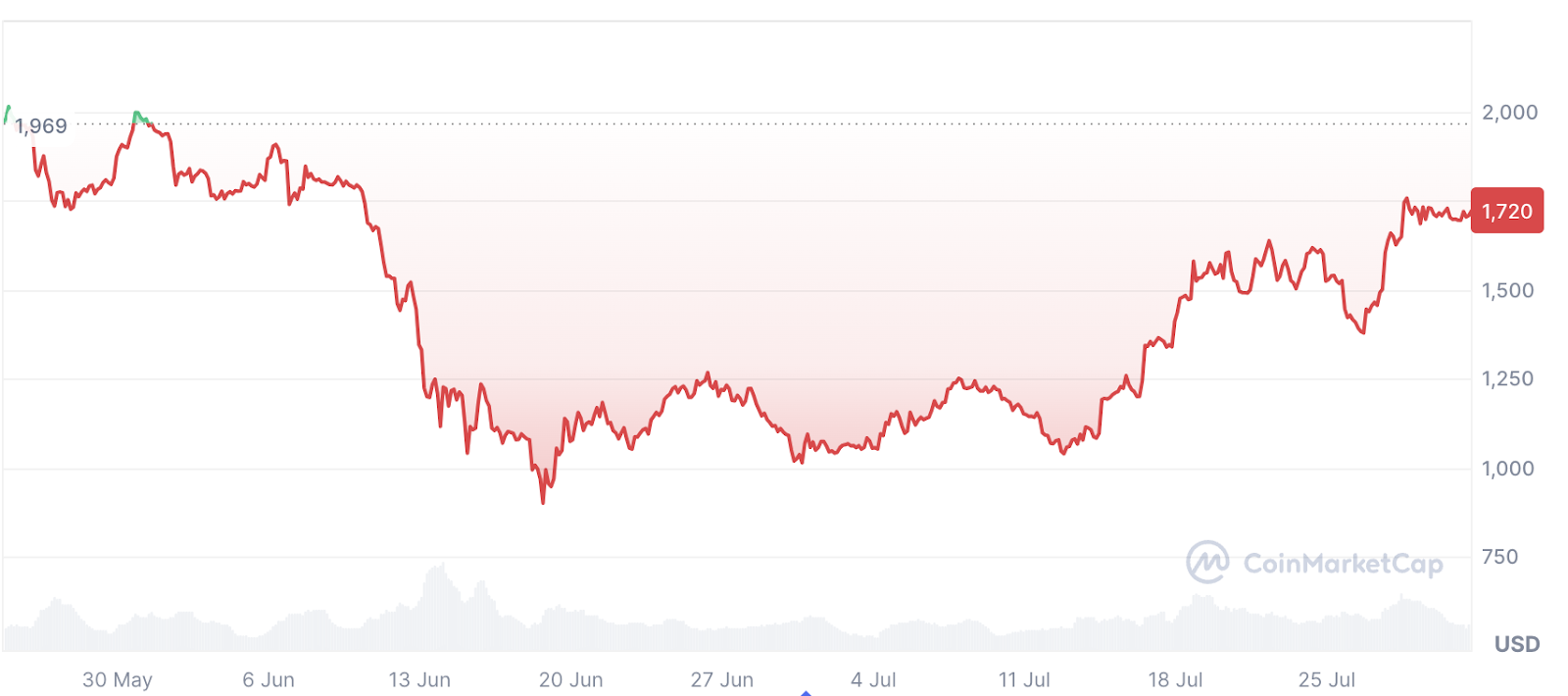
Ethereum Price 2022 (Source: CoinMarketCap)

Ethereum’s sensitivity to rate decisions became clear in several key moments. After the June 2022 hike of 75 basis points, ETH dropped by over eight percent within 48 hours. The same pattern repeated in September. By contrast, when the Fed paused in July 2023, ETH rebounded by nearly five percent over the next three trading sessions.

However, one exception came in March 2023. The collapse of Silicon Valley Bank triggered panic in financial markets. The Fed raised rates by 25 basis points but indicated it might stop soon. That shift helped ETH recover as it climbed from under $1,400 to over $1,800 within three weeks.

These events show Ethereum’s link to monetary policy. Rate hikes tighten conditions and push ETH down. Pauses or signs of easing often lead to sharp rebounds. Ethereum trades like a proxy for risk appetite in a liquidity-driven market.

Bitcoin Dominance: Crypto’s Own Macro Gauge

Bitcoin dominance tracks the percentage of total crypto market value held in Bitcoin. When dominance rises, it often reflects a retreat to safety. During periods of macro tightening, investors reduce exposure to smaller tokens and move capital into Bitcoin. This behavior mirrors broader risk-off patterns.

U.S. Interest Rate 2015-2025 (Federal Reserve Bank)

From late 2021 through 2022, Bitcoin dominance climbed from under 40 percent to nearly 48 percent. That move came during sharp inflation spikes, and a series of Fed rate increases as the market pulled back from speculative assets. Dominance rose again in mid-2023, just before the Fed indicated a pause, and fell shortly after.

This pattern supports a familiar cycle. In early risk-on phases, Bitcoin leads. Once it stabilizes, capital rotates into Ethereum, then into altcoins with lower market value. Drops in dominance often mark the beginning of these rotations. The index can act as a sign of changing sentiment within the market.

Bitcoin dominance reflects how crypto investors respond to broader economic shifts. It can function like a barometer—trending upward when uncertainty grows and falling when conditions favor higher risk exposure.

Institutional Macro Forecasts and the Next 90 Days

Institutional research over the past year has increasingly tied macro indicators to digital asset performance.

In an October 2024 report, Crypto.com Research stated: “Economic growth may generally indicate a more favourable environment for cryptocurrencies, but the impact will vary depending on other market conditions.” They noted that “increasing correlation between traditional markets and cryptocurrencies means that stock market performance may potentially provide valuable insights into potential crypto trends.”

Looking ahead, the next 90 days include several macro events that could affect crypto direction. The July CPI data is due on August 12, with consensus forecasting a YoY increase of 2.8 percent. The next FOMC meeting is on September 17, where markets currently price a 25 basis point cut. The August nonfarm payroll report (due September 6) and Q2 GDP revision (August 29) also stand out as volatility triggers.

These dates offer key decision points. A lower CPI print could reinforce Fed easing expectations and push capital into risk assets. On the other hand, a stronger-than-expected payroll may reduce those expectations. ETF-related flows and crypto-native reactions will likely hinge on these cues, reinforcing the case that macro indicators now drive the broader crypto narrative.

Conclusion: A Macro-Informed Strategy

Macroeconomic indicators now play a measurable role in shaping the crypto market direction. Inflation data, central bank policy, and internal metrics like Bitcoin dominance have shown clear relationships with past price shifts in both Bitcoin and Ethereum. These signs, when aligned, can offer a grounded framework for interpreting future moves.

While no model captures every turn, tracking CPI releases, FOMC decisions, and market reactions allows for more informed positioning. Macro data will not replace crypto-native analysis, but it adds a broader context that is becoming harder to ignore. Keeping an economic calendar in view may prove as useful as any technical chart.

Market Opportunity
LETSTOP Logo
LETSTOP Price(STOP)
$0.01838
$0.01838$0.01838
+1.37%
USD
LETSTOP (STOP) Live Price Chart
Disclaimer: The articles reposted on this site are sourced from public platforms and are provided for informational purposes only. They do not necessarily reflect the views of MEXC. All rights remain with the original authors. If you believe any content infringes on third-party rights, please contact [email protected] for removal. MEXC makes no guarantees regarding the accuracy, completeness, or timeliness of the content and is not responsible for any actions taken based on the information provided. The content does not constitute financial, legal, or other professional advice, nor should it be considered a recommendation or endorsement by MEXC.

You May Also Like

Top NYC Book Publishing Companies

Top NYC Book Publishing Companies

New York City has been the epicenter of American publishing for generations, but “NYC publishing” isn’t just one lane. Today’s landscape includes two very different
Share
Techbullion2026/02/06 14:02
Sensorion Announces its Participation in the Association for Research in Otolaryngology ARO 49th Annual Midwinter Meeting

Sensorion Announces its Participation in the Association for Research in Otolaryngology ARO 49th Annual Midwinter Meeting

MONTPELLIER, France–(BUSINESS WIRE)–Regulatory News: Sensorion (FR0012596468 – ALSEN) a pioneering clinical-stage biotechnology company which specializes in the
Share
AI Journal2026/02/06 14:45
AI Crypto Trading Secrets: What They Won’t Tell You About Profits and Pitfalls|9-Figure Media

AI Crypto Trading Secrets: What They Won’t Tell You About Profits and Pitfalls|9-Figure Media

AI crypto trading is everywhere, and every YouTube guru claims their bot mints money while they sleep. Sounds dreamy, right? However, most don’t discuss the full story, the wild profits possible, and the lurking pitfalls. As someone obsessed with the intersection of artificial intelligence and digital assets, let me pull back the curtain on the realities of algorithmic trading in the crypto jungle. Here’s what nobody tells you: 87% of retail traders using automated systems lose money within their first year. The marketing materials show cherry-picked results. The testimonials come from paid affiliates. But here’s the twist. The remaining 13% who succeed aren’t just lucky. They understand something the majority misses entirely. The Reality Behind the Hype The crypto world loves success stories. You’ve probably seen them. “I made $50,000 in three months using this bot.” What they don’t mention? The $200,000 they lost by testing seventeen other systems first. Real talk: most trading algorithms fail because they’re built for perfect market conditions. Crypto markets are anything but perfect. Think about it like this. Would you trust a Formula 1 car to handle rush hour traffic? That’s essentially what most people do with their trading bots. Why Smart Money Uses Crypto AI Tools Differently Professional traders approach crypto AI tools with surgical precision. They don’t expect miracles. They expect consistent, measured results. The difference lies in understanding what these tools actually do well: • Risk management automation • Pattern recognition at scale • Emotional bias elimination • 24/7 market monitoring • Portfolio rebalancing Notice what’s missing from that list? Get-rich-quick schemes. The smartest crypto AI tools focus on protecting capital first. Profits come second. This mindset separates winners from losers. Here’s something interesting. 9-figure media companies track these patterns religiously. They know which crypto AI tools produce sustainable results versus flashy short-term gains. Professional traders using crypto AI tools typically target 15–25% annual returns. Not 500% monthly moonshots. The Startup Connection Most People Ignore AI for startups isn’t just about building the next ChatGPT. Many successful companies use AI to optimize their crypto treasury management. Smart startups integrate crypto AI tools into their financial operations early. They automate routine decisions. They reduce human error. They scale their trading operations without hiring armies of analysts. But here’s where it gets interesting. The best AI for startup applications in crypto aren’t the obvious ones. Consider automated tax reporting. Or real-time compliance monitoring. Or treasury optimization across multiple blockchains. These unsexy applications generate more consistent profits than flashy trading algorithms. AI for startups in the crypto space succeeds when it solves boring problems efficiently. Not when it promises unrealistic returns. The most successful AI for startups implementations focus on operational efficiency. They reduce costs. They minimize risks. They free up human resources for strategic decisions. Learning from Top AI Start-Ups Top AI start-ups in the crypto space share common characteristics. They prioritize transparency over marketing hype. Look at successful top AI start-ups like Chainalysis or Elliptic. They don’t promise easy money. They provide essential infrastructure. The best top AI start-ups focus on solving real problems: • Market data analysis • Security monitoring • Regulatory compliance • Portfolio analytics • Risk assessment These top AI start-ups understand something crucial. Sustainable businesses solve actual problems. They don’t just ride hype cycles. 9-figure media outlets consistently highlight these fundamental companies. They ignore the noise. They focus on substance. Many top AI start-ups actually discourage retail trading. They know the odds. They’ve seen the casualties. Instead, successful top AI start-ups build tools for institutions. Banks. Hedge funds. Companies with proper risk management systems. The Hidden Costs Nobody Discusses Using crypto AI tools costs more than subscription fees. Much more. First, there’s the learning curve. Most people spend months figuring out proper settings. During this time, they’re paying tuition to the market. Second, there’s infrastructure. Reliable crypto AI tools require stable internet, backup systems, and proper security measures. Third, there’s opportunity cost. Time spent tweaking algorithms could be spent learning fundamental analysis. The real cost? Most people using crypto AI tools trade more frequently. Increased trading usually means increased losses. Think about 9-figure media companies again. They understand that technology amplifies existing skills. It doesn’t replace them. Smart Implementation Strategies Successful crypto AI tools users follow specific patterns: • Start with paper trading • Use position sizing rules • Set strict stop losses • Monitor performance weekly • Adjust strategies quarterly They treat crypto AI tools like any other business tool. With respect. With caution. With realistic expectations, startup applications work similarly. They augment human decision-making. They don’t replace it. The most successful AI for startups implementations in crypto involve human oversight at every level. Algorithms suggest. Humans decide. What Actually Works Here’s what separates successful crypto AI tools users from everyone else: They focus on consistency over home runs. They understand that small, regular gains compound better than occasional big wins followed by devastating losses. They apply AI principles to their approach for startups. They iterate quickly. They fail fast. They learn constantly. They study top AI start-ups for inspiration. But they don’t try to replicate their exact strategies. Most importantly, they never risk money they can’t afford to lose. The crypto market will humble anyone. AI doesn’t change this fundamental truth. Your success with crypto AI tools depends more on your discipline than the sophistication of your algorithms. Remember: the house always has an edge. Your job is to find where that edge doesn’t apply. That’s the secret they won’t tell you. AI Crypto Trading Secrets: What They Won’t Tell You About Profits and Pitfalls|9-Figure Media was originally published in Coinmonks on Medium, where people are continuing the conversation by highlighting and responding to this story
Share
Medium2025/09/18 23:20