Iran’s Revolutionary Guard (IRGC) has allegedly been using crypto to slip past Western sanctions for at least 3 years now, according to a report by TRM Labs. SinceIran’s Revolutionary Guard (IRGC) has allegedly been using crypto to slip past Western sanctions for at least 3 years now, according to a report by TRM Labs. Since

Iran Revolutionary Guard moved nearly $1B through Zedcex, Zedxion exchanges in 3 years

2026/01/09 20:30
4 min read

Iran’s Revolutionary Guard (IRGC) has allegedly been using crypto to slip past Western sanctions for at least 3 years now, according to a report by TRM Labs.

Since early 2023, the Guard has funneled about $1 billion through two UK-based crypto exchanges, Zedcex and Zedxion. Allegedly, these exchanges are helping the Guard send large amounts of USDT across borders without going through banks.

Iranian Guard used crypto to reach groups and suppliers abroad

For the uninitiated, the IRGC is the most powerful piece of Iran’s military, and it’s been under tough sanctions from the United States and others since it was decided that it was too powerful of an ally to Russia during the early days of the Ukraine war.

These rules were meant to block Iran’s Supreme Leader Ayatollah Khamenei from aiding his so-called ‘great friend’ Vladimir Putin and also doing business around the world, specifically when it comes to buying parts for weapons or allegedly supporting groups like Hezbollah, Hamas, and the Houthis.

However, TRM who couldn’t say exactly what the crypto funds were used for, just pointed out that the U.S. Treasury has already said Iranian financiers have used crypto to keep oil sales going.
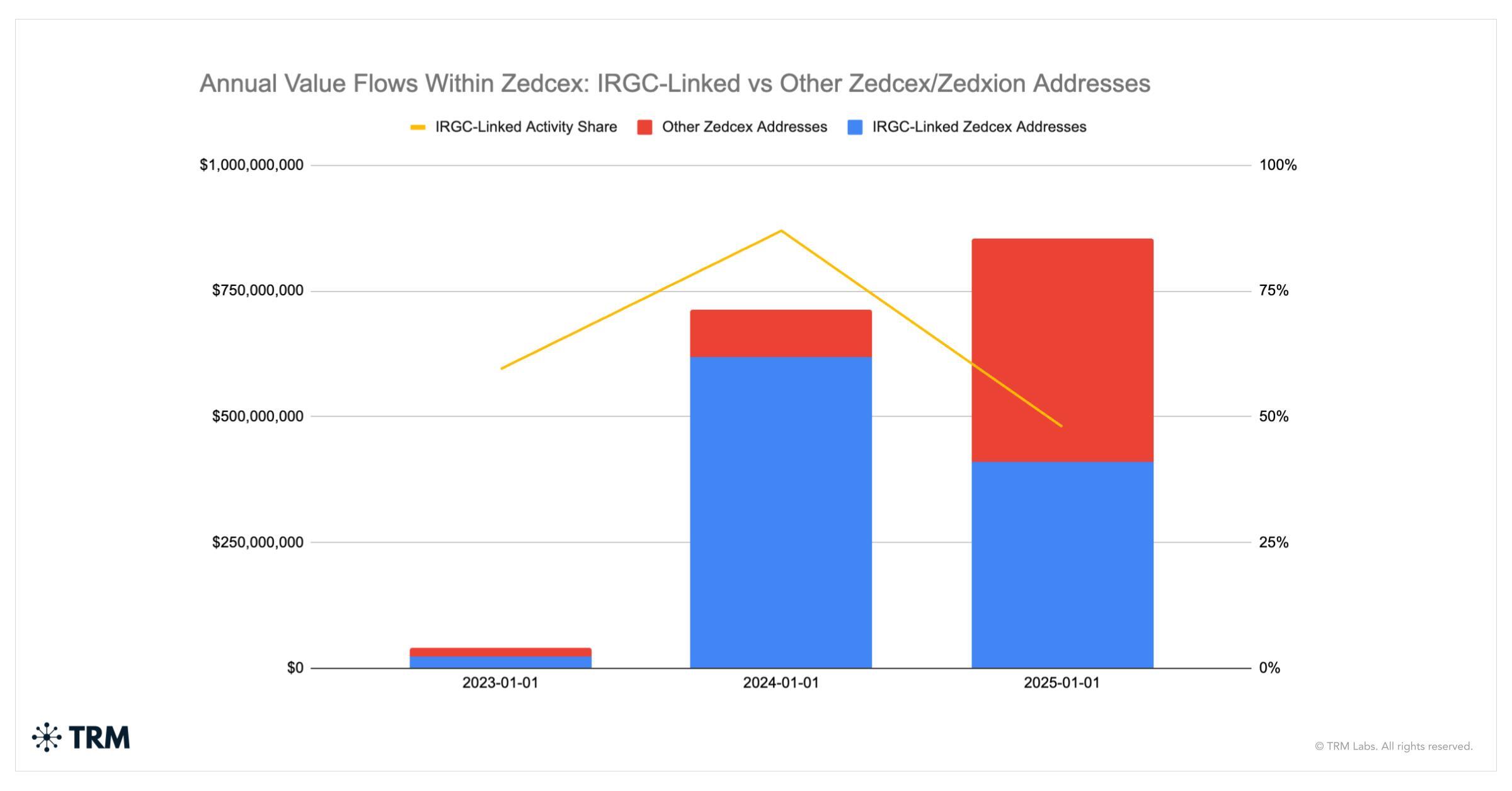
Iran’s Revolutionary Guard uses crypto USDT to evade Western sanctionsSource: TRM Labs

For years, the Guard and others in Iran have run front companies to keep business alive. The report says they’ve now added these two crypto exchanges to the list.

TRM found that between 2023 and 2025, the Guard’s transfers made up 56% of all the activity on Zedcex and Zedxion. It also said both brands are just different faces of the same company.

Ari Redbord, TRM’s policy chief, said, “Iranian-linked actors (including sanctioned military organizations) appear to be testing more persistent crypto infrastructure.”

Zedcex and Zedxion were tied to known Iranian oil smuggler

The numbers were massive: about $24 million in 2023, $619 million in 2024, and $410 million in 2025. Almost all of it went through USDT, the stablecoin made by Tether, and was sent over the Tron network.

TRM reportedly ran test transactions through the exchanges, then tracked where the money went. They followed a list of 187 wallet addresses, flagged by Israel, which were said to be run by the Guard. The money bounced between these wallets, offshore accounts, and other crypto firms inside Iran.

In one case, $10 million ended up in the wallet of a Yemeni man sanctioned by the U.S. in 2021. He was accused of selling Iranian fuel to raise cash for the Houthis.

The Guard also seemed to be working with Babak Zanjani, a name Iran watchers will know well. One of the exchange directors had the same name and birthday as him.

Zanjani was the guy who helped the government sell oil when Mahmoud Ahmadinejad was president. He got slapped with sanctions by Barack Obama in 2013 and was later accused by the Iranian government of stealing more than $2 billion.

Zanjani said he wasn’t guilty, blaming the sanctions for freezing the money. He was sentenced to death, but that never happened. His sentence was dropped in 2024, and he’s now free. The U.S. lifted its sanctions on him back in 2016 after Iran signed a nuclear deal, and those sanctions were never brought back.

Crypto channels helped Iran bypass official systems easily

Snir Levi, who runs the Israeli crypto analysis firm Nominis, backed up TRM’s findings, saying that his team allegedly looked at the same data and found at least $150 million that went through Zedxion and Zedcex tied to the Guard, though he provided absolutely no proof.

The exchanges claim on their websites that they follow anti-money-laundering rules, including checking IDs and banning users in about 30 to 50 countries. Iran is supposed to be on those lists. But the report shows that the Guard still used them.

TRM said they were able to make deposits and withdrawals from the platforms to trace how the Guard moved the money around.

Miad Maleki, who used to work at the U.S. Treasury, said, “The $1 billion figure over two years demonstrates that digital currencies are becoming a financial channel for Iran’s shadow banking apparatus.”

Tron, the crypto network involved in most of the transfers, said it had worked with Tether and TRM to try to stop this kind of activity. They claimed shady transactions have dropped “precipitously.” But clearly, the system worked well enough for the Guard to use it for $800 million over three years.

The smartest crypto minds already read our newsletter. Want in? Join them.

Market Opportunity
Nowchain Logo
Nowchain Price(NOW)
$0.0008155
$0.0008155$0.0008155
+0.62%
USD
Nowchain (NOW) Live Price Chart
Disclaimer: The articles reposted on this site are sourced from public platforms and are provided for informational purposes only. They do not necessarily reflect the views of MEXC. All rights remain with the original authors. If you believe any content infringes on third-party rights, please contact [email protected] for removal. MEXC makes no guarantees regarding the accuracy, completeness, or timeliness of the content and is not responsible for any actions taken based on the information provided. The content does not constitute financial, legal, or other professional advice, nor should it be considered a recommendation or endorsement by MEXC.
Tags:

You May Also Like

Ethereum Foundation Leadership Update: Co-Director Tomasz Stańczak to Step Down

Ethereum Foundation Leadership Update: Co-Director Tomasz Stańczak to Step Down

The post Ethereum Foundation Leadership Update: Co-Director Tomasz Stańczak to Step Down appeared on BitcoinEthereumNews.com. Why StaÅ„czak is leaving Ethereum
Share
BitcoinEthereumNews2026/02/14 07:57
Circle Unveils Cross-Chain Transfer Protocol V2 on Stellar, Expanding USDC Interoperability

Circle Unveils Cross-Chain Transfer Protocol V2 on Stellar, Expanding USDC Interoperability

Circle announced that its Cross-Chain Transfer Protocol (CCTP) V2 is coming to the Stellar network, improving interoperability for USDC, the world’s leading regulated stablecoin. The upgrade will allow users to seamlessly transfer USDC between Stellar and more than 15 other blockchains, including Ethereum, Solana, and Base, unlocking deeper liquidity and wider use cases for the Stellar ecosystem. Seamless Cross-Chain Liquidity Historically, users faced challenges when moving USDC across different blockchains, often relying on custodial bridges or Circle accounts. Liquidity was fragmented, making it difficult to dynamically manage assets between ecosystems. With CCTP V2, Stellar becomes natively interoperable with every other CCTP-enabled blockchain. This integration allows USDC liquidity to flow freely, providing exchanges, wallets, and DeFi protocols with more efficient access. For decentralized exchanges (DEXs), this means better rates for traders, while centralized exchanges (CEXs) can consolidate liquidity rather than maintaining isolated pools. Programmable Transfers for Developers CCTP V2 isn’t just about liquidity—it also introduces programmability. Developers can embed cross-chain USDC transfers directly into their decentralized applications (dApps), enabling seamless integration with the Stellar network. Projects can even include metadata within transfers that can trigger autonomous actions on the destination chain via Hooks, opening up new possibilities for automation and innovation. By building on top of CCTP V2, developers can leverage Stellar’s strengths—fast, low-cost payments and robust offramping options—without having to design complex multi-chain liquidity strategies. This creates a unified development experience across chains and accelerates the adoption of cross-chain finance. Eliminating Bridge Risk with Native Transfers A key innovation of CCTP V2 is its 1:1 burning and minting process. Instead of relying on wrapped tokens or custodial intermediaries, USDC is burned on the source chain and minted natively on the destination chain. This model eliminates bridge risk, improves transaction security, and ensures settlement can occur in seconds. For users and businesses, this means simpler, safer, and faster movement of capital across chains. The efficiency of this model also boosts confidence for institutions that require predictable liquidity and compliance-grade infrastructure. Strengthening Stellar’s Global Payments Role The Stellar network already powers global payments with low fees, near-instant settlement, and a network of 475,000+ MoneyGram locations for fiat on- and off-ramps. With CCTP V2, Stellar extends its role in cross-border finance by linking directly to the broader multichain USDC ecosystem. This upgrade makes Stellar a hub for stablecoin liquidity while enabling new financial applications, from treasury management to cross-chain lending. As programmable money gains traction, CCTP V2 ensures Stellar remains at the forefront of innovation, bridging traditional payments with the multichain future
Share
CryptoNews2025/09/18 22:00
a16z's latest in-depth analysis of the AI ​​market: Is your company still operating at a loss?

a16z's latest in-depth analysis of the AI ​​market: Is your company still operating at a loss?

Author: Deep Thinking Circle Have you ever considered that the software industry might be undergoing a transformation even more dramatic than the shift from command
Share
PANews2026/02/14 08:12