The reduction in ETH issuance and the increase in destruction will occur at the same time. Since the Ethereum merger, ETH has been scarcer than BTC.The reduction in ETH issuance and the increase in destruction will occur at the same time. Since the Ethereum merger, ETH has been scarcer than BTC.

A Deep Dive into Ethereum Issuance and Destruction: The Cat-and-Mouse Game

2025/02/08 12:00
7 min read

By Justin Drake, Ethereum Foundation Researcher

Compiled by: Felix, PANews

The ETH supply is currently growing at 0.5% per year. That is, 1% of the supply is issued per year minus 0.5% of the supply is destroyed per year. To achieve excess returns again, either the supply will decrease or the supply will increase. I personally think both will happen.

ETH and BTC

Before we delve into the issuance and destruction of Ethereum, let’s briefly introduce ETH and BTC.

Internet native money is a massive opportunity, worth tens of trillions of dollars. Monetary premiums rarely accumulate at scale. You need a truly compelling asset with outstanding properties for social coordination.

At first glance, moneyness is a zero-sum game. In the Internet age, gold is ready to be demonetized. There are only two candidate currencies that can replace it and win the battle for Internet money - BTC and ETH. No other currency can match it. Personally, I think the decisive factors are credible neutrality, security and scarcity.

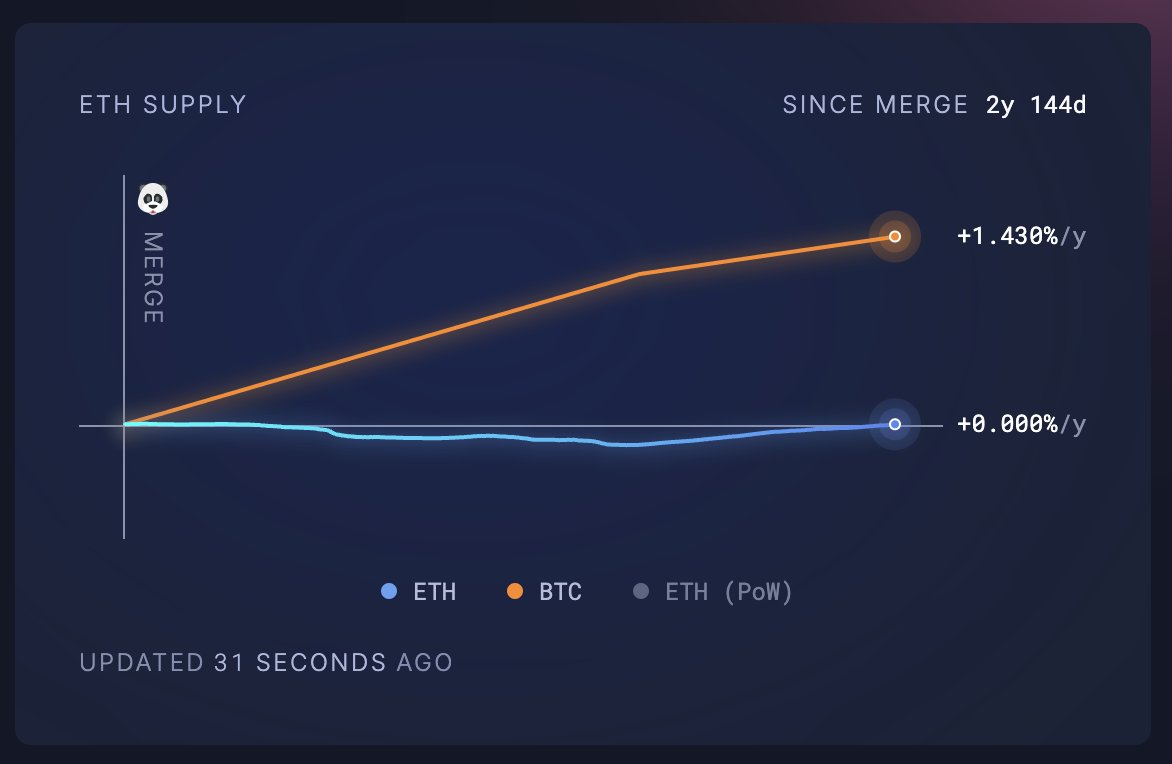
Since the Ethereum merger, ETH has become scarcer than BTC. Notably, BTC supply has grown by 666K, worth $66B, while ETH supply has remained flat. Today, BTC supply is growing at 0.83% per year, 66% faster than ETH. For those looking into the future, ETH supply will decrease again.
A Deep Dive into Ethereum Issuance and Destruction: The Cat-and-Mouse Game

Scarcity is important, but ultimately the battle for internet money may be settled by security. Ironically, the famous 21 million BTC cap is the culprit. BTC issuance will drop to zero — the most powerful social contract of Bitcoin. After a few halvings, issuance will be so small that it doesn’t matter.

Here’s a statistic: In the past seven days, only 1% of miners’ income came from Bitcoin fees, and 99% came from Bitcoin issuance. This is still the case despite four halvings, a 16-fold reduction in issuance, and despite people having spent 15 years finding Bitcoin’s transaction utility.

Personally, I think the Bitcoin blockchain is obsolete. To sustain a 51% attack on Bitcoin would require about $10 billion and 10GW of electricity. For a nation-state, the cost is negligible. As for electricity, Texas can produce 80GW. BTC has a security ratio of 200 to 1, a $2 trillion asset secured by a $10 billion economic security.

Any shortable instrument related to BTC mining incentivizes a 51% attack. There is $20 billion worth of Bitcoin mining stocks - stocks that would immediately go nuclear. There is $40 billion in BTC open interest - direct short exposure. Not to mention the potential short exposure through $100 billion ETFs and $100 billion MSTR.

Does BitVM solve the fee problem? Any BitVM bridge is an incentive to conduct a 51% attack on Bitcoin. In fact, a 51% attacker can censor fraud proofs and drain the BitVM bridge during the challenge period. Ironically, BitVM can be said to be a direct attack on Bitcoin.

If BTC price rises 10x and surpasses gold, is Bitcoin still safe? Assume this happens in the next 11 years. BTC will become a $20 trillion asset, but the issuance will be reduced by 8x due to three halvings. The safety ratio will exceed 1000 to 1. I personally think this is untenable, especially when BTC becomes institutionalized, more liquid, and ultimately easier to short. Imagine $1 trillion in perpetual open interest, but only $10 billion in economic security.

Can Bitcoin somehow fix itself before it’s too late? Bitcoin is the epitome of blockchain ossification. Can it have a 1% tail issuance per year? Maybe Bitcoin could switch to PoS and rely on minimum fees? PoS is blasphemy. Maybe Bitcoin could switch to another PoW algorithm? No, that nuclear option won’t help. Maybe Bitcoin could have big blocks and sell data availability on a massive scale? Well, there was a holy war for small blocks.

If you have read this far and understood the above, congratulations. Even today, few people realize the long-term impact of Bitcoin PoW and the impact on BTC assets. This is an opportunity to preempt execution, but patience is required. The time is not 1 month, not even 1 year - it is 10 years.

Speaking of long-term frames, Lummis’ suggestion of locking up BTC for 20 years is a bit crazy — by then Bitcoin would be obsolete. Worse, if the US holds trillions of dollars in BTC, this would directly incentivize America’s enemies to launch a 51% attack. Contrary to popular belief, Bitcoin is not at all resistant to nation-states — countries like Russia could easily launch a 51% attack.

ETH issuance

Back to ETH. The current issuance curve is a trap. Unfortunately, like Bitcoin's issuance, Ethereum's issuance design is wrong. It guarantees a 2% tail APR even if 100% of ETH is staked. Since the staking cost is much lower than 2%, every rational ETH holder will be incentivized to stake.

When most ETH is staked, it will face losses:

→ ETH swap: Liquid staking tokens like stETH and cbETH replace raw ETH as collateral. This injects systemic risk into DeFi (custody risk, slashing risk, governance risk, smart contract risk). This swap also weakens ETH’s role as a unit of account and has further knock-on effects on monetary premiums.

→ Real profits and tax rates: Real profits, i.e. earnings adjusted for supply growth, decline as ETH staking increases. When 100% of ETH is staked, all ETH holders are diluted equally. Worse, income taxes are levied on notional earnings. It would be a tragedy if no stakers enjoyed positive real profits while all ETH holders were subject to billions of dollars of selling pressure each year.

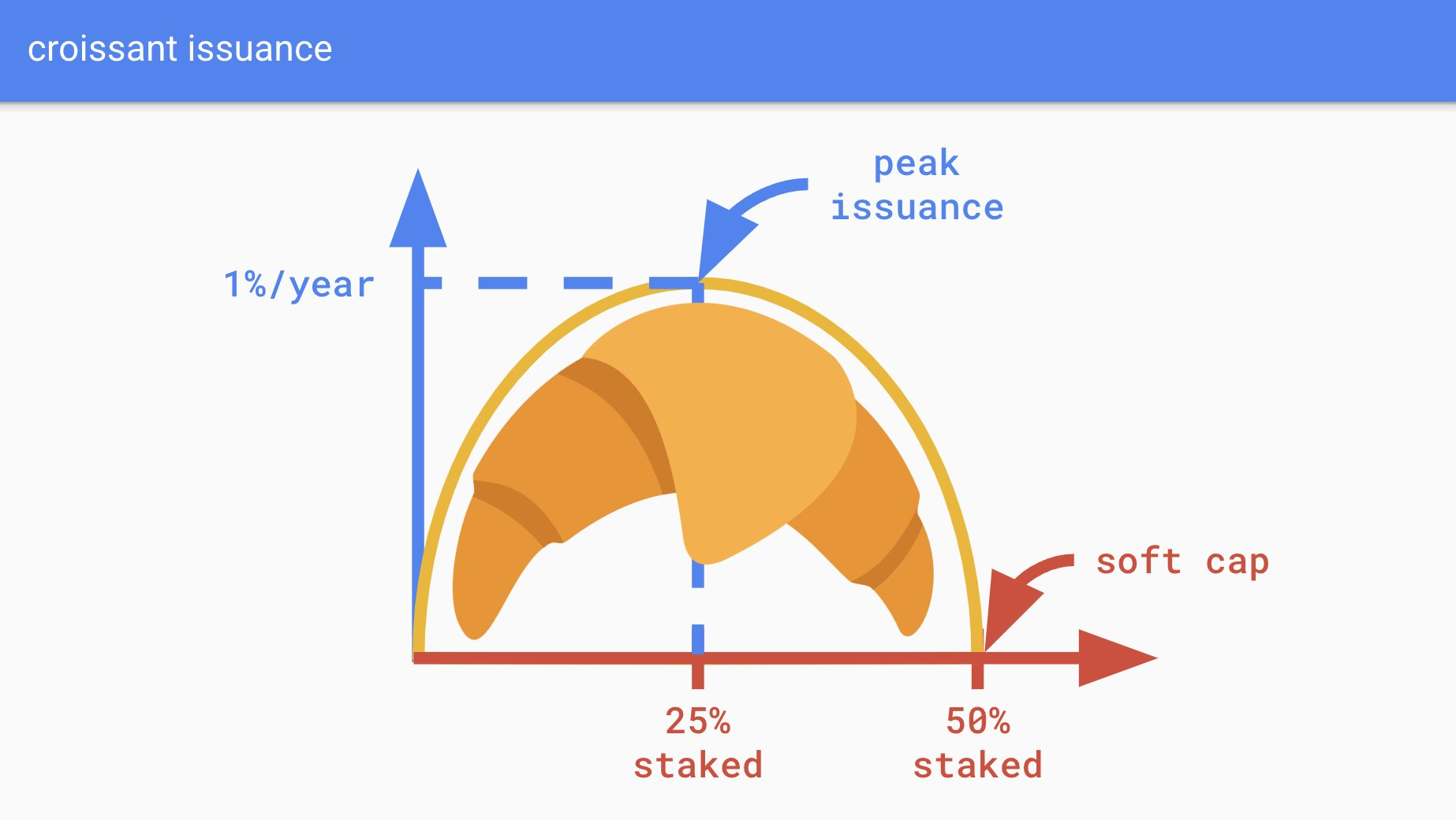
I personally believe that the issuance curve should drive the discovery of a fair issuance rate through staker competition - rather than an arbitrary 2% floor. This means that as ETH stakes increase, the issuance curve must eventually fall and return to zero. My personal suggestion is "Croissant Issuance".
A Deep Dive into Ethereum Issuance and Destruction: The Cat-and-Mouse Game

The Croissant Release is a simple half-ellipse with two parameters:

→ Soft Cap: The percentage of tokens staked when issuance reaches zero. A 50% staked soft cap feels credible, neutral, and pragmatic.

→ Peak issuance: The theoretical maximum issuance that ETH holders are subject to. An arbitrary integer (e.g. 1% per year) will do, as the final interest rate will be determined by the market.

Ethereum Foundation researchers have been studying issuance for years - there is a rough consensus that the current curve is broken and needs to change. It is not easy to guide the social layer to change issuance. This is an opportunity for the champions to deal with this situation and coordinate changes to the mainnet in the next few years.

ETH Burn

I personally think that a sustainable way to destroy a large amount of ETH is to expand data availability. It is more profitable to have a DA with 10 million TPS and pay $0.001 per transaction than to have 100 TPS and pay $100 per transaction.

I wouldn’t be surprised if we see hundreds of ETH blobs destroyed per day this year, and then that destruction could suddenly plummet again due to peer data availability (DAS) in the Fusaka fork.

Yes, the introduction of blobs by EIP-4844 reduces the total burn to some extent, which is a natural phenomenon of supply and demand. When the demand for DA catches up with the supply, blobs are expected to be burned in large quantities. In a few months, the Pectra hard fork will double the number of blobs. The short-term goal is growth, and a lot of growth is expected.

There will be a cat-and-mouse game between supply and demand over the next few years until the full Danksharding deployment is complete. I wouldn't be surprised if this year saw hundreds of ETH blobs destroyed per day, and then this destruction suddenly collapsed again due to the peer DAS crash in the Fusaka fork.

Looking ahead, this is about building infrastructure for the coming decades and centuries. The fundamentals will emerge in the next few years. Whether it is Bitcoin security, ETH issuance or ETH destruction, be patient and have faith.

Related reading: Ethereum Foundation’s “Game of Thrones”, where is the foundation’s major reform heading?

Market Opportunity
Bitcoin Logo
Bitcoin Price(BTC)
$73,709.58
$73,709.58$73,709.58
-0.55%
USD
Bitcoin (BTC) Live Price Chart
Disclaimer: The articles reposted on this site are sourced from public platforms and are provided for informational purposes only. They do not necessarily reflect the views of MEXC. All rights remain with the original authors. If you believe any content infringes on third-party rights, please contact [email protected] for removal. MEXC makes no guarantees regarding the accuracy, completeness, or timeliness of the content and is not responsible for any actions taken based on the information provided. The content does not constitute financial, legal, or other professional advice, nor should it be considered a recommendation or endorsement by MEXC.

You May Also Like

Over 60% of crypto press releases linked to high-risk or scam projects: Report

Over 60% of crypto press releases linked to high-risk or scam projects: Report

A data analysis shows crypto press release wires are dominated by scam-linked projects, hype-driven content and low-impact announcements, raising concerns about
Share
Crypto.news2026/02/04 22:02
ArtGis Finance Partners with MetaXR to Expand its DeFi Offerings in the Metaverse
ArtGis Finance Partners with MetaXR to Expand its DeFi Offerings in the Metaverse

By using this collaboration, ArtGis utilizes MetaXR’s infrastructure to widen access to its assets and enable its customers to interact with the metaverse.
Share
Blockchainreporter2025/09/18 00:07
Crucial US Stock Market Update: What Wednesday’s Mixed Close Reveals

Crucial US Stock Market Update: What Wednesday’s Mixed Close Reveals

BitcoinWorld Crucial US Stock Market Update: What Wednesday’s Mixed Close Reveals The financial world often keeps us on our toes, and Wednesday was no exception. Investors watched closely as the US stock market concluded the day with a mixed performance across its major indexes. This snapshot offers a crucial glimpse into current investor sentiment and economic undercurrents, prompting many to ask: what exactly happened? Understanding the Latest US Stock Market Movements On Wednesday, the closing bell brought a varied picture for the US stock market. While some indexes celebrated gains, others registered slight declines, creating a truly mixed bag for investors. The Dow Jones Industrial Average showed resilience, climbing by a notable 0.57%. This positive movement suggests strength in some of the larger, more established companies. Conversely, the S&P 500, a broader benchmark often seen as a barometer for the overall market, experienced a modest dip of 0.1%. The technology-heavy Nasdaq Composite also saw a slight retreat, sliding by 0.33%. This particular index often reflects investor sentiment towards growth stocks and the tech sector. These divergent outcomes highlight the complex dynamics currently at play within the American economy. It’s not simply a matter of “up” or “down” for the entire US stock market; rather, it’s a nuanced landscape where different sectors and company types are responding to unique pressures and opportunities. Why Did the US Stock Market See Mixed Results? When the US stock market delivers a mixed performance, it often points to a tug-of-war between various economic factors. Several elements could have contributed to Wednesday’s varied closings. For instance, positive corporate earnings reports from certain industries might have bolstered the Dow. At the same time, concerns over inflation, interest rate policies by the Federal Reserve, or even global economic uncertainties could have pressured growth stocks, affecting the S&P 500 and Nasdaq. Key considerations often include: Economic Data: Recent reports on employment, manufacturing, or consumer spending can sway market sentiment. Corporate Announcements: Strong or weak earnings forecasts from influential companies can significantly impact their respective sectors. Interest Rate Expectations: The prospect of higher or lower interest rates directly influences borrowing costs for businesses and consumer spending, affecting future profitability. Geopolitical Events: Global tensions or trade policies can introduce uncertainty, causing investors to become more cautious. Understanding these underlying drivers is crucial for anyone trying to make sense of daily market fluctuations in the US stock market. Navigating Volatility in the US Stock Market A mixed close, while not a dramatic downturn, serves as a reminder that market volatility is a constant companion for investors. For those involved in the US stock market, particularly individuals managing their portfolios, these days underscore the importance of a well-thought-out strategy. It’s important not to react impulsively to daily movements. Instead, consider these actionable insights: Diversification: Spreading investments across different sectors and asset classes can help mitigate risk when one area underperforms. Long-Term Perspective: Focusing on long-term financial goals rather than short-term gains can help weather daily market swings. Stay Informed: Keeping abreast of economic news and company fundamentals provides context for market behavior. Consult Experts: Financial advisors can offer personalized guidance based on individual risk tolerance and objectives. Even small movements in major indexes can signal shifts that require attention, guiding future investment decisions within the dynamic US stock market. What’s Next for the US Stock Market? Looking ahead, investors will be keenly watching for further economic indicators and corporate announcements to gauge the direction of the US stock market. Upcoming inflation data, statements from the Federal Reserve, and quarterly earnings reports will likely provide more clarity. The interplay of these factors will continue to shape investor confidence and, consequently, the performance of the Dow, S&P 500, and Nasdaq. Remaining informed and adaptive will be key to understanding the market’s trajectory. Conclusion: Wednesday’s mixed close in the US stock market highlights the intricate balance of forces influencing financial markets. While the Dow showed strength, the S&P 500 and Nasdaq experienced slight declines, reflecting a nuanced economic landscape. This reminds us that understanding the ‘why’ behind these movements is as important as the movements themselves. As always, a thoughtful, informed approach remains the best strategy for navigating the complexities of the market. Frequently Asked Questions (FAQs) Q1: What does a “mixed close” mean for the US stock market? A1: A mixed close indicates that while some major stock indexes advanced, others declined. It suggests that different sectors or types of companies within the US stock market are experiencing varying influences, rather than a uniform market movement. Q2: Which major indexes were affected on Wednesday? A2: On Wednesday, the Dow Jones Industrial Average gained 0.57%, while the S&P 500 edged down 0.1%, and the Nasdaq Composite slid 0.33%, illustrating the mixed performance across the US stock market. Q3: What factors contribute to a mixed stock market performance? A3: Mixed performances in the US stock market can be influenced by various factors, including specific corporate earnings, economic data releases, shifts in interest rate expectations, and broader geopolitical events that affect different market segments uniquely. Q4: How should investors react to mixed market signals? A4: Investors are generally advised to maintain a long-term perspective, diversify their portfolios, stay informed about economic news, and avoid impulsive decisions. Consulting a financial advisor can also provide personalized guidance for navigating the US stock market. Q5: What indicators should investors watch for future US stock market trends? A5: Key indicators to watch include upcoming inflation reports, statements from the Federal Reserve regarding monetary policy, and quarterly corporate earnings reports. These will offer insights into the future direction of the US stock market. Did you find this analysis of the US stock market helpful? Share this article with your network on social media to help others understand the nuances of current financial trends! To learn more about the latest stock market trends, explore our article on key developments shaping the US stock market‘s future performance. This post Crucial US Stock Market Update: What Wednesday’s Mixed Close Reveals first appeared on BitcoinWorld.
Share
Coinstats2025/09/18 05:30