On January 19, the database migration error on Paradex briefly priced Bitcoin at zero dollars, triggering automated liquidations across thousands of leveraged positionsOn January 19, the database migration error on Paradex briefly priced Bitcoin at zero dollars, triggering automated liquidations across thousands of leveraged positions

Paradex Bitcoin Glitch Triggers Mass Liquidations, Here’s Why HFDX Liquidity Increased by $100m

2026/01/27 22:55
4 min read

On January 19, the database migration error on Paradex briefly priced Bitcoin at zero dollars, triggering automated liquidations across thousands of leveraged positions before engineers halted trading and rolled back the chain to a pre-maintenance state. The eight-hour outage and subsequent blockchain reversal reignited a familiar debate in decentralized finance: when push comes to shove, how decentralized are these platforms really?

In the seventy-two hours following Paradex’s recovery, HFDX liquidity vaults recorded net inflows exceeding one hundred million dollars, representing the largest single-week capital migration in the protocol’s history. So why is so much capital gravitating there?

HFDXHFDX

When database migrations reveal systemic risk

The mechanics of the Paradex failure reveal why infrastructure choices matter more than marketing promises. During routine maintenance at approximately 04:30 UTC, the platform’s internal pricing system lost synchronization with on-chain oracle feeds. Automated liquidation contracts, designed to protect the protocol from undercollateralized positions, immediately began force-closing trades based on the zero-dollar Bitcoin price.

By the time engineering teams responded roughly two and a half hours later, the damage had smashed through positions. Paradex’s solution, reverting the entire blockchain, may have restored account balances for the two hundred affected traders who received compensation, but it also showed that decentralization often functions more as branding than architecture.

Oracle redundancy props liquidation design

HFDX approaches oracle dependency differently. Rather than relying on a single database feeding price data to smart contracts, the protocol aggregates feeds from multiple decentralized oracle networks with sub-second update frequencies.

This redundancy serves a specific economic purpose: during high volatility, the gap between a protocol’s perceived price and actual market conditions determines whether liquidations happen fairly or whether they simply extract value from traders who were directionally correct but got caught in a technical malfunction.

Research on perpetual futures platforms consistently shows that oracle update latency above one second creates systematic losses for liquidity providers, as informed traders exploit the gap between stale protocol prices and real-time market data. The liquidation engine architecture matters equally.

HFDX implements partial position liquidation, closing only the minimum amount necessary to bring an account above maintenance margin requirements. This design reduces cascade risk – the self-reinforcing loop where initial liquidations create sell pressure that triggers additional liquidations, which create more sell pressure, and so on until the insurance fund depletes.

Paradex’s all-or-nothing liquidation approach, combined with the oracle desynchronization, meant traders lost entire positions rather than taking incremental hits that might have been recoverable as prices normalized.

Infrastructure offers a true competitive moat

The capital inflow to HFDX following the Paradex incident tracks a pattern documented repeatedly across decentralized finance: during crisis moments, institutional capital migrates toward platforms with demonstrated resilience rather than those with the most aggressive user acquisition campaigns.

The October 2025 flash crash that wiped nineteen billion dollars in leveraged positions across the industry saw similar flows, with traders consolidating onto venues that maintained accurate pricing and avoided emergency interventions.

HFDX’s decision to maintain full transaction transparency without the possibility of chain rollbacks creates constraints (there’s no undo button when things break), but those constraints force more conservative risk management at the protocol level.

None of this suggests HFDX is without tradeoffs. The multi-oracle architecture increases infrastructure complexity and operational overhead. Conservative liquidation parameters mean lower maximum leverage compared to competitors, which limits appeal for traders seeking extreme capital efficiency.

It’s true that the platform’s focus on institutional-grade reliability over features like one-click social trading or meme coin perpetuals narrows the addressable market. But for those with capital looking to deploy liquidity in perpetual futures infrastructure, robustness is where platforms earn long-term trust. HFDX might just be the platform the market is looking for.

Make Your Money Work Smarter And Unlock A Wealth Of Opportunities With HFDX Today!

Website: https://hfdx.xyz/

Telegram: https://t.me/HFDXTrading

X: https://x.com/HfdxProtocol

Disclaimer: The articles reposted on this site are sourced from public platforms and are provided for informational purposes only. They do not necessarily reflect the views of MEXC. All rights remain with the original authors. If you believe any content infringes on third-party rights, please contact [email protected] for removal. MEXC makes no guarantees regarding the accuracy, completeness, or timeliness of the content and is not responsible for any actions taken based on the information provided. The content does not constitute financial, legal, or other professional advice, nor should it be considered a recommendation or endorsement by MEXC.

You May Also Like

XRP Buyers Defend Most Major 200-Week Price Average: Can It Be Bottom of 2026?

XRP Buyers Defend Most Major 200-Week Price Average: Can It Be Bottom of 2026?

The post XRP Buyers Defend Most Major 200-Week Price Average: Can It Be Bottom of 2026? appeared on BitcoinEthereumNews.com. XRP has returned to its 200-week moving
Share
BitcoinEthereumNews2026/02/08 19:49
Expert Tags Ethereum’s ERC-8004 Mainnet Launch An “iPhone Moment”, Here’s What It Means
Expert Tags Ethereum’s ERC-8004 Mainnet Launch An “iPhone Moment”, Here’s What It Means

Market analyst says Ethereum is having an “iPhone moment” as it approaches the ERC-8004 mainnet launch.
Share
Coinstats2026/02/08 19:56
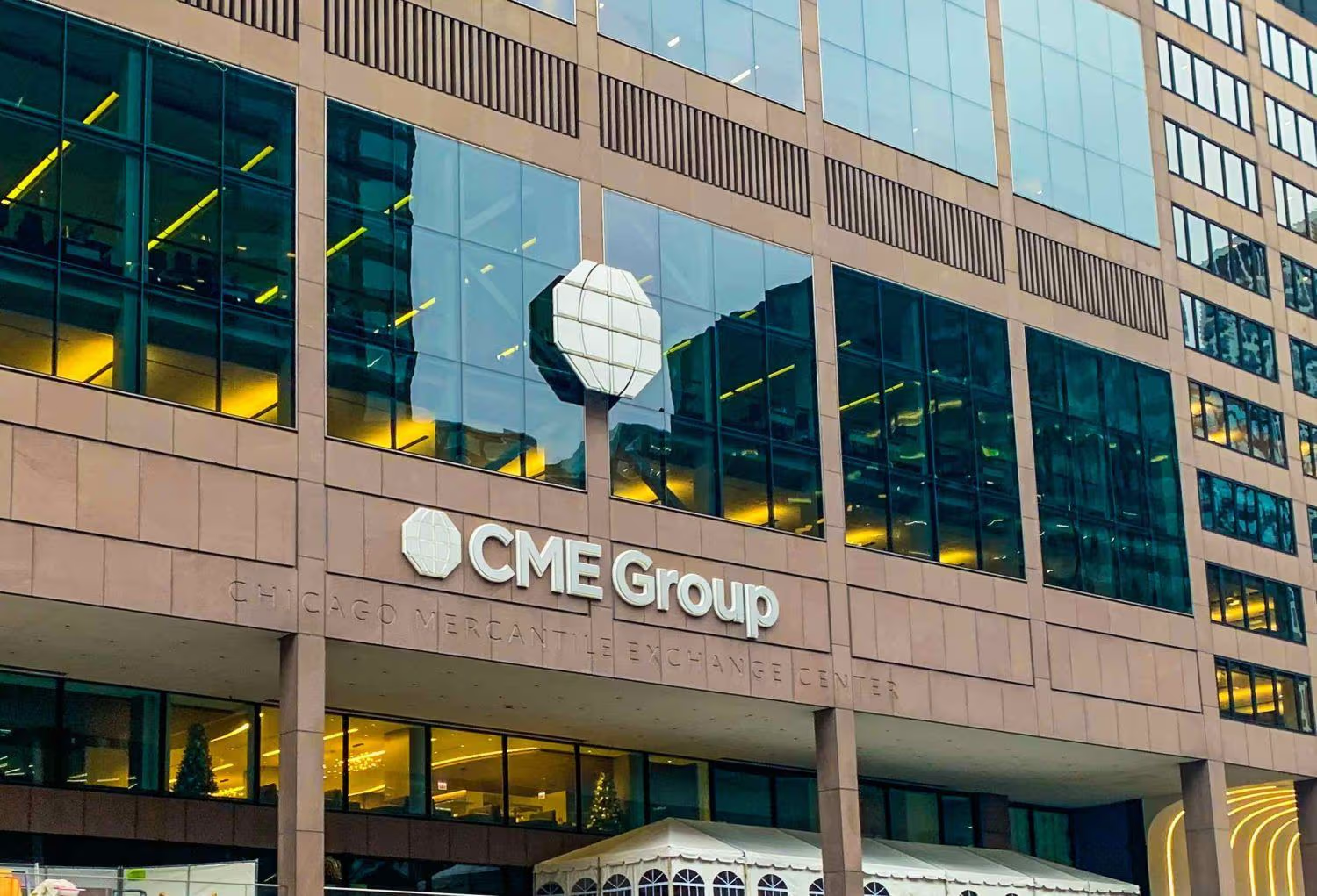
Breaking: CME Group Unveils Solana and XRP Options

Breaking: CME Group Unveils Solana and XRP Options

CME Group launches Solana and XRP options, expanding crypto offerings. SEC delays Solana and XRP ETF approvals, market awaits clarity. Strong institutional demand drives CME’s launch of crypto options contracts. In a bold move to broaden its cryptocurrency offerings, CME Group has officially launched options on Solana (SOL) and XRP futures. Available since October 13, 2025, these options will allow traders to hedge and manage exposure to two of the most widely traded digital assets in the market. The new contracts come in both full-size and micro-size formats, with expiration options available daily, monthly, and quarterly, providing flexibility for a diverse range of market participants. This expansion aligns with the rising demand for innovative products in the crypto space. Giovanni Vicioso, CME Group’s Global Head of Cryptocurrency Products, noted that the new options offer increased flexibility for traders, from institutions to active individual investors. The growing liquidity in Solana and XRP futures has made the introduction of these options a timely move to meet the needs of an expanding market. Also Read: Vitalik Buterin Reveals Ethereum’s Bold Plan to Stay Quantum-Secure and Simple! Rapid Growth in Solana and XRP Futures Trading CME Group’s decision to roll out options on Solana and XRP futures follows the substantial growth in these futures products. Since the launch of Solana futures in March 2025, more than 540,000 contracts, totaling $22.3 billion in notional value, have been traded. In August 2025, Solana futures set new records, with an average daily volume (ADV) of 9,000 contracts valued at $437.4 million. The average daily open interest (ADOI) hit 12,500 contracts, worth $895 million. Similarly, XRP futures, which launched in May 2025, have seen significant adoption, with over 370,000 contracts traded, totaling $16.2 billion. XRP futures also set records in August 2025, with an ADV of 6,600 contracts valued at $385 million and a record ADOI of 9,300 contracts, worth $942 million. Institutional Demand for Advanced Hedging Tools CME Group’s expansion into options is a direct response to growing institutional interest in sophisticated cryptocurrency products. Roman Makarov from Cumberland Options Trading at DRW highlighted the market demand for more varied crypto products, enabling more advanced risk management strategies. Joshua Lim from FalconX also noted that the new options products meet the increasing need for institutional hedging tools for assets like Solana and XRP, further cementing their role in the digital asset space. The launch of options on Solana and XRP futures marks another step toward the maturation of the cryptocurrency market, providing a broader range of tools for managing digital asset exposure. SEC’s Delay on Solana and XRP ETF Approvals While CME Group expands its offerings, the broader market is also watching the progress of Solana and XRP exchange-traded funds (ETFs). The U.S. Securities and Exchange Commission (SEC) has delayed its decisions on multiple crypto-related ETF filings, including those for Solana and XRP. Despite the delay, analysts anticipate approval may be on the horizon. This week, REX Shares and Osprey Funds are expected to launch an XRP ETF that will hold XRP directly and allocate at least 40% of its assets to other XRP-related ETFs. Despite the delays, some analysts believe that approval could come soon, fueling further interest in these assets. The delay by the SEC has left many crypto investors awaiting clarity, but approval of these ETFs could fuel further momentum in the Solana and XRP futures markets. Also Read: Tether CEO Breaks Silence on $117,000 Bitcoin Price – Market Reacts! The post Breaking: CME Group Unveils Solana and XRP Options appeared first on 36Crypto.
Share
Coinstats2025/09/18 02:35