Across digital finance, onchain markets are entering a new phase in which functional assets, liquidity and user behavior are rapidly realigning. From memecoins Across digital finance, onchain markets are entering a new phase in which functional assets, liquidity and user behavior are rapidly realigning. From memecoins

Functional assets reshape onchain markets as liquidity shifts to RWAs, perps and prediction platforms

onchain markets

Across digital finance, onchain markets are entering a new phase in which functional assets, liquidity and user behavior are rapidly realigning.

From memecoins to financially useful assets

Onchain markets are becoming more diverse as traders move beyond purely speculative tokens. Memecoins still play a key role in attracting attention and driving user onboarding, especially for first-time crypto participants.

However, most new trading volume and fresh liquidity are shifting toward real world assets (RWAs), perpetual derivatives, and prediction venues that offer clearer financial use cases and links to traditional markets. This migration is redefining how capital flows across decentralized platforms.

Moreover, RWAs are evolving from simple representations of value into usable financial instruments that can support yield strategies, risk hedging, and structured portfolio construction. That said, memecoins remain important as attention catalysts, even as functional assets gain ground.

RWAs, perpetuals and prediction platforms gain traction

RWAs are increasingly used to design onchain portfolios that mirror or complement traditional exposure. In practice, this enables strategies that combine blockchain settlement with familiar instruments such as credit-based yields or asset-backed products, while maintaining transparent, programmable ownership.

At the same time, perpetual DEXs continue to attract both active and professional traders. As their liquidity deepens and infrastructure reliability improves, these platforms are becoming core venues for derivatives participation, hedging and leveraged strategies within the broader crypto ecosystem.

Prediction platforms add another structural layer by introducing event-based pricing and information-driven markets. However, instead of trading only on asset prices, users can take positions on outcomes such as elections, macro data releases, or protocol milestones, turning information and expectations into directly tradable positions.

Unified interfaces and the rise of the wallet gateway

As trading activity concentrates on platforms that aggregate multiple asset classes, interfaces that unify access are becoming strategically important. In this environment, wallets are evolving into full-stack gateways that manage global asset allocation, execution, and cross-market coordination from a single point of control.

Moreover, users increasingly expect a wallet to orchestrate positions across RWAs, perpetual derivatives, and prediction exposure in one place. This shift allows both retail and professional participants to optimize capital usage, manage risk consistently, and react to market signals across several onchain venues without leaving the wallet interface.

That said, infrastructure providers must ensure that these unified access points preserve security, composability, and transparency. Executing multi-asset strategies through a wallet requires robust integration with liquidity sources, clear pricing, and reliable settlement across all supported protocols.

Strategic implications for platforms and users

The gradual rotation from purely speculative tokens toward functionally grounded assets changes how protocols compete and collaborate. Platforms that successfully combine RWAs, perpetual derivatives, and event-driven instruments in a single, coherent experience are positioned to capture a larger share of future volume.

For users, this evolution broadens the toolkit for yield generation, hedging, and tactical positioning. However, it also demands greater sophistication in evaluating protocol risk, collateral frameworks, and the legal or economic structures underpinning RWAs and derivatives markets.

In summary, as functional assets gain share and wallet-centric access becomes the norm, onchain markets are set to operate more like integrated global financial rails while preserving the openness and programmability that define decentralized finance.

Disclaimer: The articles reposted on this site are sourced from public platforms and are provided for informational purposes only. They do not necessarily reflect the views of MEXC. All rights remain with the original authors. If you believe any content infringes on third-party rights, please contact [email protected] for removal. MEXC makes no guarantees regarding the accuracy, completeness, or timeliness of the content and is not responsible for any actions taken based on the information provided. The content does not constitute financial, legal, or other professional advice, nor should it be considered a recommendation or endorsement by MEXC.

You May Also Like

XRP Buyers Defend Most Major 200-Week Price Average: Can It Be Bottom of 2026?

XRP Buyers Defend Most Major 200-Week Price Average: Can It Be Bottom of 2026?

The post XRP Buyers Defend Most Major 200-Week Price Average: Can It Be Bottom of 2026? appeared on BitcoinEthereumNews.com. XRP has returned to its 200-week moving
Share
BitcoinEthereumNews2026/02/08 19:49
Expert Tags Ethereum’s ERC-8004 Mainnet Launch An “iPhone Moment”, Here’s What It Means
Expert Tags Ethereum’s ERC-8004 Mainnet Launch An “iPhone Moment”, Here’s What It Means

Market analyst says Ethereum is having an “iPhone moment” as it approaches the ERC-8004 mainnet launch.
Share
Coinstats2026/02/08 19:56
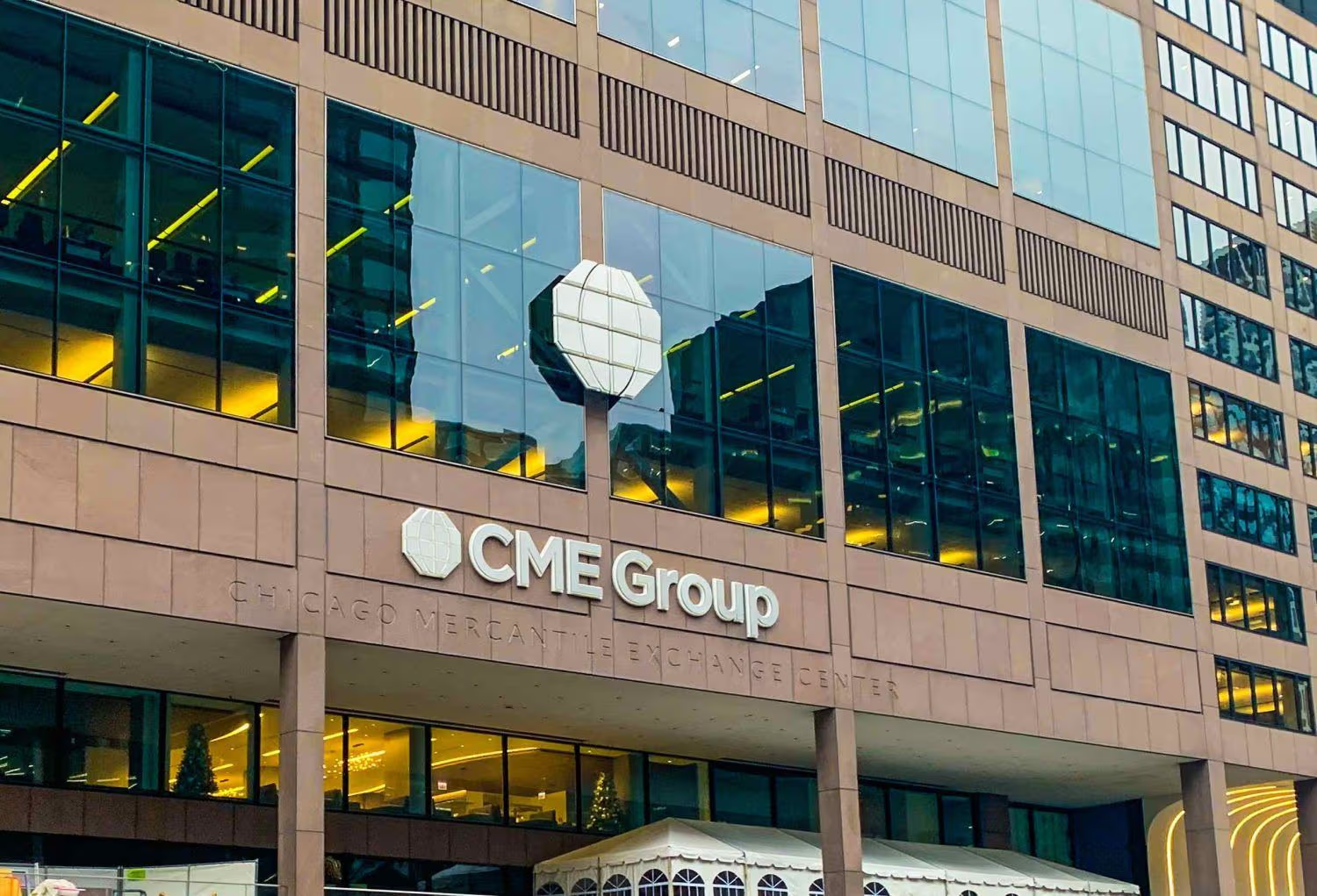
Breaking: CME Group Unveils Solana and XRP Options

Breaking: CME Group Unveils Solana and XRP Options

CME Group launches Solana and XRP options, expanding crypto offerings. SEC delays Solana and XRP ETF approvals, market awaits clarity. Strong institutional demand drives CME’s launch of crypto options contracts. In a bold move to broaden its cryptocurrency offerings, CME Group has officially launched options on Solana (SOL) and XRP futures. Available since October 13, 2025, these options will allow traders to hedge and manage exposure to two of the most widely traded digital assets in the market. The new contracts come in both full-size and micro-size formats, with expiration options available daily, monthly, and quarterly, providing flexibility for a diverse range of market participants. This expansion aligns with the rising demand for innovative products in the crypto space. Giovanni Vicioso, CME Group’s Global Head of Cryptocurrency Products, noted that the new options offer increased flexibility for traders, from institutions to active individual investors. The growing liquidity in Solana and XRP futures has made the introduction of these options a timely move to meet the needs of an expanding market. Also Read: Vitalik Buterin Reveals Ethereum’s Bold Plan to Stay Quantum-Secure and Simple! Rapid Growth in Solana and XRP Futures Trading CME Group’s decision to roll out options on Solana and XRP futures follows the substantial growth in these futures products. Since the launch of Solana futures in March 2025, more than 540,000 contracts, totaling $22.3 billion in notional value, have been traded. In August 2025, Solana futures set new records, with an average daily volume (ADV) of 9,000 contracts valued at $437.4 million. The average daily open interest (ADOI) hit 12,500 contracts, worth $895 million. Similarly, XRP futures, which launched in May 2025, have seen significant adoption, with over 370,000 contracts traded, totaling $16.2 billion. XRP futures also set records in August 2025, with an ADV of 6,600 contracts valued at $385 million and a record ADOI of 9,300 contracts, worth $942 million. Institutional Demand for Advanced Hedging Tools CME Group’s expansion into options is a direct response to growing institutional interest in sophisticated cryptocurrency products. Roman Makarov from Cumberland Options Trading at DRW highlighted the market demand for more varied crypto products, enabling more advanced risk management strategies. Joshua Lim from FalconX also noted that the new options products meet the increasing need for institutional hedging tools for assets like Solana and XRP, further cementing their role in the digital asset space. The launch of options on Solana and XRP futures marks another step toward the maturation of the cryptocurrency market, providing a broader range of tools for managing digital asset exposure. SEC’s Delay on Solana and XRP ETF Approvals While CME Group expands its offerings, the broader market is also watching the progress of Solana and XRP exchange-traded funds (ETFs). The U.S. Securities and Exchange Commission (SEC) has delayed its decisions on multiple crypto-related ETF filings, including those for Solana and XRP. Despite the delay, analysts anticipate approval may be on the horizon. This week, REX Shares and Osprey Funds are expected to launch an XRP ETF that will hold XRP directly and allocate at least 40% of its assets to other XRP-related ETFs. Despite the delays, some analysts believe that approval could come soon, fueling further interest in these assets. The delay by the SEC has left many crypto investors awaiting clarity, but approval of these ETFs could fuel further momentum in the Solana and XRP futures markets. Also Read: Tether CEO Breaks Silence on $117,000 Bitcoin Price – Market Reacts! The post Breaking: CME Group Unveils Solana and XRP Options appeared first on 36Crypto.
Share
Coinstats2025/09/18 02:35