Key Insights: Ethereum (ETH) price dropped sharply on Feb. 2, 2026, after a late-session selloff across majors. ETH price printed a daily low near $2,156 on BitstampKey Insights: Ethereum (ETH) price dropped sharply on Feb. 2, 2026, after a late-session selloff across majors. ETH price printed a daily low near $2,156 on Bitstamp

Can Ethereum Price Hold $2,000 Support or More Dip Incoming

4 min read
ethereum price eth price

Key Insights:

  • Ethereum price fell to $2,156 before stabilizing near $2,329 on Feb. 2.
  • Spot selling pressure dominated, while on-chain activity metrics diverged.
  • Traders focused on the $2,000–$2,200 zone as the next directional trigger.

Ethereum (ETH) price dropped sharply on Feb. 2, 2026, after a late-session selloff across majors. ETH price printed a daily low near $2,156 on Bitstamp before bouncing modestly. TradingView data showed Ethereum price struggling to reclaim broken intraday levels.

The move mattered because Ethereum already traded near a widely watched support band. Market participants assessed whether on-chain signals could offset visible sell pressure. The debate intensified as the price hovered above the $2,000 handle.

Ethereum Price Tested a Widely Watched Support Zone

Ethereum price moved directly into the $2,000–$2,200 support area during the session. Crypto trader Ted Pillows warned that the zone represented a must-hold structure. He cautioned that a failure could reopen downside toward April 2025 lows.
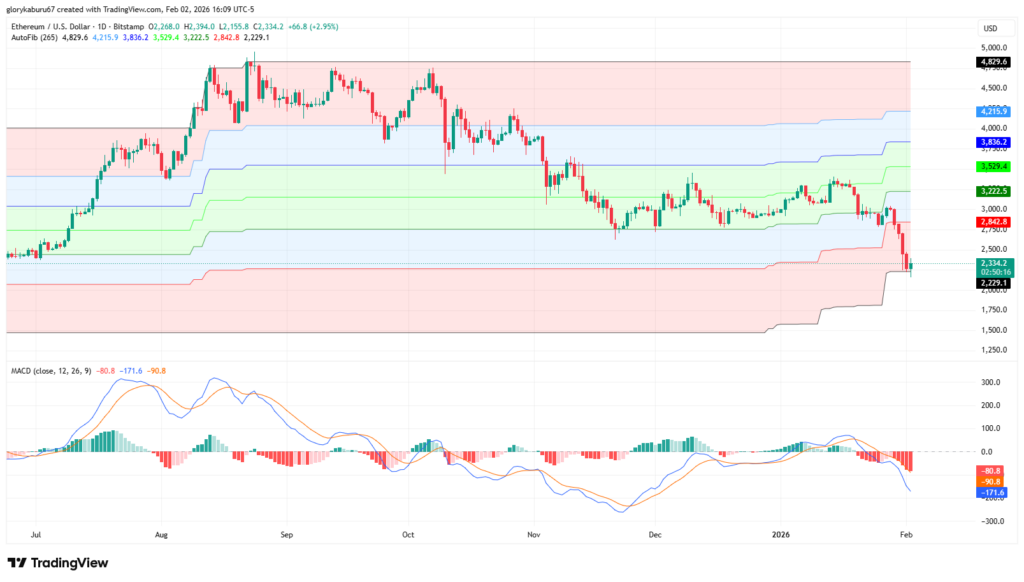
ETH/USD 1-day price chart. Source: TradingViewETH/USD 1-day price chart. Source: TradingView

TradingView’s daily chart showed ETH price closing around $2,329 after the dip. The chart highlighted a lower reference near $2,229, aligning closely with the support band. The price briefly pierced that area before recovering slightly.

Overhead, TradingView levels clustered near $2,843 as the first resistance. Higher reference bands appeared around $3,223 and $3,529. Additional zones extended toward $3,836 and $4,216, with the upper range near $4,830.

Momentum indicators reinforced the defensive tone. The Moving Average Convergence Divergence (MACD) remained negative into early February. MACD readings hovered near -81, -90, and -172, reflecting persistent downside momentum after the breakdown.

Ethereum Price Faced Heavy Spot Selling Pressure

CryptoQuant’s 90-day spot taker cumulative volume delta showed sustained taker-sell dominance. Red phases expanded as Ethereum price rolled over into February. The data suggested market participants sold aggressively at market prices.
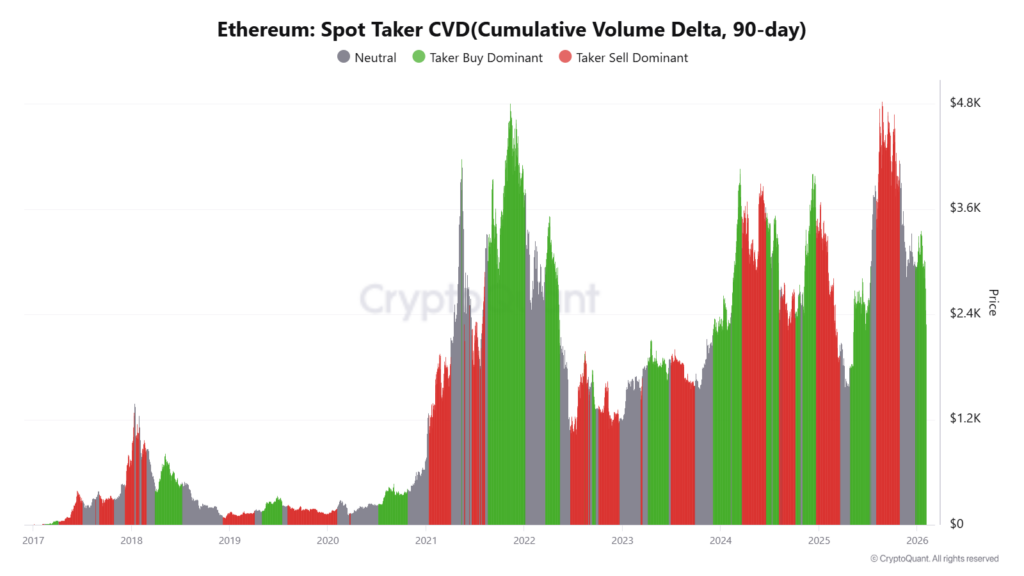
Ethereum spot taker CVD | Source: CryptoQuantEthereum spot taker CVD | Source: CryptoQuant

Such behavior often amplifies volatility during thin liquidity periods. Sellers appeared unwilling to wait for limit fills, intensifying downward moves. The CVD pattern closely mirrored the sharp intraday wick on the daily chart.

Fundstrat’s Tom Lee offered a contrasting view on ETH price direction. In comments shared by CryptosRus, Lee argued that enough time had passed since the prior cycle peak. He also said the price reached levels typically associated with bottoms.

Tom Lee on Ethereum Price | Source XTom Lee on Ethereum Price | Source X

Lee pointed to a surge in Ethereum active addresses as a supporting signal. He described address growth as parabolic, noting historical links between usage expansion and price recovery. The observation lacked precise figures, prompting traders to remain cautious.

The divergence stood out as Ethereum price slid while network activity appeared resilient. CryptoQuant’s CVD stayed negative even as address metrics strengthened. That mismatch left markets weighing structural usage against immediate selling pressure.

CryptoQuant data on exchange withdrawing addresses showed elevated activity during volatile periods. The series spiked during past bull and bear cycles, then stayed active through 2024 and 2025. The trend suggested holders frequently moved Ether off exchanges during stress.

Source: CryptoQuantSource: CryptoQuant

Rising withdrawal addresses often reduce near-term sell-side liquidity. Coins moved to self-custody typically remained unavailable for immediate spot selling. That dynamic sometimes softened drawdowns after sharp corrections.

Broader exchange flow data reinforced the risk-off environment. Analyst Crazzyblockk noted Bitcoin traded near $78,162 after a 13.2% decline over the past 30 days. He described the phase as a typical bearish correction marked by outflows.

Seven-day netflow metrics showed negative buying power across major venues. Binance averaged a -0.35 buying power ratio, while Coinbase posted -0.07 and OKX -0.10. The figures suggested capital retreated broadly during the correction.

Source: CryptoQuantSource: CryptoQuant

Stablecoin movements added further context. Crazzyblockk reported withdrawal-to-deposit ratios of 1.74x on Binance, 3.28x on Coinbase Advanced, and 3.58x on OKX. He argued those ratios reflected stress rather than platform-specific issues.

While the data focused on Bitcoin and stablecoins, it shaped Ethereum price conditions. Elevated withdrawals and reduced deployable capital limited dip-buying capacity. That backdrop aligned with CryptoQuant’s sell-dominant CVD and Ether’s price weakness.

Near term, Ethereum crypto price direction hinged on the $2,000–$2,200 zone. A sustained hold could open a rebound toward $2,843 and $3,223, based on TradingView levels. A breakdown risked a deeper downside, as Ted Pillows warned.

Traders also monitored shifts in spot taker behavior and momentum indicators. A CVD flip toward buying and improving MACD readings could stabilize Ethereum price. Without those changes, rallies likely faced supply near former support.

The post Can Ethereum Price Hold $2,000 Support or More Dip Incoming appeared first on The Coin Republic.

Disclaimer: The articles reposted on this site are sourced from public platforms and are provided for informational purposes only. They do not necessarily reflect the views of MEXC. All rights remain with the original authors. If you believe any content infringes on third-party rights, please contact [email protected] for removal. MEXC makes no guarantees regarding the accuracy, completeness, or timeliness of the content and is not responsible for any actions taken based on the information provided. The content does not constitute financial, legal, or other professional advice, nor should it be considered a recommendation or endorsement by MEXC.

You May Also Like

MoneyGram launches stablecoin-powered app in Colombia

MoneyGram launches stablecoin-powered app in Colombia

The post MoneyGram launches stablecoin-powered app in Colombia appeared on BitcoinEthereumNews.com. MoneyGram has launched a new mobile application in Colombia that uses USD-pegged stablecoins to modernize cross-border remittances. According to an announcement on Wednesday, the app allows customers to receive money instantly into a US dollar balance backed by Circle’s USDC stablecoin, which can be stored, spent, or cashed out through MoneyGram’s global retail network. The rollout is designed to address the volatility of local currencies, particularly the Colombian peso. Built on the Stellar blockchain and supported by wallet infrastructure provider Crossmint, the app marks MoneyGram’s most significant move yet to integrate stablecoins into consumer-facing services. Colombia was selected as the first market due to its heavy reliance on inbound remittances—families in the country receive more than 22 times the amount they send abroad, according to Statista. The announcement said future expansions will target other remittance-heavy markets. MoneyGram, which has nearly 500,000 retail locations globally, has experimented with blockchain rails since partnering with the Stellar Development Foundation in 2021. It has since built cash on and off ramps for stablecoins, developed APIs for crypto integration, and incorporated stablecoins into its internal settlement processes. “This launch is the first step toward a world where every person, everywhere, has access to dollar stablecoins,” CEO Anthony Soohoo stated. The company emphasized compliance, citing decades of regulatory experience, though stablecoin oversight remains fluid. The US Congress passed the GENIUS Act earlier this year, establishing a framework for stablecoin regulation, which MoneyGram has pointed to as providing clearer guardrails. This is a developing story. This article was generated with the assistance of AI and reviewed by editor Jeffrey Albus before publication. Get the news in your inbox. Explore Blockworks newsletters: Source: https://blockworks.co/news/moneygram-stablecoin-app-colombia
Share
BitcoinEthereumNews2025/09/18 07:04
Solana Treasury Firm Holdings Could Double as Forward Industries Unveils $4 Billion Raise

Solana Treasury Firm Holdings Could Double as Forward Industries Unveils $4 Billion Raise

The post Solana Treasury Firm Holdings Could Double as Forward Industries Unveils $4 Billion Raise appeared on BitcoinEthereumNews.com. In brief Forward Industries, the largest publicly traded Solana treasury company, filed to raise $4 billion through an at-the-market equity offering to expand its SOL holdings. The company’s stock (FORD) fell 8.2% following the announcement, while the proceeds could more than double the $3.1 billion currently held in Solana treasuries. DeFi Development Corp. also registered a preferred stock offering with the SEC, following similar funding tactics used by Bitcoin treasury companies like MicroStrategy. Forward Industries, the newest and largest publicly traded Solana treasury company, has filed to raise $4 billion through an at-the-market equity offering. For the sake of comparison, this $4 billion raise is nearly the same size as Bitcoin treasury Strategy’s Stride preferred stock raise in July. And it’s double the size of the Strife preferred stock offering the company did in May. The proceeds would be used for working capital; pursuit of its Solana token strategy, and “the purchase of income-generating assets to grow its business,” the company said in a press release. Forward Industries declined to comment to Decrypt on what other income-generating assets it’s considering adding to its balance sheet.  As markets opened Wednesday morning, Forward saw its stock price take a dive. The shares, which trade under the FORD ticker on the Nasdaq, dipped to $31.29 before rebounding to $34.28 at the time of writing—marking a 8.2% fall for the session. If the company sells all the shares and spends the bulk of the proceeds on buying Solana, it could more than double the amount of SOL being held in treasuries. At the time of writing, there’s already $3.1 billion in Solana treasuries, according to crypto price aggregator CoinGecko. Users on Myriad, a prediction market owned by Decrypt parent company DASTAN, have been growing more confident that SOL will reach $250 sooner than…
Share
BitcoinEthereumNews2025/09/18 12:43
Microsoft plans to invest $4 billion in building a second AI data center in Wisconsin

Microsoft plans to invest $4 billion in building a second AI data center in Wisconsin

Microsoft will invest $4 billion to build a second AI data center in Wisconsin, bringing its total investment in the region to over $7 billion.
Share
Cryptopolitan2025/09/19 03:05