Bitcoin extended its sharp weekly decline after more than $1.5 billion in leveraged long positions were liquidated, triggering a liquidity squeeze that pushed pricesBitcoin extended its sharp weekly decline after more than $1.5 billion in leveraged long positions were liquidated, triggering a liquidity squeeze that pushed prices

$1.5B liquidated as Bitcoin drops 13% and market liquidity, attention pull back

2026/02/04 00:36
4 min read

Bitcoin extended its sharp weekly decline after more than $1.5 billion in leveraged long positions were liquidated, triggering a liquidity squeeze that pushed prices down over 13% and dragged institutional flows, market participation, and media attention lower across the crypto sector.

Summary
  • More than $1.5 billion in leveraged long positions were liquidated in late January, accelerating Bitcoin’s decline and deepening short-term market stress.
  • Spot Bitcoin ETFs recorded roughly $509 million in net outflows, signaling a temporary pullback by institutional investors amid risk-off conditions.
  • Prolonged drawdowns tend to reduce public interest and media engagement, making visibility and disciplined communication harder for crypto projects during downturns.

Bitcoin extended its sharp selloff this week, falling more than 13% over seven days as a wave of forced liquidations, ETF outflows, and declining leverage drained liquidity from crypto markets. The market is witnessing the most severe short-term drawdowns since late 2025.

Liquidations drive the selloff

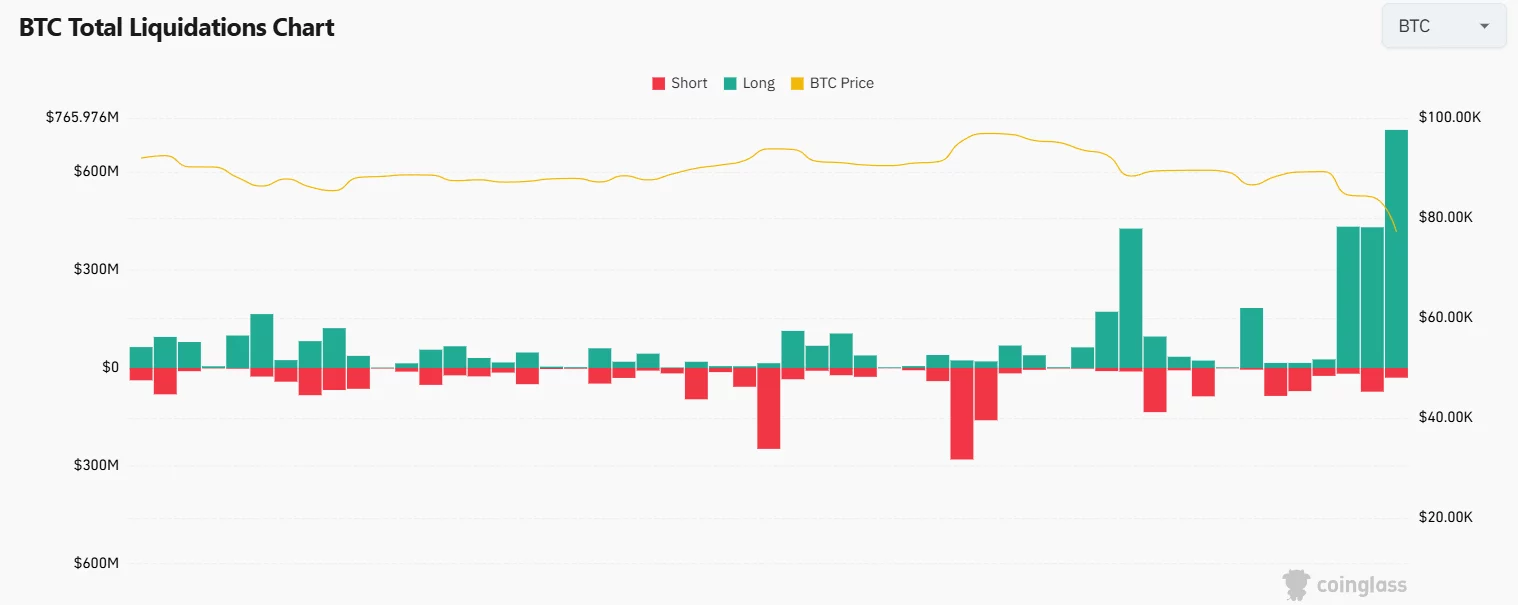
At the center of the decline was a cascade of long liquidations. Between January 29 and 31, more than $1.5 billion in leveraged long positions were wiped out, according to Coinglass data, marking the largest single-day liquidation event since November 2025. The forced selling amplified downside momentum as stop-losses were triggered and margin calls accelerated the drop.
$1.5B liquidated as Bitcoin drops 13% and market liquidity, attention pull back - 2

Once key support levels break, leveraged positions are automatically closed, pushing prices lower regardless of broader market conviction. This dynamic helps explain the speed and depth of the decline, which outpaced typical spot-driven corrections.

Institutional flows turn negative

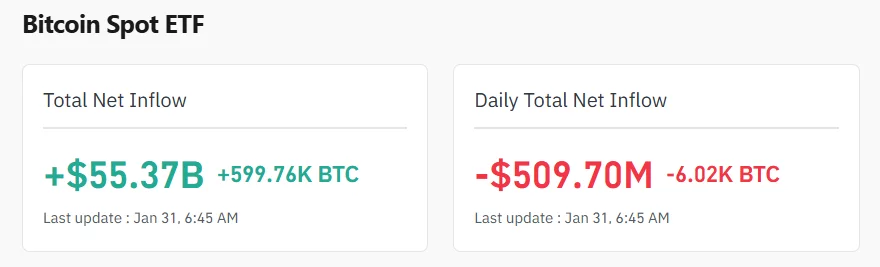
Pressure on Bitcoin intensified as institutional capital retreated from regulated crypto exposure. Spot Bitcoin exchange-traded funds recorded net outflows of approximately $509 million on January 31, signaling a shift toward risk reduction among asset managers and allocators.
$1.5B liquidated as Bitcoin drops 13% and market liquidity, attention pull back - 3

The recent outflows suggest that institutional participants are rotating capital away from Bitcoin, at least temporarily, amid broader risk-off sentiment and deteriorating technical conditions.

Bear markets weigh on crypto visibility and media attention

Beyond price action, prolonged drawdowns tend to reshape the broader crypto information landscape. During risk-off phases, declining prices are often accompanied by falling public interest, reduced search activity, and weaker traffic across crypto-focused media.

According to the latest Outset Data Pulse report on US crypto media traffic, Outset PR identified a direct correlation between Bitcoin price dynamics and readership trends across major crypto publications. As BTC enters sustained downturns, overall traffic consistently contracts, reflecting reduced retail engagement and lower speculative appetite.

This drop in attention creates a secondary challenge for the industry: visibility becomes harder to maintain precisely when clarity matters most.

Strategic communication as a defensive asset

In this environment, communication strategy becomes less about amplification and more about discipline. With fewer active market participants and shrinking media bandwidth, messaging that lacks structure or continuity is more likely to be ignored.

Outset PR highlights that during bear-market conditions, projects that maintain consistent narrative frameworks and substance-driven content rather than relying on hype tend to preserve mindshare more effectively. 

As crypto markets continue to digest the recent deleveraging cycle, visibility risks are likely to persist alongside price volatility. For Web3 projects, the ability to sustain a clear narrative through downturns may prove as important as product execution itself.

BTC technical structure remains fragile

From a technical perspective, Bitcoin sits below its 100-day moving average at 93,937, which can signal counter-trend moves rather than confirmed reversals. The Momentum indicator remains deeply negative at −12,152, and the MACD at −2,120 continues to signal sell conditions, suggesting that bearish pressure has not yet fully exhausted itself.

Oversold readings can precede short-term bounces, but without a decisive reclaim of key moving averages accompanied by rising volume and improving market breadth, upside moves are likely to be corrective rather than structural.

A market in reset mode

The current environment reflects a broader reset mode. Markets tend to stabilize once forced selling subsides, but sustained recoveries typically emerge only after leverage rebuilds under more conservative positioning and spot demand returns.

For now, Bitcoin appears caught between the aftershocks of a leverage-driven unwind and the absence of new capital willing to step in aggressively. Until participation recovers, volatility may remain elevated and rallies vulnerable.

Disclaimer: The articles reposted on this site are sourced from public platforms and are provided for informational purposes only. They do not necessarily reflect the views of MEXC. All rights remain with the original authors. If you believe any content infringes on third-party rights, please contact [email protected] for removal. MEXC makes no guarantees regarding the accuracy, completeness, or timeliness of the content and is not responsible for any actions taken based on the information provided. The content does not constitute financial, legal, or other professional advice, nor should it be considered a recommendation or endorsement by MEXC.

You May Also Like

CEO Sandeep Nailwal Shared Highlights About RWA on Polygon

CEO Sandeep Nailwal Shared Highlights About RWA on Polygon

The post CEO Sandeep Nailwal Shared Highlights About RWA on Polygon appeared on BitcoinEthereumNews.com. Polygon CEO Sandeep Nailwal highlighted Polygon’s lead in global bonds, Spiko US T-Bill, and Spiko Euro T-Bill. Polygon published an X post to share that its roadmap to GigaGas was still scaling. Sentiments around POL price were last seen to be bearish. Polygon CEO Sandeep Nailwal shared key pointers from the Dune and RWA.xyz report. These pertain to highlights about RWA on Polygon. Simultaneously, Polygon underlined its roadmap towards GigaGas. Sentiments around POL price were last seen fumbling under bearish emotions. Polygon CEO Sandeep Nailwal on Polygon RWA CEO Sandeep Nailwal highlighted three key points from the Dune and RWA.xyz report. The Chief Executive of Polygon maintained that Polygon PoS was hosting RWA TVL worth $1.13 billion across 269 assets plus 2,900 holders. Nailwal confirmed from the report that RWA was happening on Polygon. The Dune and https://t.co/W6WSFlHoQF report on RWA is out and it shows that RWA is happening on Polygon. Here are a few highlights: – Leading in Global Bonds: Polygon holds 62% share of tokenized global bonds (driven by Spiko’s euro MMF and Cashlink euro issues) – Spiko U.S.… — Sandeep | CEO, Polygon Foundation (※,※) (@sandeepnailwal) September 17, 2025 The X post published by Polygon CEO Sandeep Nailwal underlined that the ecosystem was leading in global bonds by holding a 62% share of tokenized global bonds. He further highlighted that Polygon was leading with Spiko US T-Bill at approximately 29% share of TVL along with Ethereum, adding that the ecosystem had more than 50% share in the number of holders. Finally, Sandeep highlighted from the report that there was a strong adoption for Spiko Euro T-Bill with 38% share of TVL. He added that 68% of returns were on Polygon across all the chains. Polygon Roadmap to GigaGas In a different update from Polygon, the community…
Share
BitcoinEthereumNews2025/09/18 01:10
SHIB Price Analysis for February 8

SHIB Price Analysis for February 8

The post SHIB Price Analysis for February 8 appeared on BitcoinEthereumNews.com. Original U.Today article Can traders expect SHIB to test the $0.0000070 range soon
Share
BitcoinEthereumNews2026/02/09 00:26
UK Looks to US to Adopt More Crypto-Friendly Approach

UK Looks to US to Adopt More Crypto-Friendly Approach

The post UK Looks to US to Adopt More Crypto-Friendly Approach appeared on BitcoinEthereumNews.com. The UK and US are reportedly preparing to deepen cooperation on digital assets, with Britain looking to copy the Trump administration’s crypto-friendly stance in a bid to boost innovation.  UK Chancellor Rachel Reeves and US Treasury Secretary Scott Bessent discussed on Tuesday how the two nations could strengthen their coordination on crypto, the Financial Times reported on Tuesday, citing people familiar with the matter.  The discussions also involved representatives from crypto companies, including Coinbase, Circle Internet Group and Ripple, with executives from the Bank of America, Barclays and Citi also attending, according to the report. The agreement was made “last-minute” after crypto advocacy groups urged the UK government on Thursday to adopt a more open stance toward the industry, claiming its cautious approach to the sector has left the country lagging in innovation and policy.  Source: Rachel Reeves Deal to include stablecoins, look to unlock adoption Any deal between the countries is likely to include stablecoins, the Financial Times reported, an area of crypto that US President Donald Trump made a policy priority and in which his family has significant business interests. The Financial Times reported on Monday that UK crypto advocacy groups also slammed the Bank of England’s proposal to limit individual stablecoin holdings to between 10,000 British pounds ($13,650) and 20,000 pounds ($27,300), claiming it would be difficult and expensive to implement. UK banks appear to have slowed adoption too, with around 40% of 2,000 recently surveyed crypto investors saying that their banks had either blocked or delayed a payment to a crypto provider.  Many of these actions have been linked to concerns over volatility, fraud and scams. The UK has made some progress on crypto regulation recently, proposing a framework in May that would see crypto exchanges, dealers, and agents treated similarly to traditional finance firms, with…
Share
BitcoinEthereumNews2025/09/18 02:21