

Gold Bounces Back Above $5,000 as Iran Tensions Sparks Investor Flight to Safety
TLDR
- Gold prices climbed back above $5,000 per ounce on Wednesday after a major selloff last week that saw prices drop over $1,000.
- Rising tensions between the U.S. and Iran drove safe haven demand, with the U.S. Navy shooting down an Iranian drone in the Arabian Sea.
- Spot gold rose 2.3% to $5,060.28 per ounce while gold futures increased 2.9% to $5,078.96 per ounce on Wednesday.
- Gold is still up nearly 15-17% in 2026 despite recent volatility, with analysts maintaining bullish forecasts including Deutsche Bank’s $6,000 target.
- China’s four largest gold ETFs saw nearly $1 billion in outflows on Tuesday, the largest single-day decline on record.
Gold prices bounced back above $5,000 per ounce on Wednesday as renewed tensions between the United States and Iran pushed investors toward safe haven assets. The recovery marks a sharp turnaround after bullion experienced its worst week in years.
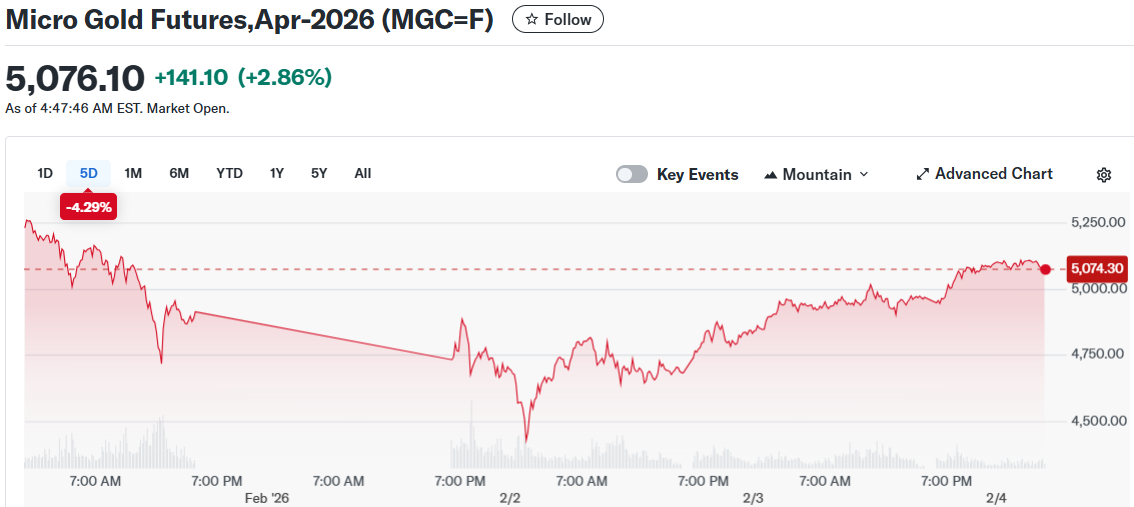 Micro Gold Futures,Apr-2026 (MGC=F)
Spot gold rose 2.3% to $5,060.28 per ounce by early Asian trading hours. Gold futures for April delivery climbed 2.9% to $5,078.96 per ounce. The gains came after a 6% jump in the previous session as dip buyers entered the market.
The price recovery followed reports that the U.S. Navy shot down an Iranian drone over the Arabian Sea. Iranian gunboats were also seen approaching a U.S.-linked tanker in the Strait of Hormuz. These incidents occurred just days before scheduled diplomatic talks between Tehran and Washington set for Friday.
Last week brought extreme volatility to precious metals markets. Gold plunged more than $1,000 from its record high of nearly $5,600 per ounce reached on January 29. Silver experienced its biggest single-day drop on record during the same period.
Historic Rally Followed by Sharp Correction
The January rally in gold was driven by multiple factors. Speculative momentum, geopolitical concerns, and worries about Federal Reserve independence all contributed to the surge. Chinese funds and Western retail investors had built large positions in precious metals.
Leveraged exchange-traded products and call-options buying added fuel to the rally. The collapse began during Asian trading hours on Friday and continued into early this week. Market analysts had warned that the advances were too large and too fast.
Despite recent losses, gold remains up between 15-17% for 2026. Silver also posted gains on Wednesday, rising 2.8% to $87.50 per ounce. Platinum rallied 3% to $2,286.72 per ounce.
Institutional Investors Remain Divided
China’s four largest gold-backed ETFs recorded combined outflows of nearly $1 billion on Tuesday. This marked the biggest single-day decline on record. The same funds had been seeing record inflows just days earlier.
Some institutional investors see the pullback as a buying opportunity. Fidelity Fund sold gold holdings before the plunge but is now watching for a chance to buy again. Portfolio manager George Efstathopoulos confirmed the fund’s interest in re-entering the market.
OCBC analysts described the recent selloff as forced selling and margin-related liquidation. They noted that these pressures appear to have faded for now. However, they cautioned that sensitivity to the U.S. dollar and Federal Reserve policy remains high.
The brokerage characterized the price drop as normalization rather than a trend reversal. OCBC maintained its end-2026 targets of $5,600 per ounce for gold and $133 per ounce for silver.
Central Bank Demand Supports Long-Term Outlook
ANZ analysts pointed out that the fundamental drivers behind gold’s strength remain in place. These include safe haven demand, physical buying, and central bank purchases. Daniel Ghali from TD Securities said forced sales have likely run their course in precious metals.
Deutsche Bank maintained its forecast for gold to reach $6,000 per ounce. Goldman Sachs analysts said they see upside risk to their year-end forecast of $5,400. Bank of America warned that volatility in precious metals will remain elevated.
The recent price drop was partly triggered by expectations around Kevin Warsh, President Donald Trump’s nominee to head the Federal Reserve. Markets anticipated Warsh would be less dovish than hoped. This sparked a sharp increase in the dollar, which pressured metal prices.
President Trump confirmed that diplomatic talks between the U.S. and Iran are ongoing despite the recent military incidents.
The post Gold Bounces Back Above $5,000 as Iran Tensions Sparks Investor Flight to Safety appeared first on CoinCentral.
You May Also Like

Shiba Inu Offers 50 ETH Bounty to Recover Shibarium Stolen Funds
