Amazon and Apple beat earnings expectations, but their shares fell on weak jobs data.Amazon and Apple beat earnings expectations, but their shares fell on weak jobs data.

Dow Jones down 600 points as rate cuts odds surge on hiring slump

2 min read

U.S. stock indices fell as weak jobs data spooked investors, despite earnings beats from Apple and Amazon.

Summary
  • Dow Jones fell more than 600 points on weak jobs data.
  • Apple stock fell despite strong earnings.
  • Fed may have to lower interest rates to boost hiring.

Weak jobs data hit stocks hard, despite improving odds of the Federal Reserve cutting interest rates. On Friday, April 1, the Dow Jones dropped 620 points, or 1.42%, while the S&P 500 lost 1.75%. At the same time, the tech-heavy Nasdaq declined as much as 2.33%. The main driver of the declines was July’s labor market report, which showed just 73,000 new jobs versus the expected 104,000.

Tech stocks were among the biggest losers, and even Apple fell 2.5% despite strong earnings. The tech giant reported its highest revenue growth since December 2021. The report indicated that U.S. consumers continued spending despite inflation concerns stemming from the trade war. Apple also stated it plans to significantly increase its investment in AI.
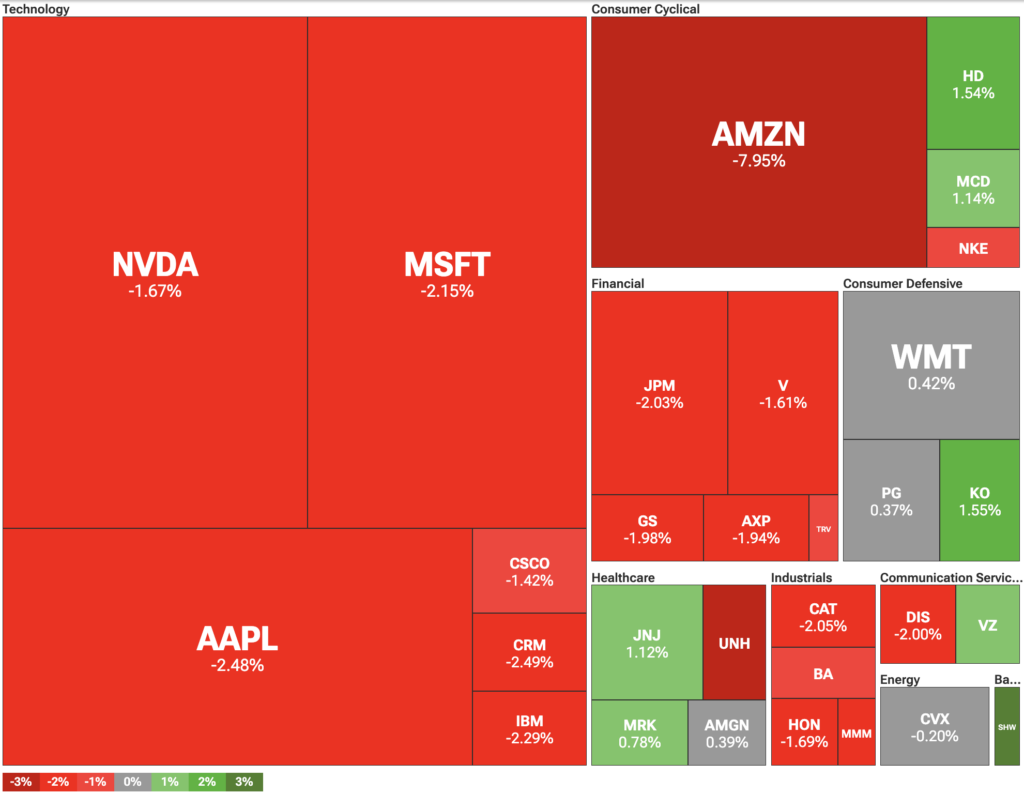
Dow Jones Industrial Average heatmap

Amazon’s earnings also exceeded expectations, with earnings per share of $1.68 compared to the $1.33 estimate. However, the company’s third-quarter guidance was relatively modest. This fell short of investor expectations, especially following the company’s multibillion-dollar investment in AI. As a result, its stock was among the biggest losers, falling 8%.

Fed may have to cut rates on weak jobs data

While tech stocks took a beating, there may be a silver lining. Specifically, the weak labor market could force the Federal Reserve to cut interest rates. CME FedWatch futures markets are now pricing in an 83% chance of a rate cut in September, up sharply from 38% just a day earlier—likely due to the disappointing employment data.

The Fed has a dual mandate to maintain low inflation and high employment. So far, the central bank has resisted pressure from President Donald Trump’s White House to lower rates, despite a split among FOMC members.

Disclaimer: The articles reposted on this site are sourced from public platforms and are provided for informational purposes only. They do not necessarily reflect the views of MEXC. All rights remain with the original authors. If you believe any content infringes on third-party rights, please contact [email protected] for removal. MEXC makes no guarantees regarding the accuracy, completeness, or timeliness of the content and is not responsible for any actions taken based on the information provided. The content does not constitute financial, legal, or other professional advice, nor should it be considered a recommendation or endorsement by MEXC.

You May Also Like

Strategy to initiate a bitcoin security program addressing quantum uncertainty

Strategy to initiate a bitcoin security program addressing quantum uncertainty

Markets Share Share this article
Copy linkX (Twitter)LinkedInFacebookEmail
Strategy to initiate a bitcoin security prog
Share
Coindesk2026/02/06 18:21
Strategic Shift Impacts Crypto Trading Landscape

Strategic Shift Impacts Crypto Trading Landscape

The post Strategic Shift Impacts Crypto Trading Landscape appeared on BitcoinEthereumNews.com. Bybit Delists MILK: Strategic Shift Impacts Crypto Trading Landscape
Share
BitcoinEthereumNews2026/02/06 18:01
SEC clears framework for fast-tracked crypto ETF listings

SEC clears framework for fast-tracked crypto ETF listings

The post SEC clears framework for fast-tracked crypto ETF listings appeared on BitcoinEthereumNews.com. The Securities and Exchange Commission has approved new generic listing standards for spot crypto exchange-traded funds, clearing the way for faster approvals. Summary SEC has greenlighted new generic listing standards for spot crypto ETFs. Rule change eliminates lengthy case-by-case approvals, aligning crypto ETFs with commodity funds. Grayscale’s Digital Large Cap Fund and Bitcoin ETF options also gain approval. The U.S. SEC has approved new generic listing standards that will allow exchanges to fast-track spot crypto ETFs, marking a pivotal shift in U.S. digital asset regulation. According to a Sept. 17 press release, the SEC voted to approve rule changes from Nasdaq, NYSE Arca, and Cboe BZX, enabling them to list and trade commodity-based trust shares, including those holding spot digital assets, without submitting individual proposals for each product. A streamlined path for crypto ETFs Under the new rules, an ETF can be listed without SEC sign-off if its underlying asset trades on a market with surveillance-sharing agreements, has active CFTC-regulated futures contracts for at least six months, or already represents at least 40% of an existing listed ETF. This brings crypto ETFs in line with traditional commodity-based funds under Rule 6c-11, eliminating a process that could take up to 240 days. SEC chair Paul Atkins said the move was designed to “maximize investor choice and foster innovation” while ensuring the U.S. remains the leading market for digital assets. Jamie Selway, director of the division of trading and markets, called the framework “a rational, rules-based approach” that balances access with investor protection. First products already approved Alongside the new standards, the SEC cleared the listing of the Grayscale Digital Large Cap Fund, which tracks spot assets based on the CoinDesk 5 Index. It also approved trading of options tied to the Cboe Bitcoin U.S. ETF Index and its mini version, with…
Share
BitcoinEthereumNews2025/09/18 14:04