In this article, PANews reviews the market performance of the 14 tokens involved in the crypto trust funds launched by Grayscale in the last bull market cycle. Most of the products were launched in the middle and late stages of the bull market, with an average maximum increase of 204.8%. The price performance was significantly affected by market fluctuations, and the average period required to reach a new high was about 84.4 days.In this article, PANews reviews the market performance of the 14 tokens involved in the crypto trust funds launched by Grayscale in the last bull market cycle. Most of the products were launched in the middle and late stages of the bull market, with an average maximum increase of 204.8%. The price performance was significantly affected by market fluctuations, and the average period required to reach a new high was about 84.4 days.

Revisiting the "Grayscale Effect" of the last bull market: 14 tokens have a return rate of over 200%, and the market cycle has a significant impact

2024/12/24 16:45
6 min read

Author: Nancy, PANews

In recent times, with the soaring prices of coins such as SUI and ZEN, the "Grayscale effect" has reappeared, and Grayscale's holdings have become one of the market investment indicators. So, how do Grayscale's carefully selected crypto tokens perform in terms of return on investment? In this article, PANews reviewed the market performance of the 14 tokens involved in the crypto trust fund launched by Grayscale during the last bull market cycle, from March 2021 to March 2022.

The average rate of return exceeds 200%, and the market cycle has a significant impact

During the last bull market, Grayscale launched 14 cryptocurrency trust products through the over-the-counter market, DeFi fund DEFG and GSCPxE fund. These products were launched one after another in about a year. Judging from the time of product launch, Grayscale began to launch related token funds in the early stage of the bull market, and began to accelerate the layout frequency in the middle and late stages.
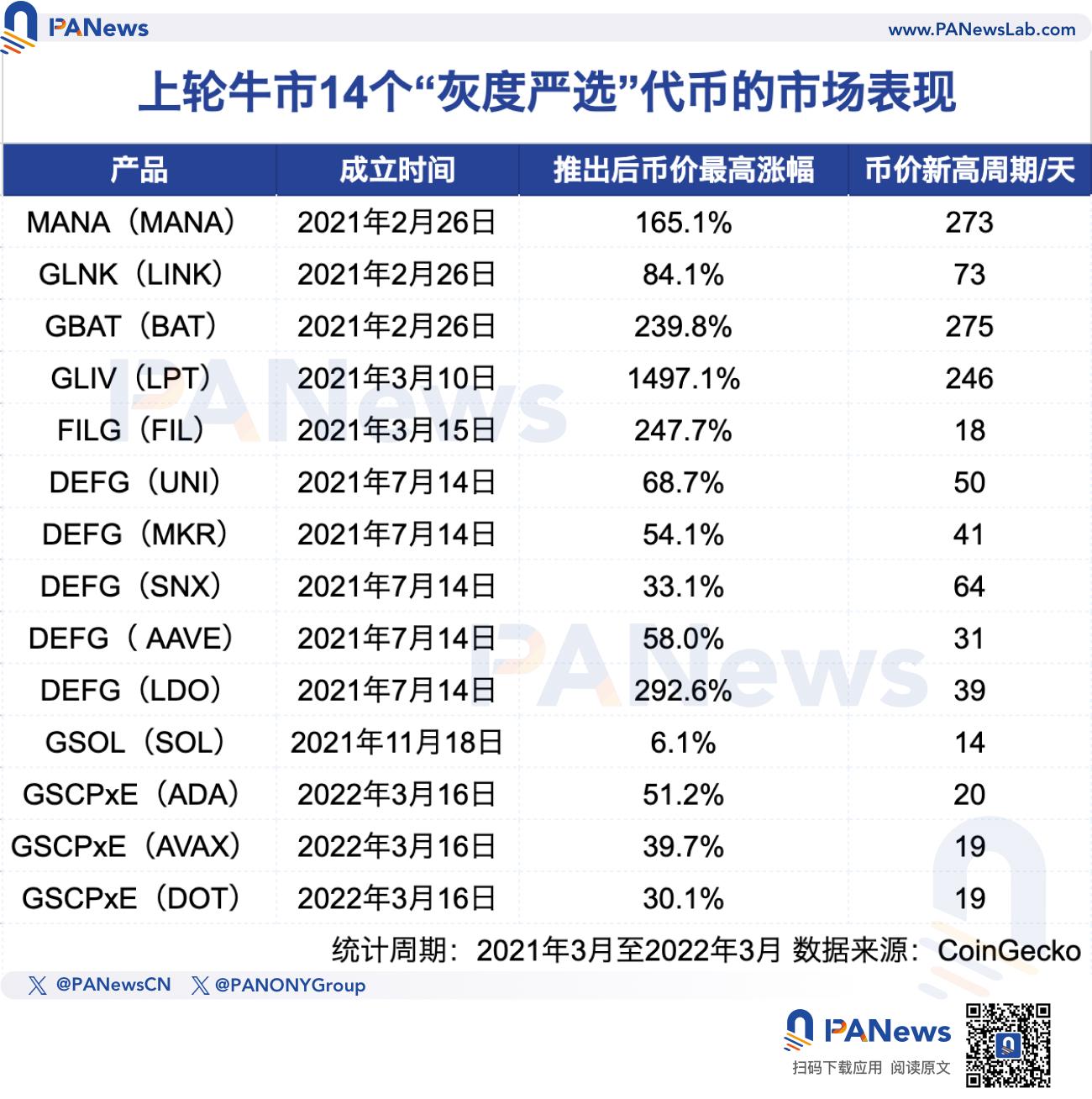
Revisiting the "Grayscale Effect" of the last bull market: 14 tokens have a return rate of over 200%, and the market cycle has a significant impact

In terms of return on investment, the average maximum increase of these 14 tokens after the launch of Grayscale was 204.8%. Among them, the increases of LPT, LDO and BAT were particularly outstanding, reaching 1497.1%, 292.6% and 239.8% respectively. In contrast, the increases of SOL, DOT and SNX were far below the average.

From the perspective of the length of time required for investment to generate returns, the average period for the 14 tokens to reach a new high is 84.4 days, among which BAT, MANA and LPT require a longer period, basically exceeding 250 days, but the rate of return is also relatively high; while SOL, FIL, AVAX and DOT reached new highs in a shorter period of time, but their gains were relatively limited, and this period was in the market adjustment period after Bitcoin reached a new high. In addition to indicating that under normal circumstances, the longer the investment period during the bull market, the more advantageous the holding rate of return, this phenomenon is also related to the time of product launch. In the past, the rising cycle of the sector showed that most public chains were the first wave of rising targets in the bull market. Most of these projects launched by Grayscale achieved good gains in the early stage, resulting in limited room for later growth.

However, this difference is also affected to some extent by changes in the market cycle. Specifically, the average increase of the token funds launched by Grayscale in the early bull market in the first half of 2021 was 446.8%; in the middle of the bull market from April to November 2021, the increase dropped to 85.4%; by March 2022, when the crypto market was in a correction period, the increase of the tokens launched was only 40.3%. It can be seen that Grayscale's return on investment is greatly affected by market cycle fluctuations and shows obvious cyclical characteristics.

From this point of view, although Grayscale's cryptocurrency trust products provided considerable returns during the bull market, their performance was significantly affected by market fluctuations. Therefore, investors should fully consider the overall market trend when making investment decisions.

Participate in multiple explosive token layouts to expand the scope of investment products

Recently, the prices of multiple tokens have performed strongly, and Grayscale’s layout may play an important role in driving market trends.

For example, XRP, whose price broke through a multi-year high some time ago. In September this year, Grayscale announced that it would re-launch the first US XRP Trust Fund and officially open it to qualified investors in the near future. You should know that as early as January 2021, Grayscale withdrew from the XRP Trust and liquidated its tokens due to Ripple's legal dispute. This shift was also interpreted by the outside world as paving the way for a potential XRP spot ETF, and the price of XRP continued to rise in the following months, which may indicate the market's positive response to Grayscale's move.

The price of SUI has also performed very strongly in the past few months. A few months ago, Grayscale updated its investment strategy and announced the top 20 tokens that are expected to rise sharply by the end of 2024, including the addition of 6 new tokens such as SUI and TAO. At the same time, Grayscale also started the investment layout of SUI, announcing in August this year that it would launch GrayscaleSuiTrust, which will be officially opened to qualified investors in the near future.

Another token worth noting is ZEN, which has also seen a gratifying rise in price recently, with a 30-day increase of about 215%. After recently increasing its holdings of ZEN tokens, Grayscale also announced that it had submitted Grayscale Horizen Trust (ZEN) 8-K form to the SEC, allowing investors to gain exposure to ZEN tokens in the form of securities.

In addition to the above projects, Grayscale has also provided legitimacy and recognition for more crypto assets. On December 24, Grayscale announced that it would open private subscriptions for 22 cryptocurrency trust products to qualified investors, including mainstream tokens such as AAVE, AVAX, LINK, SOL, XRP, and fund products in subdivided tracks such as DeFi and AI. Investors can subscribe according to net asset value (NAV). The products opened this time include theme funds such as Grayscale Decentralized AI Fund and Grayscale Decentralized Finance Fund, as well as single asset trusts of emerging protocols such as Bittensor, Lido DAO, and Optimism.

In addition, Grayscale is further accelerating its business expansion and seeking more professional talents to cope with increasingly complex market demands. Earlier this month, Grayscale announced the launch of recruitment, involving positions including: tax director, ETF product senior manager, digital asset trader, portfolio manager, product manager and engineering director.

Although the specific impact of these measures on currency price changes has not yet fully emerged, Grayscale will further promote crypto assets into the mainstream market by providing investors with more diversified and professional investment products.

Related reading: A review of 21 Grayscale crypto trust funds: some have risen 10 times, while others have been bearish all the way. It is easy to step on the last train of the bull market and become a counter-indicator of the market

Market Opportunity
Effect AI Logo
Effect AI Price(EFFECT)
$0.004676
$0.004676$0.004676
+0.06%
USD
Effect AI (EFFECT) Live Price Chart
Disclaimer: The articles reposted on this site are sourced from public platforms and are provided for informational purposes only. They do not necessarily reflect the views of MEXC. All rights remain with the original authors. If you believe any content infringes on third-party rights, please contact [email protected] for removal. MEXC makes no guarantees regarding the accuracy, completeness, or timeliness of the content and is not responsible for any actions taken based on the information provided. The content does not constitute financial, legal, or other professional advice, nor should it be considered a recommendation or endorsement by MEXC.

You May Also Like

Over 60% of crypto press releases linked to high-risk or scam projects: Report

Over 60% of crypto press releases linked to high-risk or scam projects: Report

A data analysis shows crypto press release wires are dominated by scam-linked projects, hype-driven content and low-impact announcements, raising concerns about
Share
Crypto.news2026/02/04 22:02
ArtGis Finance Partners with MetaXR to Expand its DeFi Offerings in the Metaverse
ArtGis Finance Partners with MetaXR to Expand its DeFi Offerings in the Metaverse

By using this collaboration, ArtGis utilizes MetaXR’s infrastructure to widen access to its assets and enable its customers to interact with the metaverse.
Share
Blockchainreporter2025/09/18 00:07
Crucial US Stock Market Update: What Wednesday’s Mixed Close Reveals

Crucial US Stock Market Update: What Wednesday’s Mixed Close Reveals

BitcoinWorld Crucial US Stock Market Update: What Wednesday’s Mixed Close Reveals The financial world often keeps us on our toes, and Wednesday was no exception. Investors watched closely as the US stock market concluded the day with a mixed performance across its major indexes. This snapshot offers a crucial glimpse into current investor sentiment and economic undercurrents, prompting many to ask: what exactly happened? Understanding the Latest US Stock Market Movements On Wednesday, the closing bell brought a varied picture for the US stock market. While some indexes celebrated gains, others registered slight declines, creating a truly mixed bag for investors. The Dow Jones Industrial Average showed resilience, climbing by a notable 0.57%. This positive movement suggests strength in some of the larger, more established companies. Conversely, the S&P 500, a broader benchmark often seen as a barometer for the overall market, experienced a modest dip of 0.1%. The technology-heavy Nasdaq Composite also saw a slight retreat, sliding by 0.33%. This particular index often reflects investor sentiment towards growth stocks and the tech sector. These divergent outcomes highlight the complex dynamics currently at play within the American economy. It’s not simply a matter of “up” or “down” for the entire US stock market; rather, it’s a nuanced landscape where different sectors and company types are responding to unique pressures and opportunities. Why Did the US Stock Market See Mixed Results? When the US stock market delivers a mixed performance, it often points to a tug-of-war between various economic factors. Several elements could have contributed to Wednesday’s varied closings. For instance, positive corporate earnings reports from certain industries might have bolstered the Dow. At the same time, concerns over inflation, interest rate policies by the Federal Reserve, or even global economic uncertainties could have pressured growth stocks, affecting the S&P 500 and Nasdaq. Key considerations often include: Economic Data: Recent reports on employment, manufacturing, or consumer spending can sway market sentiment. Corporate Announcements: Strong or weak earnings forecasts from influential companies can significantly impact their respective sectors. Interest Rate Expectations: The prospect of higher or lower interest rates directly influences borrowing costs for businesses and consumer spending, affecting future profitability. Geopolitical Events: Global tensions or trade policies can introduce uncertainty, causing investors to become more cautious. Understanding these underlying drivers is crucial for anyone trying to make sense of daily market fluctuations in the US stock market. Navigating Volatility in the US Stock Market A mixed close, while not a dramatic downturn, serves as a reminder that market volatility is a constant companion for investors. For those involved in the US stock market, particularly individuals managing their portfolios, these days underscore the importance of a well-thought-out strategy. It’s important not to react impulsively to daily movements. Instead, consider these actionable insights: Diversification: Spreading investments across different sectors and asset classes can help mitigate risk when one area underperforms. Long-Term Perspective: Focusing on long-term financial goals rather than short-term gains can help weather daily market swings. Stay Informed: Keeping abreast of economic news and company fundamentals provides context for market behavior. Consult Experts: Financial advisors can offer personalized guidance based on individual risk tolerance and objectives. Even small movements in major indexes can signal shifts that require attention, guiding future investment decisions within the dynamic US stock market. What’s Next for the US Stock Market? Looking ahead, investors will be keenly watching for further economic indicators and corporate announcements to gauge the direction of the US stock market. Upcoming inflation data, statements from the Federal Reserve, and quarterly earnings reports will likely provide more clarity. The interplay of these factors will continue to shape investor confidence and, consequently, the performance of the Dow, S&P 500, and Nasdaq. Remaining informed and adaptive will be key to understanding the market’s trajectory. Conclusion: Wednesday’s mixed close in the US stock market highlights the intricate balance of forces influencing financial markets. While the Dow showed strength, the S&P 500 and Nasdaq experienced slight declines, reflecting a nuanced economic landscape. This reminds us that understanding the ‘why’ behind these movements is as important as the movements themselves. As always, a thoughtful, informed approach remains the best strategy for navigating the complexities of the market. Frequently Asked Questions (FAQs) Q1: What does a “mixed close” mean for the US stock market? A1: A mixed close indicates that while some major stock indexes advanced, others declined. It suggests that different sectors or types of companies within the US stock market are experiencing varying influences, rather than a uniform market movement. Q2: Which major indexes were affected on Wednesday? A2: On Wednesday, the Dow Jones Industrial Average gained 0.57%, while the S&P 500 edged down 0.1%, and the Nasdaq Composite slid 0.33%, illustrating the mixed performance across the US stock market. Q3: What factors contribute to a mixed stock market performance? A3: Mixed performances in the US stock market can be influenced by various factors, including specific corporate earnings, economic data releases, shifts in interest rate expectations, and broader geopolitical events that affect different market segments uniquely. Q4: How should investors react to mixed market signals? A4: Investors are generally advised to maintain a long-term perspective, diversify their portfolios, stay informed about economic news, and avoid impulsive decisions. Consulting a financial advisor can also provide personalized guidance for navigating the US stock market. Q5: What indicators should investors watch for future US stock market trends? A5: Key indicators to watch include upcoming inflation reports, statements from the Federal Reserve regarding monetary policy, and quarterly corporate earnings reports. These will offer insights into the future direction of the US stock market. Did you find this analysis of the US stock market helpful? Share this article with your network on social media to help others understand the nuances of current financial trends! To learn more about the latest stock market trends, explore our article on key developments shaping the US stock market‘s future performance. This post Crucial US Stock Market Update: What Wednesday’s Mixed Close Reveals first appeared on BitcoinWorld.
Share
Coinstats2025/09/18 05:30