

Orbital AI Data Centers: The Daunting Economic Reality Behind the Space Compute Dream
BitcoinWorld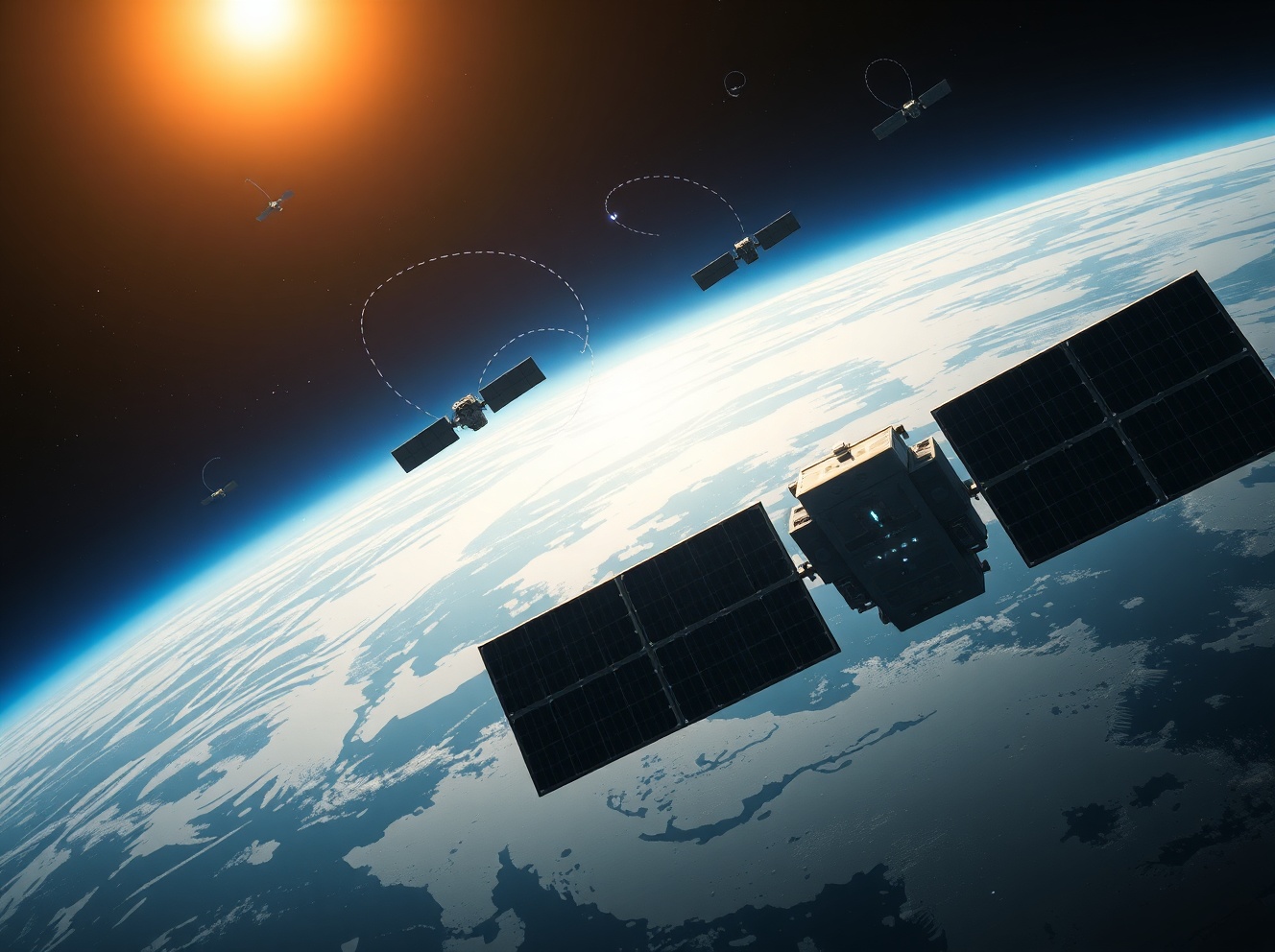
Orbital AI Data Centers: The Daunting Economic Reality Behind the Space Compute Dream
San Francisco, CA – October 2025: The vision of massive artificial intelligence data centers floating in orbit has shifted from science fiction to a serious corporate strategy. However, beneath the ambitious announcements from SpaceX, Google, and well-funded startups lies a brutal economic equation. Launch costs, satellite manufacturing, and the unforgiving space environment present monumental hurdles that make terrestrial data centers, for now, the far cheaper option.
The Sky-High Price Tag of Orbital Compute
Currently, building compute capacity in space carries a staggering premium. According to an analysis by space engineer Andrew McCalip, a 1 Gigawatt orbital data center could cost approximately $42.4 billion. This figure is nearly three times the cost of an equivalent ground-based facility. The primary drivers are the upfront capital expenditures for satellite construction and the expense of launching thousands of tons of hardware into orbit. This economic reality tempers the immediate feasibility of projects like SpaceX’s proposed million-satellite constellation or Starcloud’s 80,000-satellite network.
Experts consistently identify launch costs as the fundamental barrier. While SpaceX’s Falcon 9 has dramatically reduced prices to roughly $3,600 per kilogram, orbital data center business models require a further 18-fold reduction. Project Suncatcher, Google’s space AI effort, cites a target of $200/kg, a milestone not expected until the 2030s. The entire economic case hinges on the success and pricing strategy of next-generation vehicles like SpaceX’s Starship, which remains in development.
The Manufacturing Challenge Beyond Launch
Even with cheaper launches, satellite production costs present a second massive hurdle. “People are not taking into account the satellites are almost $1,000 a kilo right now,” McCalip noted. High-performance AI satellites need robust solar arrays, advanced thermal management systems, and laser communication links. Mass-producing these complex systems at a fraction of current costs is essential. SpaceX’s experience scaling Starlink production offers a blueprint, but AI satellites are fundamentally more demanding and expensive.
Confronting the Hostile Space Environment
Proponents often claim space offers “free” cooling, but this is a significant oversimplification. In reality, dissipating heat in a vacuum requires large, heavy radiators. “You’re relying on very large radiators to just be able to dissipate that heat into the blackness of space,” explained Mike Safyan of Planet Labs, which is building prototypes for Google. Thermal management is recognized as a long-term engineering challenge.
Furthermore, cosmic radiation poses a constant threat. It degrades silicon chips over time and can cause “bit flip” errors that corrupt data. Mitigation strategies like radiation shielding or using hardened components add mass, complexity, and cost. Companies like Google and SpaceX are actively testing their AI chips in particle accelerators to understand these effects. Additionally, the solar panels that power these stations face their own dilemma: cheap silicon panels degrade quickly in space, while durable, space-grade panels are prohibitively expensive.
Architectural and Workload Limitations
A critical, unanswered question is what type of AI work these orbital centers will actually perform. Training massive AI models requires thousands of GPUs to work in tight coordination with extremely high-bandwidth connections. Current inter-satellite laser links max out around 100 Gbps, far below the hundreds of gigabits per second used in terrestrial data center networks. Google’s Project Suncatcher concept addresses this by flying 81 satellites in a precise formation to use terrestrial-grade connections, introducing immense operational complexity.
Consequently, the initial use case will likely be AI inference—the process of running a trained model, such as answering a ChatGPT query—rather than training. Inference tasks can be performed on dozens of GPUs, potentially on a single satellite. “Training is not the ideal thing to do in space,” said Starcloud CEO Philip Johnston. “I think almost all inference workloads will be done in space.” This delineation shapes the near-term business model and potential revenue streams for the first orbital AI deployments.
The Path to Economic Viability
The economic case for orbital AI rests on a convergence of factors beyond just cheaper launches. It requires:
- Massive Capital Investment: Funding the development of new spacecraft, supply chains, and infrastructure.
- Technology Breakthroughs: In radiation-hardened computing, efficient space-based power, and thermal management.
- Rising Terrestrial Costs: The equation improves if ground-based data centers face soaring energy prices, resource scarcity, or regulatory bottlenecks.
For a company like SpaceX, the strategy may be one of optionality. By developing both terrestrial AI compute through xAI and orbital capabilities, it can scale where it finds the fewest constraints. “A FLOP is a FLOP, it doesn’t matter where it lives,” McCalip said. “[SpaceX] can just scale until [it] hits permitting or capex bottlenecks on the ground, and then fall back to [their] space deployments.”
Conclusion
The dream of orbital AI data centers is propelled by genuine technological ambition and the promise of nearly limitless solar energy. However, the current economics are brutally challenging. Success depends not on a single innovation, but on simultaneous advances across launch vehicles, satellite manufacturing, and space-hardened computing. While prototypes may launch by 2027 and small-scale inference operations could begin sooner, the vision of shifting a significant percentage of global compute to orbit by 2028 remains a formidable long-term bet against physics, engineering, and finance. The race is less about who announces first and more about who can systematically dismantle this multi-faceted cost barrier.
FAQs
Q1: Why are companies like SpaceX interested in orbital AI data centers?
Companies are pursuing orbital AI primarily for energy arbitrage. Solar panels in space are far more efficient and can generate power nearly continuously. This could potentially provide a vast, clean energy source for power-hungry AI computations, circumventing terrestrial grid limitations and costs.
Q2: What is the biggest cost obstacle for space-based data centers?
The single largest cost obstacle is launch expense. Putting the massive weight of servers, solar panels, and supporting infrastructure into orbit is prohibitively expensive with current rocket technology. The business case requires launch costs to drop from thousands of dollars per kilogram to just a few hundred.
Q3: Can AI models be trained in orbit?
Training the largest AI models in orbit is currently impractical due to the need for extremely high-speed, low-latency connections between thousands of chips. The initial focus for orbital compute is on AI inference—running already-trained models—which has less demanding hardware coordination requirements.
Q4: How does radiation in space affect computer chips?
Cosmic radiation can degrade silicon chips over time and cause “bit flips,” where data in memory is accidentally changed. This can corrupt calculations and crash systems. Protecting chips requires heavy shielding or specialized, expensive “rad-hardened” components, both of which increase cost and mass.
Q5: When could orbital data centers become economically competitive?
Most analysts and company roadmaps, such as Google’s Project Suncatcher, suggest orbital data centers are unlikely to be cost-competitive with terrestrial centers until the 2030s. This timeline depends on the successful development and dramatic cost reduction of new heavy-lift rockets like Starship, alongside breakthroughs in satellite manufacturing.
This post Orbital AI Data Centers: The Daunting Economic Reality Behind the Space Compute Dream first appeared on BitcoinWorld.
You May Also Like

Upexi Posts $179M Q4 Loss as Solana Slides Near $78

Trump's 'tin-pot dictator' move guarantees his impeachment: conservative
