TLDR Markets face a shortened trading week due to Presidents Day, with focus on Walmart earnings and delayed economic data from last year’s government shutdown TLDR Markets face a shortened trading week due to Presidents Day, with focus on Walmart earnings and delayed economic data from last year’s government shutdown

Daily Market Update: Walmart Earnings and Key Economic Data Set the Tone for Shortened Week

2026/02/15 23:35
4 min read

TLDR

  • Markets face a shortened trading week due to Presidents Day, with focus on Walmart earnings and delayed economic data from last year’s government shutdown
  • Friday’s PCE inflation report for December and Q4 GDP data will give investors key insights into economic health and Federal Reserve rate decisions
  • Walmart reports quarterly earnings Thursday under new CEO John Furner after recently hitting $1 trillion market cap with 4.2% comparable sales growth
  • AI disruption fears continue hitting multiple sectors, with software, logistics, and tech stocks selling off on concerns about business model threats
  • January jobs data showed 130,000 additions (double estimates) while CPI inflation cooled more than expected, keeping Fed rates likely steady through mid-2026

Markets will navigate a compressed trading schedule this week as investors await key earnings reports and delayed economic data. The Presidents Day holiday closes markets Monday before a busy week of corporate results and inflation numbers.

Walmart takes center stage Thursday with its quarterly earnings report. The release marks the first under new CEO John Furner following his recent promotion. The retail giant recently crossed $1 trillion in market capitalization, becoming the first big box store to reach that milestone.

In its previous report, Walmart posted a 4.2% increase in comparable sales. The company also raised its full-year sales forecast. Investors will watch closely to see if consumer spending remained strong through the holiday season.

Economic Data and Federal Reserve Focus

Friday brings the Personal Consumption Expenditures price index for December. The PCE report is the Federal Reserve’s preferred inflation measure. Recent Consumer Price Index data showed inflation remained unchanged in December, and the PCE numbers could influence the Fed’s rate policy decisions.
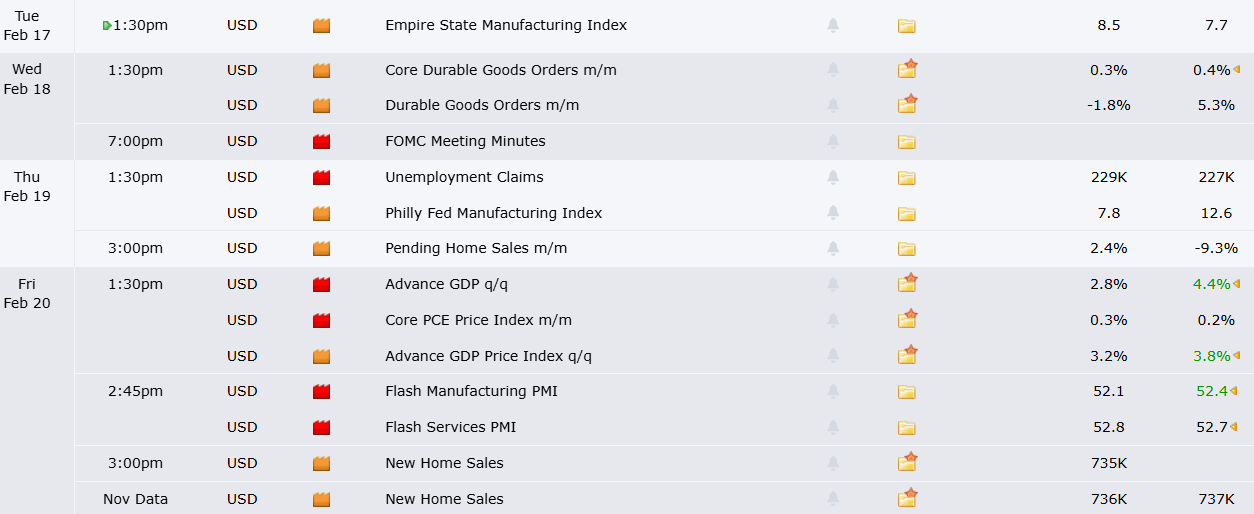
Source: Forex Factory

Thursday’s GDP release will show fourth quarter economic growth for the first time. The Bureau of Economic Analysis previously reported 4.4% growth for the third quarter. The new data will reveal whether that momentum continued into year-end.

Housing market data delayed from last year’s government shutdown will also arrive this week. Both November and December figures for housing starts and new home sales are scheduled for release. Pending home sales for January will offer a forward-looking view of the market.

January’s Federal Reserve meeting minutes will provide insight into officials’ economic views. The minutes come as markets try to gauge when the central bank might adjust interest rates. Fed Vice Chair Michelle Bowman and other officials are scheduled to speak throughout the week.

AI Disruption Pressures Multiple Sectors

Recent market action has been dominated by AI-related selling pressure. Software stocks initially led the decline, followed by financial services, retail, and logistics companies. Investors are dumping stocks at the first sign that AI tools might disrupt traditional business models.

The Nasdaq Composite fell 2.1% last week while the S&P 500 dropped 1.4%. The Dow Jones Industrial Average declined 1.2%. These index moves masked sharper swings in individual stocks across various sectors.
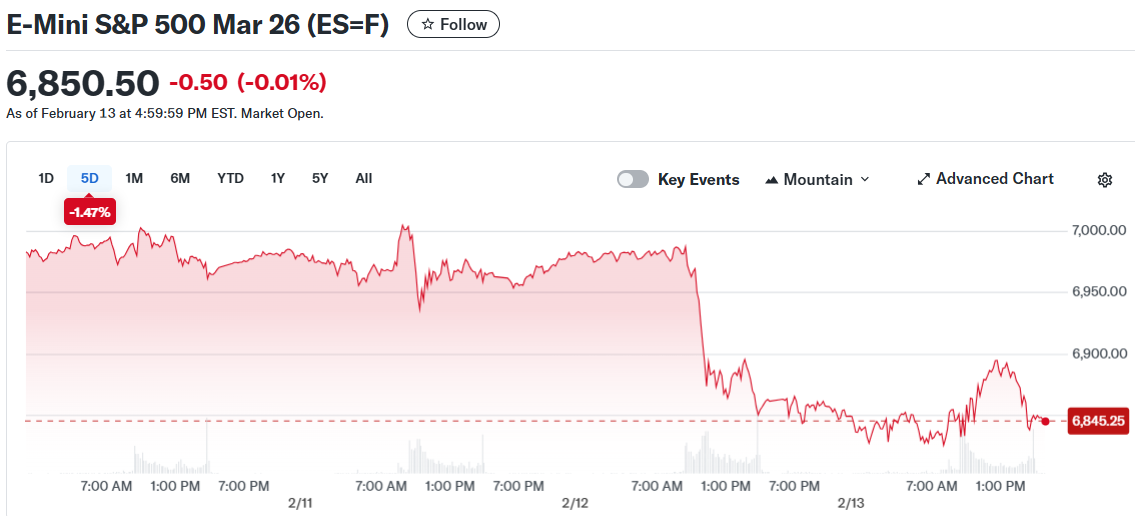
E-Mini S&P 500 Mar 26 (ES=F)E-Mini S&P 500 Mar 26 (ES=F)

A logistics company announcement this week triggered double-digit declines in freight stocks. CH Robinson Worldwide fell 12% and Universal Logistics dropped 10% after a karaoke machine maker unveiled an AI-powered logistics platform. The platform claims to scale freight volumes by 300% to 400% without adding staff.

Major tech stocks also slid despite rising AI spending projections from large corporations. Nvidia, Alphabet, and Amazon all fell on Friday. AppLovin stock dropped 18% after disappointing earnings while Pinterest tumbled 21% following its results.

Mixed Economic Signals Keep Fed Policy Steady

January’s jobs report surprised markets with 130,000 additions, double economist estimates. However, revisions cut 400,000 jobs from 2024’s total. The adjustments brought 2024’s monthly average to roughly 15,000 jobs added per month.

Friday’s CPI data showed inflation cooled more than expected in January. Core CPI, excluding food and energy, rose at the slowest annual rate since December 2021. Some categories that improved most, including non-vehicle goods and non-shelter services, matter most for long-term inflation trends.

Traders are pricing in just over 50% odds of a quarter-point Fed rate cut by June. That would bring the target rate to 3.25%-3.5%. Fed Chair Jay Powell’s term ends in May, with Kevin Warsh expected to bring a fresh perspective to monetary policy.

The post Daily Market Update: Walmart Earnings and Key Economic Data Set the Tone for Shortened Week appeared first on CoinCentral.

Disclaimer: The articles reposted on this site are sourced from public platforms and are provided for informational purposes only. They do not necessarily reflect the views of MEXC. All rights remain with the original authors. If you believe any content infringes on third-party rights, please contact [email protected] for removal. MEXC makes no guarantees regarding the accuracy, completeness, or timeliness of the content and is not responsible for any actions taken based on the information provided. The content does not constitute financial, legal, or other professional advice, nor should it be considered a recommendation or endorsement by MEXC.

You May Also Like

Structural job strain caps rand gains – Commerzbank

Structural job strain caps rand gains – Commerzbank

The post Structural job strain caps rand gains – Commerzbank appeared on BitcoinEthereumNews.com. Commerzbank’s Volkmar Baur highlights that South Africa’s unemployment
Share
BitcoinEthereumNews2026/02/19 05:27
Trump gushes over Nicki Minaj's skin to mark Black History Month: 'So beautiful'

Trump gushes over Nicki Minaj's skin to mark Black History Month: 'So beautiful'

President Donald Trump used an event marking Black History Month to remark on Nicki Minaj's complexion."I love Nikki Minaj," the president told the audience. "She
Share
Rawstory2026/02/19 05:07
Google's AP2 protocol has been released. Does encrypted AI still have a chance?

Google's AP2 protocol has been released. Does encrypted AI still have a chance?

Following the MCP and A2A protocols, the AI Agent market has seen another blockbuster arrival: the Agent Payments Protocol (AP2), developed by Google. This will clearly further enhance AI Agents' autonomous multi-tasking capabilities, but the unfortunate reality is that it has little to do with web3AI. Let's take a closer look: What problem does AP2 solve? Simply put, the MCP protocol is like a universal hook, enabling AI agents to connect to various external tools and data sources; A2A is a team collaboration communication protocol that allows multiple AI agents to cooperate with each other to complete complex tasks; AP2 completes the last piece of the puzzle - payment capability. In other words, MCP opens up connectivity, A2A promotes collaboration efficiency, and AP2 achieves value exchange. The arrival of AP2 truly injects "soul" into the autonomous collaboration and task execution of Multi-Agents. Imagine AI Agents connecting Qunar, Meituan, and Didi to complete the booking of flights, hotels, and car rentals, but then getting stuck at the point of "self-payment." What's the point of all that multitasking? So, remember this: AP2 is an extension of MCP+A2A, solving the last mile problem of AI Agent automated execution. What are the technical highlights of AP2? The core innovation of AP2 is the Mandates mechanism, which is divided into real-time authorization mode and delegated authorization mode. Real-time authorization is easy to understand. The AI Agent finds the product and shows it to you. The operation can only be performed after the user signs. Delegated authorization requires the user to set rules in advance, such as only buying the iPhone 17 when the price drops to 5,000. The AI Agent monitors the trigger conditions and executes automatically. The implementation logic is cryptographically signed using Verifiable Credentials (VCs). Users can set complex commission conditions, including price ranges, time limits, and payment method priorities, forming a tamper-proof digital contract. Once signed, the AI Agent executes according to the conditions, with VCs ensuring auditability and security at every step. Of particular note is the "A2A x402" extension, a technical component developed by Google specifically for crypto payments, developed in collaboration with Coinbase and the Ethereum Foundation. This extension enables AI Agents to seamlessly process stablecoins, ETH, and other blockchain assets, supporting native payment scenarios within the Web3 ecosystem. What kind of imagination space can AP2 bring? After analyzing the technical principles, do you think that's it? Yes, in fact, the AP2 is boring when it is disassembled alone. Its real charm lies in connecting and opening up the "MCP+A2A+AP2" technology stack, completely opening up the complete link of AI Agent's autonomous analysis+execution+payment. From now on, AI Agents can open up many application scenarios. For example, AI Agents for stock investment and financial management can help us monitor the market 24/7 and conduct independent transactions. Enterprise procurement AI Agents can automatically replenish and renew without human intervention. AP2's complementary payment capabilities will further expand the penetration of the Agent-to-Agent economy into more scenarios. Google obviously understands that after the technical framework is established, the ecological implementation must be relied upon, so it has brought in more than 60 partners to develop it, almost covering the entire payment and business ecosystem. Interestingly, it also involves major Crypto players such as Ethereum, Coinbase, MetaMask, and Sui. Combined with the current trend of currency and stock integration, the imagination space has been doubled. Is web3 AI really dead? Not entirely. Google's AP2 looks complete, but it only achieves technical compatibility with Crypto payments. It can only be regarded as an extension of the traditional authorization framework and belongs to the category of automated execution. There is a "paradigm" difference between it and the autonomous asset management pursued by pure Crypto native solutions. The Crypto-native solutions under exploration are taking the "decentralized custody + on-chain verification" route, including AI Agent autonomous asset management, AI Agent autonomous transactions (DeFAI), AI Agent digital identity and on-chain reputation system (ERC-8004...), AI Agent on-chain governance DAO framework, AI Agent NPC and digital avatars, and many other interesting and fun directions. Ultimately, once users get used to AI Agent payments in traditional fields, their acceptance of AI Agents autonomously owning digital assets will also increase. And for those scenarios that AP2 cannot reach, such as anonymous transactions, censorship-resistant payments, and decentralized asset management, there will always be a time for crypto-native solutions to show their strength? The two are more likely to be complementary rather than competitive, but to be honest, the key technological advancements behind AI Agents currently all come from web2AI, and web3AI still needs to keep up the good work!
Share
PANews2025/09/18 07:00