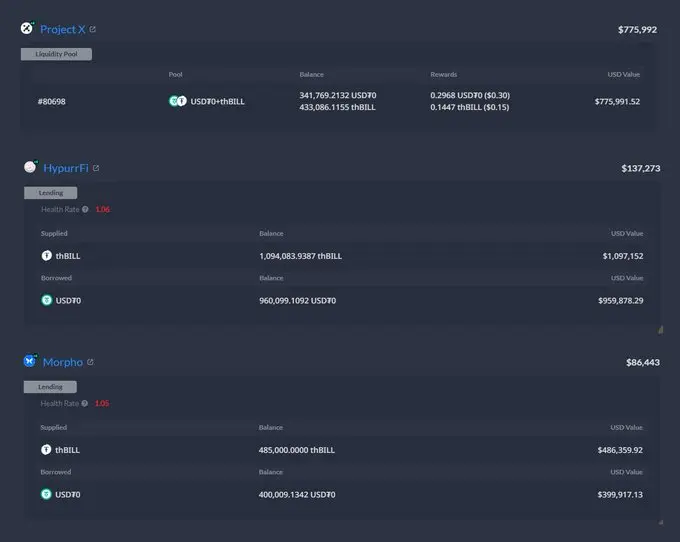
Author: Octoshi.eth Compiled by Tim, PANews By participating in points events and investing in real income agreements, I was making about $500,000 a month, which sounds crazy. The following article will explain the sources of income. This is my current allocation, and my average annualized rate of return is 78%. While my estimate is conservative, a large portion of it is based on activity points, which makes it highly predictive. The first source of income was participating in Plasma. I deposited $2.3 million and bought $125,000 worth of XPL tokens at $500 million FDV. Taking into account a 90-day investment cycle and the current $5.7 billion valuation on Hyperliquid, my annualized return is 217%. XLP is aiming for $10 billion! The second source of income is a passive position that provides immediate liquidity so that I can jump in at any time when I find new income opportunities or interesting trades. The operation is simple: I just need to deposit money into the Morpho fund, which currently earns an annualized rate of return of 10%. The next source of revenue is Euler Finance’s Spark mining activity on Unichain, from which OP token incentives can be obtained. Under the current circumstances, the annualized rate of return is 27% (Euler does not display OP rewards), which is actually quite high considering the relatively low risk. The next one is Theo Network, a new player that just went online not long ago. They've introduced a points system, which I'm very optimistic about. There are no private PY transactions, so everyone can participate with peace of mind and will not feel cheated. Pray that the annualized rate of return can reach 30% Next up is Neutrl. This project hasn’t officially launched yet, but it offers a private transaction with different options. I chose to lock my funds for 12 months to get a fixed annualized rate of return of 30%. Maybe it will be online soon? The next source of income is MorphoLabs' RLP arbitrage, which currently has an actual annualized yield of 33% (with high volatility), and has not yet included Resolv point rewards, which are expected to add an additional 10% annualized yield. The last one is Open Eden. Although I am optimistic about this project, I have to reduce my holdings due to the decline in profitability of the revolving lending strategy due to rising interest rates (but I will increase my holdings again soon). With an FDV of $300 million, I estimate an annualized return of approximately 50%. $500,000 per month and an average annualized return of 78%—both of which are speculative and heavily influenced by Plasma—proved to be a very wise investment.Author: Octoshi.eth Compiled by Tim, PANews By participating in points events and investing in real income agreements, I was making about $500,000 a month, which sounds crazy. The following article will explain the sources of income. This is my current allocation, and my average annualized rate of return is 78%. While my estimate is conservative, a large portion of it is based on activity points, which makes it highly predictive. The first source of income was participating in Plasma. I deposited $2.3 million and bought $125,000 worth of XPL tokens at $500 million FDV. Taking into account a 90-day investment cycle and the current $5.7 billion valuation on Hyperliquid, my annualized return is 217%. XLP is aiming for $10 billion! The second source of income is a passive position that provides immediate liquidity so that I can jump in at any time when I find new income opportunities or interesting trades. The operation is simple: I just need to deposit money into the Morpho fund, which currently earns an annualized rate of return of 10%. The next source of revenue is Euler Finance’s Spark mining activity on Unichain, from which OP token incentives can be obtained. Under the current circumstances, the annualized rate of return is 27% (Euler does not display OP rewards), which is actually quite high considering the relatively low risk. The next one is Theo Network, a new player that just went online not long ago. They've introduced a points system, which I'm very optimistic about. There are no private PY transactions, so everyone can participate with peace of mind and will not feel cheated. Pray that the annualized rate of return can reach 30% Next up is Neutrl. This project hasn’t officially launched yet, but it offers a private transaction with different options. I chose to lock my funds for 12 months to get a fixed annualized rate of return of 30%. Maybe it will be online soon? The next source of income is MorphoLabs' RLP arbitrage, which currently has an actual annualized yield of 33% (with high volatility), and has not yet included Resolv point rewards, which are expected to add an additional 10% annualized yield. The last one is Open Eden. Although I am optimistic about this project, I have to reduce my holdings due to the decline in profitability of the revolving lending strategy due to rising interest rates (but I will increase my holdings again soon). With an FDV of $300 million, I estimate an annualized return of approximately 50%. $500,000 per month and an average annualized return of 78%—both of which are speculative and heavily influenced by Plasma—proved to be a very wise investment.

A complete analysis of my stablecoin income strategy with a monthly income of $500,000 and an average annualized return of 78%.

2025/08/27 17:23
3 min read

Author: Octoshi.eth

Compiled by Tim, PANews

By participating in points events and investing in real income agreements, I was making about $500,000 a month, which sounds crazy.

The following article will explain the sources of income.

This is my current allocation, and my average annualized rate of return is 78%. While my estimate is conservative, a large portion of it is based on activity points, which makes it highly predictive.
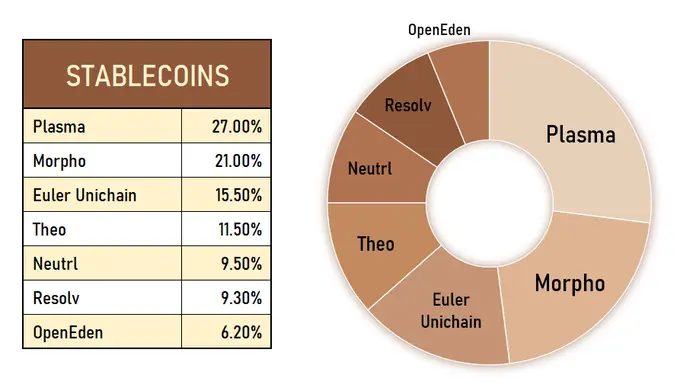
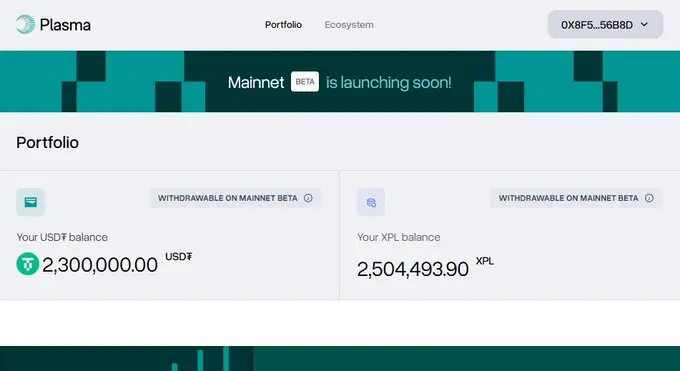
The first source of income was participating in Plasma. I deposited $2.3 million and bought $125,000 worth of XPL tokens at $500 million FDV.

Taking into account a 90-day investment cycle and the current $5.7 billion valuation on Hyperliquid, my annualized return is 217%. XLP is aiming for $10 billion!
The second source of income is a passive position that provides immediate liquidity so that I can jump in at any time when I find new income opportunities or interesting trades.

The operation is simple: I just need to deposit money into the Morpho fund, which currently earns an annualized rate of return of 10%.

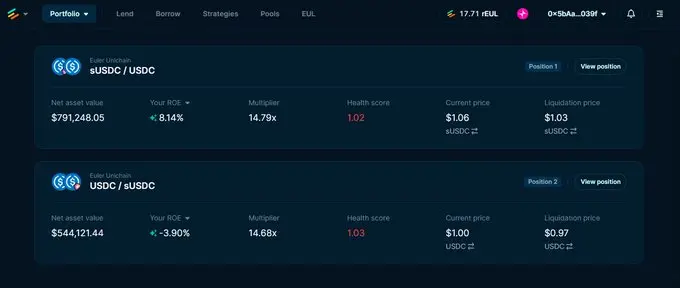
The next source of revenue is Euler Finance’s Spark mining activity on Unichain, from which OP token incentives can be obtained.

Under the current circumstances, the annualized rate of return is 27% (Euler does not display OP rewards), which is actually quite high considering the relatively low risk.
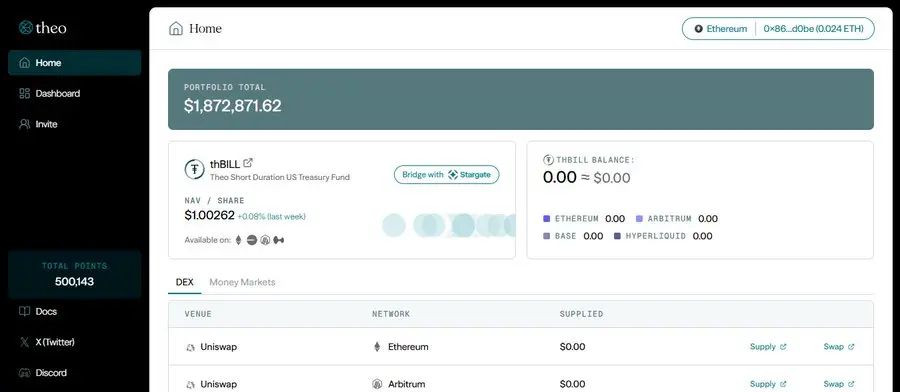
The next one is Theo Network, a new player that just went online not long ago.

They've introduced a points system, which I'm very optimistic about.

There are no private PY transactions, so everyone can participate with peace of mind and will not feel cheated.

Pray that the annualized rate of return can reach 30%
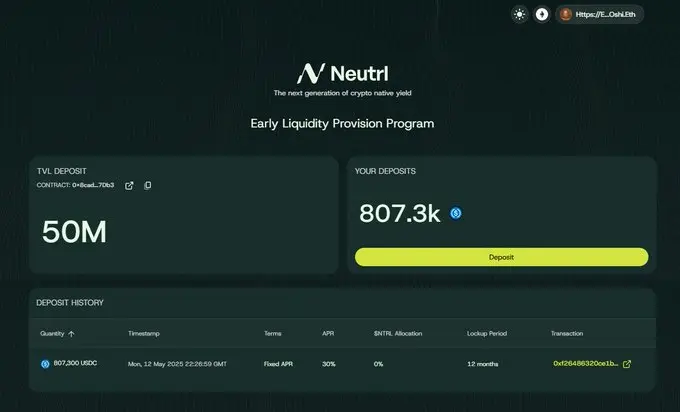
Next up is Neutrl. This project hasn’t officially launched yet, but it offers a private transaction with different options. I chose to lock my funds for 12 months to get a fixed annualized rate of return of 30%.

Maybe it will be online soon?
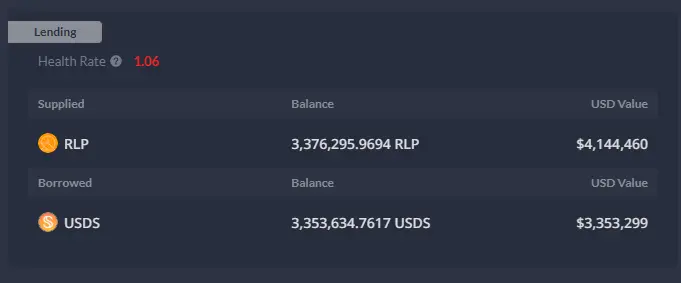
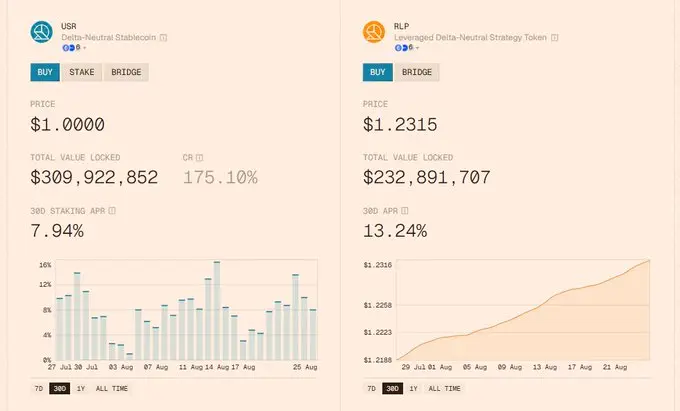
The next source of income is MorphoLabs' RLP arbitrage, which currently has an actual annualized yield of 33% (with high volatility), and has not yet included Resolv point rewards, which are expected to add an additional 10% annualized yield.
The last one is Open Eden. Although I am optimistic about this project, I have to reduce my holdings due to the decline in profitability of the revolving lending strategy due to rising interest rates (but I will increase my holdings again soon).

With an FDV of $300 million, I estimate an annualized return of approximately 50%.
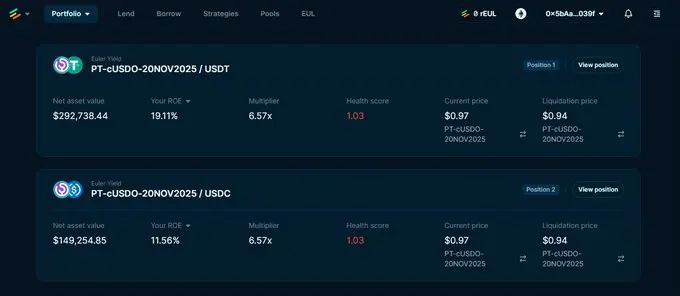
$500,000 per month and an average annualized return of 78%—both of which are speculative and heavily influenced by Plasma—proved to be a very wise investment.

Market Opportunity
MemeCore Logo
MemeCore Price(M)
$1.68273
$1.68273$1.68273
+4.60%
USD
MemeCore (M) Live Price Chart
Disclaimer: The articles reposted on this site are sourced from public platforms and are provided for informational purposes only. They do not necessarily reflect the views of MEXC. All rights remain with the original authors. If you believe any content infringes on third-party rights, please contact [email protected] for removal. MEXC makes no guarantees regarding the accuracy, completeness, or timeliness of the content and is not responsible for any actions taken based on the information provided. The content does not constitute financial, legal, or other professional advice, nor should it be considered a recommendation or endorsement by MEXC.

You May Also Like

Shocking OpenVPP Partnership Claim Draws Urgent Scrutiny

Shocking OpenVPP Partnership Claim Draws Urgent Scrutiny

The post Shocking OpenVPP Partnership Claim Draws Urgent Scrutiny appeared on BitcoinEthereumNews.com. The cryptocurrency world is buzzing with a recent controversy surrounding a bold OpenVPP partnership claim. This week, OpenVPP (OVPP) announced what it presented as a significant collaboration with the U.S. government in the innovative field of energy tokenization. However, this claim quickly drew the sharp eye of on-chain analyst ZachXBT, who highlighted a swift and official rebuttal that has sent ripples through the digital asset community. What Sparked the OpenVPP Partnership Claim Controversy? The core of the issue revolves around OpenVPP’s assertion of a U.S. government partnership. This kind of collaboration would typically be a monumental endorsement for any private cryptocurrency project, especially given the current regulatory climate. Such a partnership could signify a new era of mainstream adoption and legitimacy for energy tokenization initiatives. OpenVPP initially claimed cooperation with the U.S. government. This alleged partnership was said to be in the domain of energy tokenization. The announcement generated considerable interest and discussion online. ZachXBT, known for his diligent on-chain investigations, was quick to flag the development. He brought attention to the fact that U.S. Securities and Exchange Commission (SEC) Commissioner Hester Peirce had directly addressed the OpenVPP partnership claim. Her response, delivered within hours, was unequivocal and starkly contradicted OpenVPP’s narrative. How Did Regulatory Authorities Respond to the OpenVPP Partnership Claim? Commissioner Hester Peirce’s statement was a crucial turning point in this unfolding story. She clearly stated that the SEC, as an agency, does not engage in partnerships with private cryptocurrency projects. This response effectively dismantled the credibility of OpenVPP’s initial announcement regarding their supposed government collaboration. Peirce’s swift clarification underscores a fundamental principle of regulatory bodies: maintaining impartiality and avoiding endorsements of private entities. Her statement serves as a vital reminder to the crypto community about the official stance of government agencies concerning private ventures. Moreover, ZachXBT’s analysis…
Share
BitcoinEthereumNews2025/09/18 02:13
SEI Technical Analysis Feb 6

SEI Technical Analysis Feb 6

The post SEI Technical Analysis Feb 6 appeared on BitcoinEthereumNews.com. SEI is consolidating at the $0.08 level under general downtrend pressure; although RSI
Share
BitcoinEthereumNews2026/02/07 02:43
South Korean Crypto Exchange Accidentally Gave Away $95 Billion in Bitcoin

South Korean Crypto Exchange Accidentally Gave Away $95 Billion in Bitcoin

The post South Korean Crypto Exchange Accidentally Gave Away $95 Billion in Bitcoin appeared on BitcoinEthereumNews.com. In brief South Korean exchange Bithumb
Share
BitcoinEthereumNews2026/02/07 02:16