Dutch crypto service provider Amdax has secured €20 million ($23 million) in initial funding for its Amsterdam Bitcoin Treasury Strategy (AMBTS), planning to accumulate 1% of Bitcoin’s total supply over time. AMBTS plans to complete its private funding round at €30 million ($34 million) before pursuing a public listing on Euronext Amsterdam. The company plans to leverage capital markets to grow Bitcoin per share while building toward the 210,000 BTC target, worth approximately $23 billion at current prices. Corporate Bitcoin holdings have exploded to 3.68 million tokens across 310 entities, valued at $408 billion.Source: Bitcoin Treasuries MicroStrategy leads with 632,457 BTC, followed by MARA Holdings at 50,639 BTC. Recent corporate entries include KindlyMD’s $5 billion equity offering and the aggressive accumulation by Japanese firms. Additionally, the healthcare company KindlyMD filed a $5 billion at-the-market equity offering to fund its aggressive Bitcoin treasury strategy, which at the time represented one of the largest corporate crypto accumulation programs. Europe Enters Bitcoin Treasury Race Amdax established AMBTS as an independent company following its successful registration with the Dutch Central Bank in 2020. The firm became one of the first to receive approval under Europe’s Markets in Crypto-Assets Regulation framework, providing an easy and regulated entry point for institutional Bitcoin exposure. CEO Lucas Wensing cited growing demand within Amdax’s ecosystem for dedicated Bitcoin treasury services. The company believes Europe needs its own Bitcoin treasury giant to compete with U.S. and Asian corporate adoption rates, in which institutional holdings have reached a large scale. However, amid this growth, corporate treasury strategies face mounting scrutiny. Morningstar DBRS analysts recently warned that crypto treasury functions heighten credit risks due to Bitcoin’s volatility compared to traditional reserve assets. The concentration among top holders amplifies systemic exposure, with the top 20 public companies controlling 94% of corporate Bitcoin reserves. Bitcoin volatility measures are nearly five times higher than those of the S&P 500 in short-term periods and four times higher in the long term. This volatility fundamentally alters traditional treasury management roles, which are designed to maintain stability and ensure consistent operations. Additionally, regulatory uncertainty remains a pressing challenge, as there is no uniform global framework governing cryptocurrencies. Since the beginning of corporate Bitcoin accumulation, unusual stock movements ahead of these treasury announcements have been observed and are prompting scrutiny of insider trading. For instance, MEI Pharma’s stock nearly doubled before it announced a $100 million acquisition of Litecoin. Similarly, SharpLink’s shares more than doubled three days before the company announced a $425 million Ethereum allocation. Warning Signs Flash as Institutional Momentum Builds Earlier this month, Sentora research also warned that Bitcoin treasury strategies are “negative-carry trades” where companies borrow fiat to acquire non-yielding assets. Unlike traditional carry trades with positive yield cushions, Bitcoin strategies offer no yield protection during adverse conditions. Rising interest rates amplify negative carry effects, while Bitcoin’s price stagnation over extended periods could erode conviction and make equity issuance dilutive. The research notes that no lender of last resort exists when Bitcoin carry trades break, making risks “binary and reflexive.” Companies that use aggressive financing mechanisms face a particular vulnerability. Mining firms often maintain razor-thin margins while holding 50-80% of Bitcoin assets, creating high liquidation risks during downturns when short-term cash needs emerge. While treasuries are actively accumulating, ETFs are also dominating the market. According to a Cryptonews report today, Bitcoin ETFs have captured 13.1% of total spot trading volume since the U.S. presidential election, generating $5-10 billion in daily activity that rivals that of major cryptocurrency exchanges. Ethereum ETFs experienced strong momentum, with $4 billion in net inflows in August, while Bitcoin ETFs recorded $800 million in net outflows. Investment advisers emerged as the largest identifiable ETF holders, controlling over $1.3 billion in Ether ETFs and $17 billion across Bitcoin ETFs. The institutional preference for Ethereum’s rotation accelerated as corporate treasury activity expanded beyond BitcoinDutch crypto service provider Amdax has secured €20 million ($23 million) in initial funding for its Amsterdam Bitcoin Treasury Strategy (AMBTS), planning to accumulate 1% of Bitcoin’s total supply over time. AMBTS plans to complete its private funding round at €30 million ($34 million) before pursuing a public listing on Euronext Amsterdam. The company plans to leverage capital markets to grow Bitcoin per share while building toward the 210,000 BTC target, worth approximately $23 billion at current prices. Corporate Bitcoin holdings have exploded to 3.68 million tokens across 310 entities, valued at $408 billion.Source: Bitcoin Treasuries MicroStrategy leads with 632,457 BTC, followed by MARA Holdings at 50,639 BTC. Recent corporate entries include KindlyMD’s $5 billion equity offering and the aggressive accumulation by Japanese firms. Additionally, the healthcare company KindlyMD filed a $5 billion at-the-market equity offering to fund its aggressive Bitcoin treasury strategy, which at the time represented one of the largest corporate crypto accumulation programs. Europe Enters Bitcoin Treasury Race Amdax established AMBTS as an independent company following its successful registration with the Dutch Central Bank in 2020. The firm became one of the first to receive approval under Europe’s Markets in Crypto-Assets Regulation framework, providing an easy and regulated entry point for institutional Bitcoin exposure. CEO Lucas Wensing cited growing demand within Amdax’s ecosystem for dedicated Bitcoin treasury services. The company believes Europe needs its own Bitcoin treasury giant to compete with U.S. and Asian corporate adoption rates, in which institutional holdings have reached a large scale. However, amid this growth, corporate treasury strategies face mounting scrutiny. Morningstar DBRS analysts recently warned that crypto treasury functions heighten credit risks due to Bitcoin’s volatility compared to traditional reserve assets. The concentration among top holders amplifies systemic exposure, with the top 20 public companies controlling 94% of corporate Bitcoin reserves. Bitcoin volatility measures are nearly five times higher than those of the S&P 500 in short-term periods and four times higher in the long term. This volatility fundamentally alters traditional treasury management roles, which are designed to maintain stability and ensure consistent operations. Additionally, regulatory uncertainty remains a pressing challenge, as there is no uniform global framework governing cryptocurrencies. Since the beginning of corporate Bitcoin accumulation, unusual stock movements ahead of these treasury announcements have been observed and are prompting scrutiny of insider trading. For instance, MEI Pharma’s stock nearly doubled before it announced a $100 million acquisition of Litecoin. Similarly, SharpLink’s shares more than doubled three days before the company announced a $425 million Ethereum allocation. Warning Signs Flash as Institutional Momentum Builds Earlier this month, Sentora research also warned that Bitcoin treasury strategies are “negative-carry trades” where companies borrow fiat to acquire non-yielding assets. Unlike traditional carry trades with positive yield cushions, Bitcoin strategies offer no yield protection during adverse conditions. Rising interest rates amplify negative carry effects, while Bitcoin’s price stagnation over extended periods could erode conviction and make equity issuance dilutive. The research notes that no lender of last resort exists when Bitcoin carry trades break, making risks “binary and reflexive.” Companies that use aggressive financing mechanisms face a particular vulnerability. Mining firms often maintain razor-thin margins while holding 50-80% of Bitcoin assets, creating high liquidation risks during downturns when short-term cash needs emerge. While treasuries are actively accumulating, ETFs are also dominating the market. According to a Cryptonews report today, Bitcoin ETFs have captured 13.1% of total spot trading volume since the U.S. presidential election, generating $5-10 billion in daily activity that rivals that of major cryptocurrency exchanges. Ethereum ETFs experienced strong momentum, with $4 billion in net inflows in August, while Bitcoin ETFs recorded $800 million in net outflows. Investment advisers emerged as the largest identifiable ETF holders, controlling over $1.3 billion in Ether ETFs and $17 billion across Bitcoin ETFs. The institutional preference for Ethereum’s rotation accelerated as corporate treasury activity expanded beyond Bitcoin

Amdax Raises $23M for Bitcoin Treasury – Europe’s Bold Bid to Rival MicroStrategy?

4 min read

Dutch crypto service provider Amdax has secured €20 million ($23 million) in initial funding for its Amsterdam Bitcoin Treasury Strategy (AMBTS), planning to accumulate 1% of Bitcoin’s total supply over time.

AMBTS plans to complete its private funding round at €30 million ($34 million) before pursuing a public listing on Euronext Amsterdam.

The company plans to leverage capital markets to grow Bitcoin per share while building toward the 210,000 BTC target, worth approximately $23 billion at current prices.

Corporate Bitcoin holdings have exploded to 3.68 million tokens across 310 entities, valued at $408 billion.
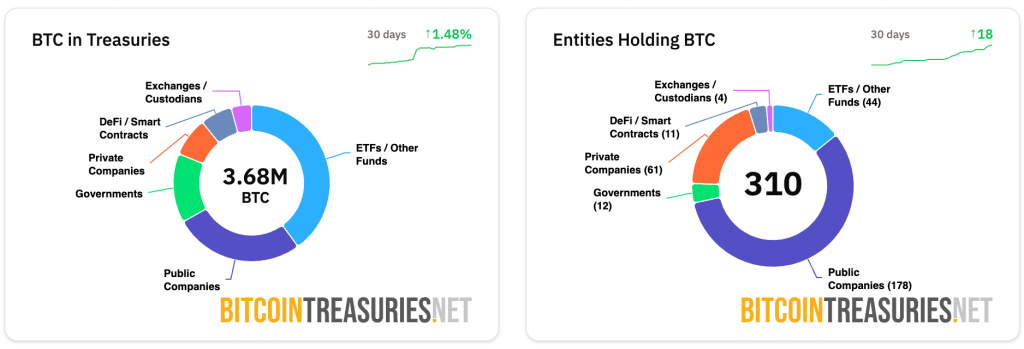
Source: Bitcoin Treasuries

MicroStrategy leads with 632,457 BTC, followed by MARA Holdings at 50,639 BTC. Recent corporate entries include KindlyMD’s $5 billion equity offering and the aggressive accumulation by Japanese firms.

Additionally, the healthcare company KindlyMD filed a $5 billion at-the-market equity offering to fund its aggressive Bitcoin treasury strategy, which at the time represented one of the largest corporate crypto accumulation programs.

Europe Enters Bitcoin Treasury Race

Amdax established AMBTS as an independent company following its successful registration with the Dutch Central Bank in 2020.

The firm became one of the first to receive approval under Europe’s Markets in Crypto-Assets Regulation framework, providing an easy and regulated entry point for institutional Bitcoin exposure.

CEO Lucas Wensing cited growing demand within Amdax’s ecosystem for dedicated Bitcoin treasury services.

The company believes Europe needs its own Bitcoin treasury giant to compete with U.S. and Asian corporate adoption rates, in which institutional holdings have reached a large scale.

However, amid this growth, corporate treasury strategies face mounting scrutiny. Morningstar DBRS analysts recently warned that crypto treasury functions heighten credit risks due to Bitcoin’s volatility compared to traditional reserve assets.

The concentration among top holders amplifies systemic exposure, with the top 20 public companies controlling 94% of corporate Bitcoin reserves.

Bitcoin volatility measures are nearly five times higher than those of the S&P 500 in short-term periods and four times higher in the long term.

This volatility fundamentally alters traditional treasury management roles, which are designed to maintain stability and ensure consistent operations.

Additionally, regulatory uncertainty remains a pressing challenge, as there is no uniform global framework governing cryptocurrencies.

Since the beginning of corporate Bitcoin accumulation, unusual stock movements ahead of these treasury announcements have been observed and are prompting scrutiny of insider trading.

For instance, MEI Pharma’s stock nearly doubled before it announced a $100 million acquisition of Litecoin. Similarly, SharpLink’s shares more than doubled three days before the company announced a $425 million Ethereum allocation.

Warning Signs Flash as Institutional Momentum Builds

Earlier this month, Sentora research also warned that Bitcoin treasury strategies are “negative-carry trades” where companies borrow fiat to acquire non-yielding assets.

Unlike traditional carry trades with positive yield cushions, Bitcoin strategies offer no yield protection during adverse conditions.

Rising interest rates amplify negative carry effects, while Bitcoin’s price stagnation over extended periods could erode conviction and make equity issuance dilutive.

The research notes that no lender of last resort exists when Bitcoin carry trades break, making risks “binary and reflexive.”

Companies that use aggressive financing mechanisms face a particular vulnerability.

Mining firms often maintain razor-thin margins while holding 50-80% of Bitcoin assets, creating high liquidation risks during downturns when short-term cash needs emerge.

While treasuries are actively accumulating, ETFs are also dominating the market.

According to a Cryptonews report today, Bitcoin ETFs have captured 13.1% of total spot trading volume since the U.S. presidential election, generating $5-10 billion in daily activity that rivals that of major cryptocurrency exchanges.

Ethereum ETFs experienced strong momentum, with $4 billion in net inflows in August, while Bitcoin ETFs recorded $800 million in net outflows.

Investment advisers emerged as the largest identifiable ETF holders, controlling over $1.3 billion in Ether ETFs and $17 billion across Bitcoin ETFs.

The institutional preference for Ethereum’s rotation accelerated as corporate treasury activity expanded beyond Bitcoin.

Market Opportunity
CreatorBid Logo
CreatorBid Price(BID)
$0.008172
$0.008172$0.008172
-9.81%
USD
CreatorBid (BID) Live Price Chart
Disclaimer: The articles reposted on this site are sourced from public platforms and are provided for informational purposes only. They do not necessarily reflect the views of MEXC. All rights remain with the original authors. If you believe any content infringes on third-party rights, please contact [email protected] for removal. MEXC makes no guarantees regarding the accuracy, completeness, or timeliness of the content and is not responsible for any actions taken based on the information provided. The content does not constitute financial, legal, or other professional advice, nor should it be considered a recommendation or endorsement by MEXC.

You May Also Like

Strategy to initiate a bitcoin security program addressing quantum uncertainty

Strategy to initiate a bitcoin security program addressing quantum uncertainty

Markets Share Share this article
Copy linkX (Twitter)LinkedInFacebookEmail
Strategy to initiate a bitcoin security prog
Share
Coindesk2026/02/06 18:21
Strategic Shift Impacts Crypto Trading Landscape

Strategic Shift Impacts Crypto Trading Landscape

The post Strategic Shift Impacts Crypto Trading Landscape appeared on BitcoinEthereumNews.com. Bybit Delists MILK: Strategic Shift Impacts Crypto Trading Landscape
Share
BitcoinEthereumNews2026/02/06 18:01
SEC clears framework for fast-tracked crypto ETF listings

SEC clears framework for fast-tracked crypto ETF listings

The post SEC clears framework for fast-tracked crypto ETF listings appeared on BitcoinEthereumNews.com. The Securities and Exchange Commission has approved new generic listing standards for spot crypto exchange-traded funds, clearing the way for faster approvals. Summary SEC has greenlighted new generic listing standards for spot crypto ETFs. Rule change eliminates lengthy case-by-case approvals, aligning crypto ETFs with commodity funds. Grayscale’s Digital Large Cap Fund and Bitcoin ETF options also gain approval. The U.S. SEC has approved new generic listing standards that will allow exchanges to fast-track spot crypto ETFs, marking a pivotal shift in U.S. digital asset regulation. According to a Sept. 17 press release, the SEC voted to approve rule changes from Nasdaq, NYSE Arca, and Cboe BZX, enabling them to list and trade commodity-based trust shares, including those holding spot digital assets, without submitting individual proposals for each product. A streamlined path for crypto ETFs Under the new rules, an ETF can be listed without SEC sign-off if its underlying asset trades on a market with surveillance-sharing agreements, has active CFTC-regulated futures contracts for at least six months, or already represents at least 40% of an existing listed ETF. This brings crypto ETFs in line with traditional commodity-based funds under Rule 6c-11, eliminating a process that could take up to 240 days. SEC chair Paul Atkins said the move was designed to “maximize investor choice and foster innovation” while ensuring the U.S. remains the leading market for digital assets. Jamie Selway, director of the division of trading and markets, called the framework “a rational, rules-based approach” that balances access with investor protection. First products already approved Alongside the new standards, the SEC cleared the listing of the Grayscale Digital Large Cap Fund, which tracks spot assets based on the CoinDesk 5 Index. It also approved trading of options tied to the Cboe Bitcoin U.S. ETF Index and its mini version, with…
Share
BitcoinEthereumNews2025/09/18 14:04