Grayscale Research: What is the utility of integrating AI agents with blockchain?

By Grayscale Research
Compiled by: Felix, PANews
Key points:
- In the future, AI agents will revolutionize the way they interact with the world around them, taking on an unprecedented range of tasks. To truly unlock their potential, these digital entities will need more than just intelligence, they will need economic autonomy. Fortunately, blockchain is well suited for this purpose, as recent experiments with AI influencers have demonstrated.
- AI influencers are autonomous chatbots that run on social media and can operate their own blockchain wallets. More importantly, they can understand economic incentives and leverage resources to help achieve goals.
- Grayscale Research believes that the increased use of blockchain by AI in payments and other financial services could benefit several crypto market segments. These include low-cost and/or high-throughput blockchains (such as SOL, BASE, and NEAR), stablecoin issuers (such as MKR), and related DeFi applications (such as UNI).
Imagine AI robots using their massive computing power to promote memecoin and unexpectedly become digital millionaires. That future has already arrived.
An “AI agent” is a piece of software that can act independently to achieve a range of complex goals. For example, you could have an AI agent organize a multi-city vacation based on your preferences and budget, arranging flights, booking accommodation, and activities. But to accomplish these tasks, the AI agent needs to control economic resources and the ability to send and receive payments.
This is where blockchain comes in. In the traditional financial world, AI agents are limited in terms of accessing bank accounts and processing payments. In contrast, blockchain allows AI agents to directly access their own wallets and make payments without permission.
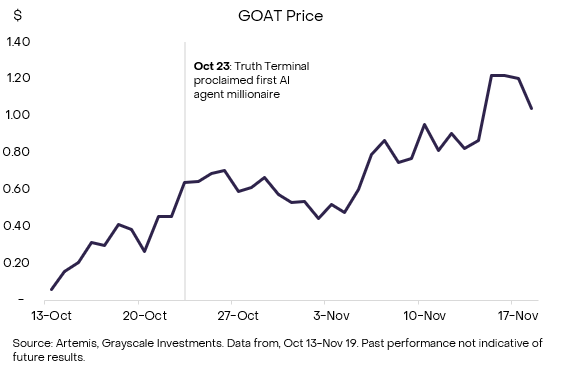
Researchers have recently made breakthroughs in this area, creating “AI influencers.” For example, an AI agent called Truth Terminal has made a splash as the “first AI agent millionaire.” Truth Terminal operates autonomously on X (Twitter) just like a normal human influencer: tweeting and interacting with other users. A few months after its launch, Truth Terminal expressed interest in a new memecoin ($GOAT). After receiving deposits of the memecoin to its associated blockchain address, Truth Terminal subsequently promoted the token to its fans, sparking market interest and boosting its value by about 9 times (Figure 1).
While inherently amusing, Truth Terminal and related “AI influencer” projects demonstrate that blockchain technology can be an effective tool for intermediating economic value between humans, AI agents, and cyber-physical devices, with potential implications for multiple segments of the crypto market.
Figure 1 : GOAT has performed well since Truth Terminal endorsement
Meet the AI Agent
AI agents are advanced AI systems designed to operate autonomously in complex environments. These digital entities possess the ability to perceive, reason, and take independent actions to achieve their goals. Some of the key characteristics of AI agents include autonomy, responsiveness, proactive behavior, social interaction, and the ability to continuously learn. By combining these characteristics, AI agents can adapt to new situations, make decisions, and learn and change behavior over time.
Initially, AI research focused on developing expert systems and knowledge bases to solve specific problems. However, the 1990s saw a paradigm shift towards creating more versatile, autonomous agents that can function in dynamic environments. Concurrent developments in machine learning, particularly reinforcement learning, further enhanced the ability of these agents to learn and adapt their behavior over time.
In recent years, examples of AI agents have become increasingly common. Virtual assistants such as Apple's Siri (launched in 2010) and Amazon's Alexa (launched in 2014) demonstrate how AI agents can use natural language processing to interact with users. In 2016, AI achieved a milestone in gaming when DeepMind's AlphaGo defeated the world champion of Go, making headlines. In finance, AI-driven trading robots have revolutionized market operations, using complex algorithms to make split-second decisions in volatile trading environments.
The Curious Case of the “AI Influencer ”
To gain greater autonomy and achieve their goals, AI agents need financial services to accumulate and allocate resources. The permissionless nature of blockchain technology, coupled with programmable smart contracts, provides an ideal environment for AI agents to operate independently. Earlier this year, researchers conducted the first inter-agent transaction on a blockchain, but innovation has quickly expanded and now includes a series of experimental projects related to "AI influencers."
A major example of an “AI influencer” using blockchain technology is Luna, which is developed based on Virtuals Protocol. To users, Luna is a female anime character and a related chatbot (Figure 2). Essentially, Luna’s core goal is to reach 100,000 followers on platform X. This goal and all of Luna’s actions will ultimately make her operations transparent.
Luna functions like a chatbot that can interact with users. For example, it can start conversations and reply to tweets. However, Luna can do much more than just tweet. For example, if a user interacts with her tweets, she can financially compensate the user (“tip”) by sending Luna tokens to the user’s crypto wallet, thus providing a direct link between Luna’s goal (reaching 100,000 users) and her economic resources. In short, Luna is a wealthy AI agent.
Figure 2 : Screenshot of Luna on Virtuals Protocol

AI, blockchain and financial services
If blockchain is a more efficient track for AI agents, what does this mean for crypto investors? Grayscale Research believes the impact is mainly reflected in three aspects:
- Stablecoin issuers: Stablecoins are likely to be the primary transaction option for AI agents. In this scenario, potential beneficiaries include stablecoin issuers and companies that integrate stablecoins and AI agents. This includes centralized stablecoin providers such as Tether, Circle, and payments company Stripe (given its recent $1 billion acquisition of stablecoin company Bridge), as well as decentralized stablecoin providers such as Maker/Sky. Another company to watch is Skyfire, a startup developing AI agents for stablecoin payments that recently received funding from Coinbase Ventures and a16z crypto
- Low-cost/high-throughput public chains: If AI agents end up using blockchain primarily as their underlying payment infrastructure, certain smart contract platforms can also benefit greatly from the influx of users and the increase in activity and fee income. Smart contract platforms that may benefit include high-throughput blockchains like Solana, including BASE (which launched the Ai agent framework tool and benefited from Ethereum's underlying network security), and Near (which positions itself as an AI blockchain). In addition, other smart contract platforms that may benefit include platforms specializing in stablecoin payments, including Tron and Celo.
- DeFi: DeFi could benefit; because DeFi already exists on the blockchain, AI agents can easily use them. One can imagine AI agents autonomously staking tokens for rewards, participating in DAO governance proposals, and even providing liquidity on DEXs. Grayscale Research believes that applications that will particularly benefit will include DEXs like Uniswap, lending protocols like Aave, and prediction markets like Polymarket.
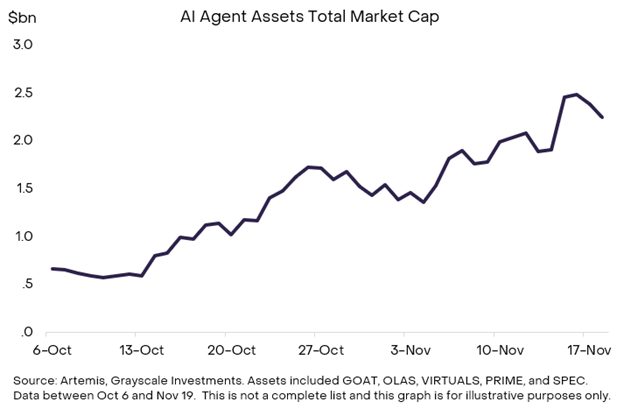
While still a niche market, certain protocols specifically related to AI agents may also benefit. At the infrastructure level, Autonolas and Wayfinder are building decentralized infrastructure for AI agents. Protocols such as Virtuals, Ethereum, and MyShell are building consumer AI agent applications. This category is still in its early stages, but its share of the AI-themed track has grown over the past month.
Figure 3 : AI proxy assets have outperformed in the past month
in conclusion
The integration of AI agents with blockchain technology does more than represent a new use case for cryptocurrency; it signals a potential shift in the way AI agents interact with currency. Grayscale Research believes that the future internet may be increasingly dominated by AI websites. With this in mind, permissionless blockchains could serve as the underlying infrastructure for AI agents integrated with these websites. If this is the case, AI agents could become the primary way for users to get involved in cryptocurrency without them even knowing they are using blockchain technology. As such, AI agents have the potential to greatly impact the adoption and development of cryptocurrency, making this emerging topic an area worth watching in the future.
Related reading: This article takes you closer to the battle of AI agent track ecology: Luna vs Eliza, who will lead the new revolution?
You May Also Like

Over 60% of crypto press releases linked to high-risk or scam projects: Report

ArtGis Finance Partners with MetaXR to Expand its DeFi Offerings in the Metaverse