Shiba Inu’s core team has issued a sweeping post-mortem update on the Shibarium bridge breach, detailing a multi-step attack that combined a flash-loan powered governance capture with compromised validator keys—followed by emergency protocol changes and a split bounty offer aimed at recovering user funds. Shiba Inu Devs Speak Out On Shibarium Bridge Exploit In an […]Shiba Inu’s core team has issued a sweeping post-mortem update on the Shibarium bridge breach, detailing a multi-step attack that combined a flash-loan powered governance capture with compromised validator keys—followed by emergency protocol changes and a split bounty offer aimed at recovering user funds. Shiba Inu Devs Speak Out On Shibarium Bridge Exploit In an […]

Shiba Inu Team Issues Explosive Update On Shibarium Bridge Exploit

Shiba Inu’s core team has issued a sweeping post-mortem update on the Shibarium bridge breach, detailing a multi-step attack that combined a flash-loan powered governance capture with compromised validator keys—followed by emergency protocol changes and a split bounty offer aimed at recovering user funds.

Shiba Inu Devs Speak Out On Shibarium Bridge Exploit

In an X post published on September 17, 2025, the official Shiba Inu account said the exploiter “executed a flash loan swap to acquire 4.6M BONE from ShibaSwap” and delegated them to “Ryoshi Validator 1,” which pushed their voting power “> 2/3 majority” across Shibarium validators. Using “compromised internal validators” to co-sign a malicious state, the attacker then drained assets from the L2’s canonical bridge. The team now pegs direct losses at $4.1 million.

The disclosure adds granular color on what left the bridge exposed and how responders moved. The Shiba Inu team says the “leading possibility for the root cause” was a compromise of internal validator keys—“either from the developer machine or the server’s KMS”—not a CCIP predicate path that “was unrelated.”

The team further says it suspended bridge operations, began forensic analysis, and initiated a hardening campaign: revoking root chain manager access on the PoS bridge, lengthening the half-exit time on the Plasma path, and removing a predicate burn-only entry from the Plasma registry to prevent withdrawals. “We have suspended bridge operations… there is a significant loss of user funds on Shibarium,” the update states.

According to the team’s accounting, 17 tokens were taken from the bridge, including roughly $1.0M in ETH, $1.3M in SHIB, $717K in KNINE, $680K in LEASH, and $260K in ROAR, alongside smaller balances of TREAT, USDC, USDT, BAD, SHIFU, FUND, DAI, LTD, xFUND, WBTC and OSCAR. The exploiter has so far sold only USDT and USDC into ETH; they attempted seven times to sell KNINE before the K9 Finance DAO blacklisted the attacker’s wallet. The rest of the assets remain under the attacker’s control and “at risk,” the team warned.

SHIB Team Ups Bounty To 50 ETH

The remediation push now includes two distinct bounty tracks. First, the bounty chronology began with K9 Finance DAO—the Shibarium-aligned liquid-staking project—publishing an on-chain 5 ETH offer to the attacker for the return of KNINE, structured to decay after seven days and expire after 30 days.

K9’s accompanying X posts stressed the “accept()” finality and “code-is-law” terms embedded in the escrow contract. The exploiter then replied publicly: “I can’t accept 5 ETH. The bounty I can accept is 50 ETH and I will not return KNINE for less.”

After that refusal did the Shiba Inu team transmit a separate, on-chain 50 ETH bounty message via its Deployer 2 address covering the non-KNINE assets, conditioned on full restitution and a whitehat disclosure, with a promise of a legal-action waiver upon verified return.

The Shiba Inu team’s on-chain message reads in part: “Offer: 50 ETH bounty via a new bounty smart contract escrow,” adding that the attacker must return WETH, SHIB, LEASH, ROAR, TREAT, USDC, USDT, BAD, SHIFU, FUND, DAI, LTD, xFUND, WBTC, and OSCAR, and submit a full technical disclosure; “upon complete restitution and accepted disclosure, we will issue a waiver of legal action (subject to applicable law).” Transaction records show the message was sent from shiba-swap.eth (Deployer 2) to the address labeled ShibaSwap Exploiter on September 17.

For now, bridge operations remain disabled, and users are cautioned that assets listed as “under attacker control” remain exposed until recovery or further containment.

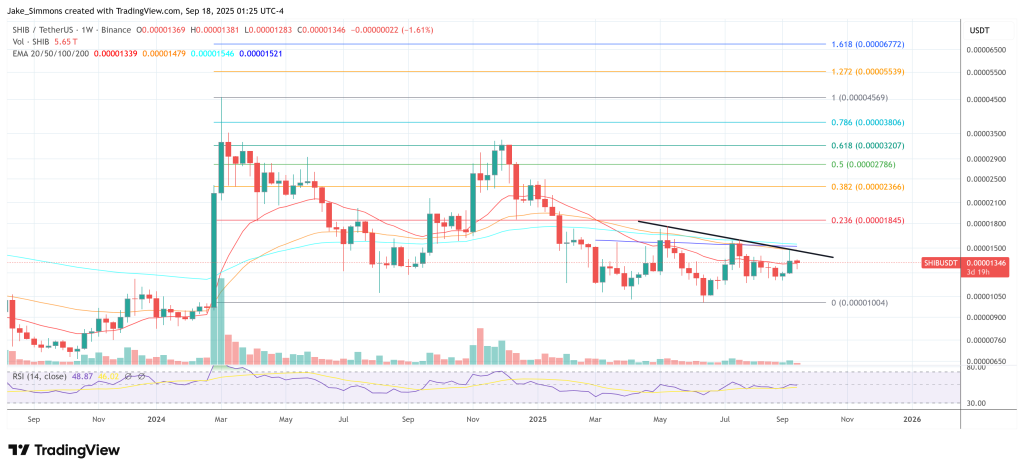
At press time, SHIB traded at $0.00001346.
Shiba Inu price
Piyasa Fırsatı
Hyperbridge Logosu
Hyperbridge Fiyatı(BRIDGE)
$0.02337
$0.02337$0.02337
-1.55%
USD
Hyperbridge (BRIDGE) Canlı Fiyat Grafiği
Sorumluluk Reddi: Bu sitede yeniden yayınlanan makaleler, halka açık platformlardan alınmıştır ve yalnızca bilgilendirme amaçlıdır. MEXC'nin görüşlerini yansıtmayabilir. Tüm hakları telif sahiplerine aittir. Herhangi bir içeriğin üçüncü taraf haklarını ihlal ettiğini düşünüyorsanız, kaldırılması için lütfen [email protected] ile iletişime geçin. MEXC, içeriğin doğruluğu, eksiksizliği veya güncelliği konusunda hiçbir garanti vermez ve sağlanan bilgilere dayalı olarak alınan herhangi bir eylemden sorumlu değildir. İçerik, finansal, yasal veya diğer profesyonel tavsiye niteliğinde değildir ve MEXC tarafından bir tavsiye veya onay olarak değerlendirilmemelidir.

Ayrıca Şunları da Beğenebilirsiniz

Kalshi Jumps to 62% Market Share While Polymarket Eyes $10B Valuation

Kalshi Jumps to 62% Market Share While Polymarket Eyes $10B Valuation

The post Kalshi Jumps to 62% Market Share While Polymarket Eyes $10B Valuation appeared on BitcoinEthereumNews.com. Fintech 19 September 2025 | 16:03 Event-based trading platforms are no longer niche experiments – they’re emerging as a major arena where finance, crypto, and information converge. After months of subdued activity, volumes are climbing again, and U.S.-regulated Kalshi has unexpectedly taken the lead. Betting on Everything From Rates to Sports Analysts at Bernstein describe prediction markets as a new “interface for information,” where users speculate not only on sports results but also on Federal Reserve decisions, quarterly earnings, and even crypto price moves. This year alone, more than $200 million changed hands on Polymarket contracts linked to the Fed’s recent 25 bps rate cut, while $85 million traded on Kalshi around the same decision. Mainstream brokers like Coinbase and Robinhood are watching closely, with ambitions to capture some of the momentum. With U.S. sports betting already worth tens of billions annually, the overlap is too big to ignore. Against that backdrop, Kalshi has delivered one of its strongest months since the 2024 elections. The platform reports $1.3 billion in trading volume so far in September, accounting for 62% of global prediction market activity. Just a year ago, Kalshi’s share stood at 3%. CEO Tarek Mansour called the growth “remarkable,” noting that the exchange still serves only U.S. clients. Polymarket’s Pushback Its main rival, Polymarket, has logged about $773 million in trades this month. While that trails Kalshi for now, Polymarket has unique advantages: as a crypto-native platform, it has carved out strong global demand and is working toward a formal U.S. relaunch via its acquisition of derivatives exchange QCEX. The two platforms now stand as the clear leaders of the sector, though they embody different philosophies — one regulated from the ground up, the other built around decentralization. Investors Take Notice The boom hasn’t escaped venture capital. Reports suggest…
Paylaş
BitcoinEthereumNews2025/09/19 21:34
Visa Expands USDC Stablecoin Settlement For US Banks

Visa Expands USDC Stablecoin Settlement For US Banks

The post Visa Expands USDC Stablecoin Settlement For US Banks appeared on BitcoinEthereumNews.com. Visa Expands USDC Stablecoin Settlement For US Banks
Paylaş
BitcoinEthereumNews2025/12/17 15:23
Bitcoin Lightning Network Capacity Surges to Historic Peak as Exchange Adoption Accelerates

Bitcoin Lightning Network Capacity Surges to Historic Peak as Exchange Adoption Accelerates

The Bitcoin Lightning Network has reached an all-time high in total network capacity, marking a significant milestone for the layer-2 scaling solution designed to enable fast and inexpensive Bitcoin transactions. The surge comes as major cryptocurrency exchanges increasingly integrate Lightning functionality, bringing the technology to millions of users who previously relied solely on slower, more expensive on-chain transactions. This capacity expansion reflects growing confidence in Lightning's reliability and utility after years of development and real-world testing. What began as an experimental protocol discussed primarily among technical enthusiasts has matured into infrastructure that some of the industry's largest platforms now consider essential to their operations.
Paylaş
MEXC NEWS2025/12/17 17:14