

Ethereum In Revolt: Polygon’s Nailwal Turns On The Foundation
Polygon Foundation CEO Sandeep Nailwal has publicly questioned his “loyalty toward Ethereum,” igniting a rare, unvarnished bout of soul-searching across the ecosystem that drew immediate responses from core contributors, investors, and ultimately Vitalik Buterin himself. The exchange, which unfolded on X over the past 10 hours, centers on whether the Ethereum Foundation (EF) adequately supports its builders, how Layer-2 projects are recognized within Ethereum’s narrative and market “beta,” and whether the community’s culture has drifted from its original ideals.
Is The Ethereum Foundation A ‘Shitshow’?
“Read this from Peter and realized that it’s time for me to also speak up,” Nailwal wrote, referencing core developer Péter Szilágyi’s decision on October 19 to publish a letter he says he sent to EF leadership roughly 18 months ago. Nailwal, who credits Ethereum and Buterin as his entry point and inspiration, said his long-standing moral loyalty to Ethereum has come at personal and corporate cost: “Though I/we never got any direct support from the EF or the Ethereum CT community — in fact, the reverse. But I have always felt moral loyalty towards Ethereum even if [it] costs me billions of dollars in Polygon’s valuation perhaps.”
Nailwal’s critique is both cultural and financial. “The Ethereum community as a whole has been a shit show for quite some time,” he wrote, adding that recurring public crises force major contributors to “question what they’re even doing here.” He said friends, including AkshayBD (Chief Marketing Officer of the Solana Foundation and a co-founder of SuperteamDAO), have urged him to declare Polygon an L1 and “walk away from this circus,” and claimed the community’s “socialistic behavior” has trolled Polygon despite its contributions “because of some arbitrary ‘technical definition.’”
He argued that market structure punishes Polygon for refusing the L1 label: “It’s widely believed that if Polygon ever decided to call itself an L1, it would probably be valued 2–5× higher than it is today,” pointing to a now-widely discussed comparison: “Like think about it, Hedera Hashgraph an L1 is valued higher than Polygon, Arbitrum, Optimism and Scroll combined.”
The classification dispute, in Nailwal’s telling, has real-world consequences for recognition and index inclusion. He insisted “Polygon PoS effectively hinged on Ethereum, while Katana, XLayer, and dozens of other chains in Polygon’s ecosystem are true L2s,” yet “the Ethereum community ensures Polygon is never considered an L2 and is never included in the markets’ perceived Ethereum Beta.” He added that a “prominent Polygon Stakeholder” scolded him because he “can’t get Polygon on GrowthPie, which refuses to list the Polygon chain,” and contrasted how Polymarket’s success is credited to “Ethereum” even as “Polygon itself is not Ethereum. Mind-boggling.”
Despite the frustration, Nailwal said he intends to try once more to realign technical and social consensus around scaling: “I’m going to give this a final push that might just revive the entire L2 narrative. Just bear with me for a few more weeks.” He concluded with a qualified defense of the messiness: “Ethereum is a democracy — and in any democracy, people on all sides end up disgruntled. But it’s still the only system that truly works in the long run.”
The thread drew immediate reactions from prominent builders. Andre Cronje — who says he burned “over 700 ETH on deployments and ETH infra” during his Ethereum years — questioned EF’s support priorities outright. “I tried contacting EF, never a response, no BD outreach, no grants, 0 support, not even a retweet,” Cronje wrote. Comparing his experience to Fantom’s Sonic ecosystem, he said he was “confused” to see teams there receive BD support, grants, TVL, audits and marketing, and asked: “If it isn’t the core builders, Peter & geth, and it isn’t the loudest L2 supporters (Sandeep and Polygon), where is it going?”
Tommy Shaughnessy of Delphi Ventures framed the problem as under-compensation of irreplaceable talent. “The Ethereum foundation should be paying its developers like professional athletes.[…] The Ethereum foundation is basically paying people to leave. Top developers should be paid like Pro Athletes.”
Vitalik Buterin Reacts
Buterin responded several hours later with an unusually personal note of appreciation for both Nailwal and Polygon’s contributions, while also offering a technical path forward. “I really appreciate both @sandeepnailwal’s personal contributions and @0xPolygon’s immensely valuable role in the ethereum ecosystem,” he wrote, name-checking Polygon’s role hosting Polymarket, its early and resource-intensive bets on ZK-EVM proving (“bringing in Jordi Baylina’s team”), infrastructure for proof aggregation via AggLayer, and support for “applications that have needed high levels of scalability.”
On the central technical question — whether Polygon can and should harden its security guarantees with modern zero-knowledge proofs — Buterin argued that the market has evolved toward a separation of concerns between L2 operators and ZK-prover specialists.
“It’s very difficult to be both the best L2 and the best ZK team, the two are very different skill sets,” he wrote, citing standalone ZK providers and urging Polygon to “pick up off the shelf ZK tech that has now gotten quite good and apply it to the PoS chain to get full stage 1 and later stage 2 guarantees from the ethereum L1.”
He emphasized how far the economics have moved: “Proving costs are around $0.0001/tx,” and said many L2 teams “are very surprised when I tell them the recent numbers… The latest ZK-EVMs, and live projects like @Lighter_xyz, show that this is false” with respect to the idea that ZK is unviable at hyperscale.
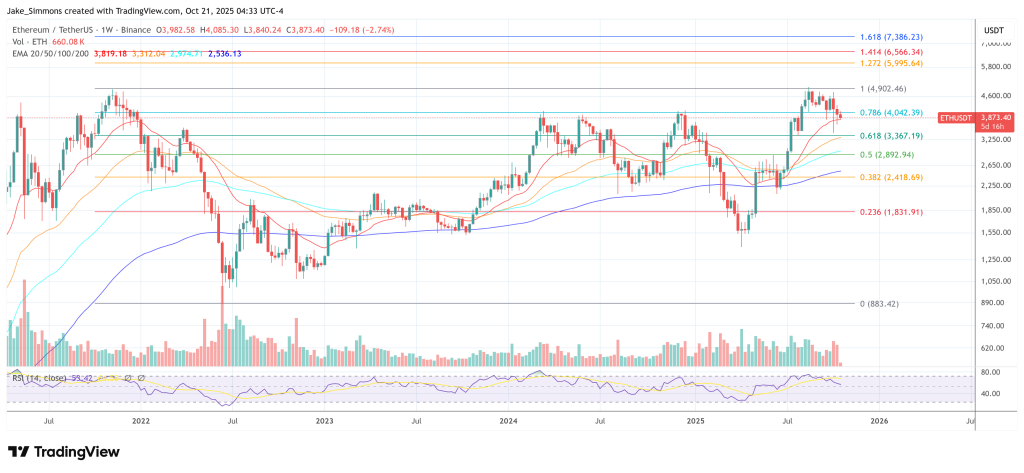
At press time, ETH traded at $3,873.
Ayrıca Şunları da Beğenebilirsiniz

Lyno AI Tops Analyst Rankings

XRP Stuns ETF Market With Strange $0 Print in Biggest Fund
