Durante los primeros 10 meses del 2025 el valor de las ventas del sector ha caído 4.8%, su primer tropiezo desde el 2016, excluyendo el 2020 por su carácter atípico.Durante los primeros 10 meses del 2025 el valor de las ventas del sector ha caído 4.8%, su primer tropiezo desde el 2016, excluyendo el 2020 por su carácter atípico.

Envíos automotrices de México caen 14% afectados por aranceles de Trump

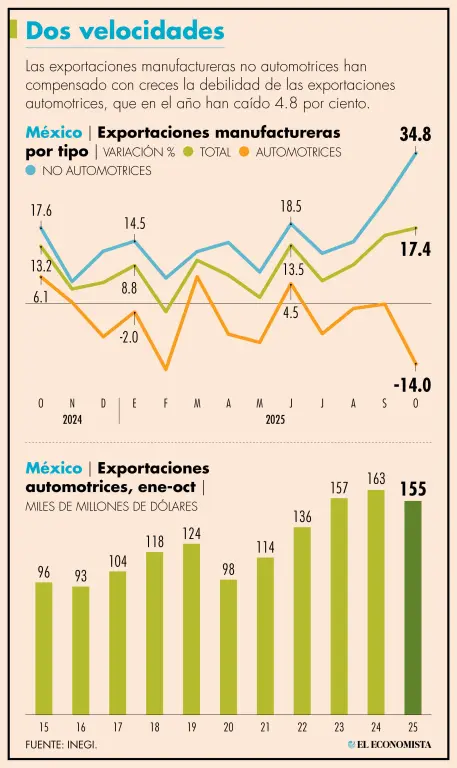
Las exportaciones automotrices de México disminuyeron 14% a tasa interanual en octubre, a 16,122.1 millones de dólares, afectadas por los aranceles del presidente de Estados Unidos, Donald Trump.

En el acumulado de los 10 primeros meses de 2025, estas ventas tuvieron una caída de 4.8%, a 154,946.5 millones de dólares, desliz que resulta el primero para la variable desde el pandémico 2020, aunque si se hace un lado ese año por su carácter atípico, sería el primero desde el 2016, cuando cayó 3.1 por ciento.

Las exportaciones manufactureras reflejan la marcada integración en las cadenas productivas de ambos países, destacando que los envíos manufactureros presentan un crecimiento anual de 8.6% de enero a octubre.

“Sin embargo, en el rubro automotriz se observa una dinámica diferente, pues registró una contracción de 4.8% en lo que va del año, acentuando los retos que mantienen las exportaciones automotrices mexicanas ante la imposición de aranceles vigentes para la industria”, comentaron Janneth Quiroz Zamora y Kevin Louis Castro, analistas de Monex.

Este deterioro se acentuó en septiembre tras el anuncio de Trump de un arancel de 25.0% a los camiones pesados a partir del 1 de octubre, que si bien se pospuso para el 1 de noviembre, generó cautela entre los importadores estadounidenses.

“Si bien la tasa arancelaria efectiva promedio que pagaron las exportaciones mexicanas dirigidas a Estados Unidos fue de 4.68% en agosto y el 84.5% de ellas cumplió con las reglas del T-MEC (un avance notable frente al 47.8% del mismo periodo de 2024), es probable que los aranceles vigentes de nuestro principal socio comercial permanezcan en los próximos meses, como parte de la estrategia de negociación de Trump: (retirar aranceles a cambio de concesiones de México en la revisión del tratado)”, opinaron los analistas de Monex.

Te puede interesar

  • El Economista

    Empresas

    Exportaciones mexicanas aumentan 14.2% impulsadas por manufacturas no automotrices

  • El Economista

    Economía

    Debilidad económica genera recorte de expectativas para 2025 a rango de 0.2 a 0.6%

“Trump no ha abandonado el proteccionismo comercial, por lo que no se pueden descartar nuevos aranceles o el cobro más agresivo de los aranceles anunciados en meses previos”, consideraron Gabriela Siller y Jesús Anacarsis López Flores, analistas de Banco Base.

El 1 de noviembre entraron también en vigor en Estados Unidos los aranceles de 10% para las importaciones de autobuses.

Con datos al mes de agosto, 82.96% de las importaciones de camiones pesados que realiza Estados Unidos (partida 8704) se originó en México.

“Con la entrada en vigor de este arancel se espera que deteriore aún más las exportaciones automotrices a Estados Unidos y el desempeño de la industria de fabricación de equipo de transporte en México”, dijeron los analistas de Banco Base.

Las exportaciones de manufacturas no automotrices explican 63.2% de las exportaciones totales de México de enero a octubre de 2025, subiendo desde 58.1% en el mismo periodo del 2024 y su mayor proporción para un periodo igual desde 2009 (65.0 por ciento).

Para los analistas de Banco Base, esto se debe a que los aranceles que Estados Unidos impuso a México bajo la Ley de Poderes Económicos de Emergencia Internacional (IEEPA), no se están cobrando al pie de la letra y el cumplimiento de México con el T-MEC se mantiene elevado, mientras que los aranceles sectoriales que se aplican al sector automotriz sí se están cobrando.

Por esta razón, las exportaciones automotrices acumulan una contracción en 2025, mientras que las exportaciones manufactureras distintas al sector automotriz siguen creciendo.

El 83.9% de las exportaciones no petroleras entre enero y octubre del 2025 se dirigen a Estados Unidos y acumulan un crecimiento de 8.0%, explicado por las exportaciones distintas al sector automotriz que acumulan un avance de 15.1%, mientras que las exportaciones automotrices acumulan un retroceso de 5.9%, consecuencia de los aranceles impuestos por la Administración Trump.
imageEnlace imagen

Gráfico EE

Piyasa Fırsatı
PortugalNationalTeam Logosu
PortugalNationalTeam Fiyatı(POR)
$0.5398
$0.5398$0.5398
+1.96%
USD
PortugalNationalTeam (POR) Canlı Fiyat Grafiği
Sorumluluk Reddi: Bu sitede yeniden yayınlanan makaleler, halka açık platformlardan alınmıştır ve yalnızca bilgilendirme amaçlıdır. MEXC'nin görüşlerini yansıtmayabilir. Tüm hakları telif sahiplerine aittir. Herhangi bir içeriğin üçüncü taraf haklarını ihlal ettiğini düşünüyorsanız, kaldırılması için lütfen [email protected] ile iletişime geçin. MEXC, içeriğin doğruluğu, eksiksizliği veya güncelliği konusunda hiçbir garanti vermez ve sağlanan bilgilere dayalı olarak alınan herhangi bir eylemden sorumlu değildir. İçerik, finansal, yasal veya diğer profesyonel tavsiye niteliğinde değildir ve MEXC tarafından bir tavsiye veya onay olarak değerlendirilmemelidir.

Ayrıca Şunları da Beğenebilirsiniz

Crucial Insights: Two Fed Interest Rate Cuts on the Horizon?

Crucial Insights: Two Fed Interest Rate Cuts on the Horizon?

BitcoinWorld Crucial Insights: Two Fed Interest Rate Cuts on the Horizon? The financial world is buzzing with discussions around the future of monetary policy, and a recent statement from a key Federal Reserve official has added fuel to the fire. Investors, businesses, and consumers alike are keenly watching for signals regarding potential Fed interest rate cuts and their broader economic implications. What’s Driving Talk of Fed Interest Rate Cuts? Neel Kashkari, the president of the Minneapolis Federal Reserve Bank, recently made headlines by stating his belief that two additional Fed interest rate cuts would be appropriate this year. This isn’t the first time Kashkari has shared this perspective; he expressed a similar view back in August. His comments offer a glimpse into the ongoing internal debates and varying outlooks among policymakers regarding the optimal path for the nation’s economy. Understanding the context behind such statements is crucial. The Federal Reserve uses interest rates as a primary tool to manage inflation and support employment. When inflation is high, the Fed typically raises rates to cool down economic activity. Conversely, when economic growth slows or inflation targets are met, the Fed might consider cutting rates to stimulate spending and investment. How Do Fed Interest Rate Cuts Impact You? The prospect of Fed interest rate cuts carries significant weight for everyone. For instance, lower interest rates generally translate to: Cheaper Borrowing: Mortgages, car loans, and credit card interest rates can decrease, making it more affordable for consumers to borrow money. This can encourage home buying and larger purchases. Business Investment: Companies find it less expensive to borrow for expansion, new projects, and hiring, potentially boosting economic growth and job creation. Stock Market Performance: Lower rates can make bonds less attractive, pushing investors towards stocks, which might see increased valuations. This can also signal a more optimistic economic outlook. Savings Account Returns: On the flip side, interest rates on savings accounts and Certificates of Deposit (CDs) might also fall, offering lower returns for savers. These ripple effects touch various sectors, from housing to retail, and even extend into the cryptocurrency markets, where investor sentiment is often influenced by broader economic conditions and liquidity. Navigating the Economic Landscape: Why Are Policymakers Divided on Fed Interest Rate Cuts? While some policymakers, like Kashkari, see the appropriateness of multiple Fed interest rate cuts, others may hold different views. The Federal Reserve’s decisions are complex, balancing the need to control inflation with the goal of maintaining maximum employment. Key factors influencing these decisions include: Inflation Data: The pace at which inflation is returning to the Fed’s 2% target is a primary concern. Sustained progress is needed. Employment Figures: A strong job market might give the Fed more leeway to keep rates higher for longer, whereas signs of weakness could prompt cuts. Global Economic Conditions: International economic trends and geopolitical events can also influence the Fed’s domestic policy decisions. Market Expectations: The Fed also considers how financial markets are pricing in future rate movements, aiming to avoid undue volatility. The path forward is rarely straightforward, and the Fed’s approach is often described as data-dependent, meaning decisions can shift as new economic information becomes available. The Outlook for Future Fed Interest Rate Cuts Kashkari’s consistent view on two Fed interest rate cuts this year provides an important perspective, but it’s essential to remember that he is one voice among many on the Federal Open Market Committee (FOMC). The committee as a whole determines monetary policy through a consensus-driven process. As the year progresses, market participants will be closely monitoring upcoming inflation reports, employment data, and official Fed statements for further clarity. The timing and magnitude of any potential rate adjustments will significantly shape the economic environment, influencing everything from investment strategies to everyday household budgets. In summary: Neel Kashkari’s consistent advocacy for two Fed interest rate cuts this year highlights a potential shift in monetary policy. These cuts, if they materialize, could offer relief to borrowers, stimulate economic activity, and impact various markets. However, the ultimate decision rests with the broader Federal Reserve committee, which weighs a multitude of economic indicators before acting. Frequently Asked Questions (FAQs) Q1: What does it mean when the Fed cuts interest rates? When the Federal Reserve cuts interest rates, it generally means they are reducing the cost for banks to borrow money. This, in turn, often leads to lower interest rates for consumers and businesses on loans like mortgages, car loans, and credit cards, aiming to stimulate economic activity. Q2: Why would the Fed consider two Fed interest rate cuts this year? The Fed might consider two interest rate cuts if they believe inflation is consistently moving towards their 2% target, or if there are signs of slowing economic growth that could benefit from stimulation. Policymakers like Kashkari may feel the current rates are too restrictive given the economic outlook. Q3: How quickly do Fed interest rate cuts affect the economy? The effects of Fed interest rate cuts can be seen relatively quickly in financial markets, but they typically take several months to fully filter through to the broader economy, impacting consumer spending, business investment, and inflation. Q4: Will Fed interest rate cuts impact my cryptocurrency investments? While not a direct impact, Fed interest rate cuts can indirectly affect cryptocurrency markets. Lower traditional interest rates might make riskier assets like cryptocurrencies more attractive to investors seeking higher returns. Additionally, a more liquid and stimulated economy can sometimes boost overall market sentiment, benefiting crypto assets. Q5: Who is Neel Kashkari? Neel Kashkari is the president of the Federal Reserve Bank of Minneapolis. He is one of the twelve regional Federal Reserve Bank presidents who contribute to the Federal Open Market Committee (FOMC) discussions, which set the nation’s monetary policy. Did you find this article insightful? Share your thoughts and help others understand the potential impact of future Fed decisions! You can share this article on your favorite social media platforms. To learn more about the latest crypto market trends, explore our article on key developments shaping Bitcoin price action. This post Crucial Insights: Two Fed Interest Rate Cuts on the Horizon? first appeared on BitcoinWorld.
Paylaş
Coinstats2025/09/19 19:35
US Senators Introduce SAFE Crypto Act to Target Rising Crypto Scams

US Senators Introduce SAFE Crypto Act to Target Rising Crypto Scams

The post US Senators Introduce SAFE Crypto Act to Target Rising Crypto Scams appeared first on Coinpedia Fintech News Crypto scams are getting faster, smarter and
Paylaş
CoinPedia2025/12/17 18:33
Crypto.com Data Leak Revealed: Hidden Attack Exposed by Bloomberg

Crypto.com Data Leak Revealed: Hidden Attack Exposed by Bloomberg

Bloomberg exposes Crypto.com’s 2023 user data leak. The perpetrators used phishing to access employee accounts, compromising privacy. A data breach that occurred in 2023 at Crypto.com compromised the personal information of its users, according to a disclosure by Bloomberg.  The hacking was planned by a well-known hacker organization known as Scattered Spider.  This team was […] The post Crypto.com Data Leak Revealed: Hidden Attack Exposed by Bloomberg appeared first on Live Bitcoin News.
Paylaş
LiveBitcoinNews2025/09/23 03:00






