In 2025, approximately 74% of Nigeria’s internet traffic on mobile devices originated from Android devices, while iOS devices…In 2025, approximately 74% of Nigeria’s internet traffic on mobile devices originated from Android devices, while iOS devices…

Android devices fueled 74% of Nigeria’s internet traffic on smartphones in 2025 – report

2025/12/17 16:37

In 2025, approximately 74% of Nigeria’s internet traffic on mobile devices originated from Android devices, while iOS devices accounted for 26% of the traffic. This is according to a latest report by Cloudflare titled Cloudflare Radar 2025 Year in Review.

As the two leading mobile device operating systems globally are Google’s Android and Apple’s iOS, the report based the tracking of global internet traffic on web requests. In the explanation of its methodology, Cloudflare explained that the trends (from web requests) were used to detect what type of device is accessing a website.

“By analysing information in the User-Agent header included with each Web request, we can calculate the distribution of traffic by client operating system throughout the year,” it said. 

At 74% usage, Nigeria is placed in 87th position of countries where Android devices drive internet usage, while it sits 119th in the iOS device category with 26% usage. 
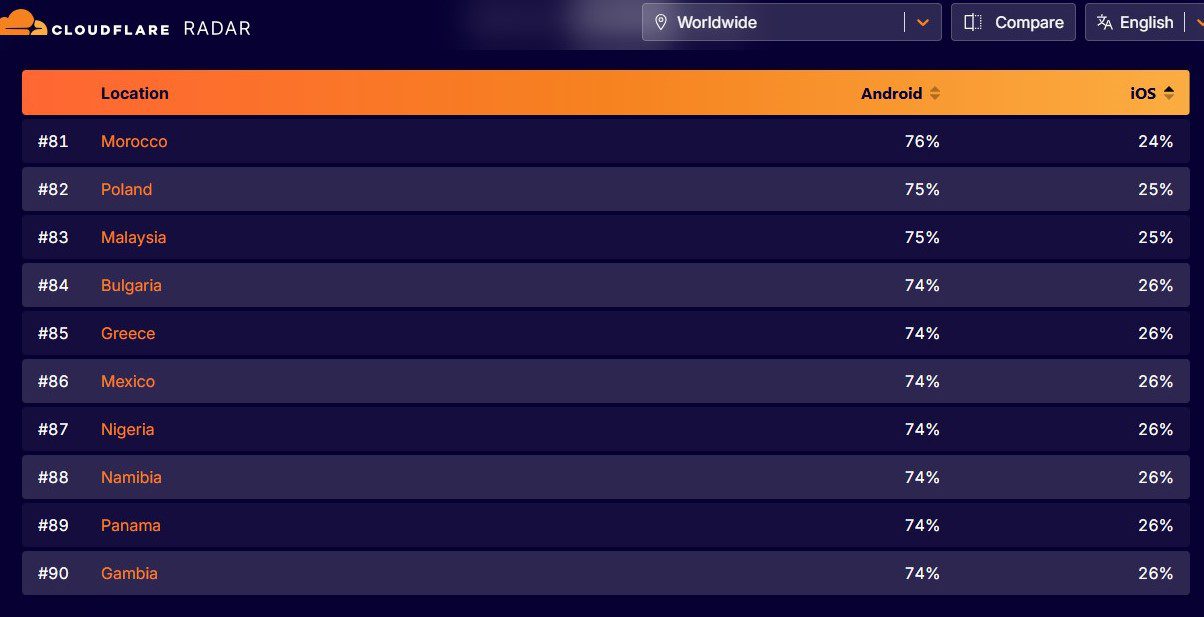
Android: Cloudflare Radar - NigeriaNigeria at 74% internet traffic on Android devices. (Metrics on Cloudflare Radar 2025

Moving up in the ladderboard, 127 countries saw 90% of internet traffic on mobile devices driven by Android in 2025. Papua New Guinea is the highest at 97%. Sudan, Malawi, Bangladesh, and Ethiopia also registered a 95% share or more. Android was responsible for 50% or more of mobile device traffic in 175 countries/regions. The Bahamas’ 51% share placed it at the bottom of that list.

For iOS traffic share, Monaco had the highest share, at 70%. iOS drove 50% or more of mobile device traffic in a total of 30 countries/regions, including Denmark (65%), Japan (57%), and Puerto Rico (52%). Papua New Guinea has the least iOS mobile device traffic at 3.5%. 

Globally, Android devices generated 75% of mobile device traffic while iOS saw 35%, recording a 2% YoY increase. The report explained that the devices continue to generate the majority of mobile device traffic globally due to the “wide distribution of price points, form factors, and capabilities of such devices.”

Also Read: Nigeria’s smartphone shipment grew by 29% in Q3 2025 driven by naira stability.

What’s driving the Android surge

The reasons behind the statistics are not far-fetched. Android smartphones continue to dominate in the global market due to their affordability and adoption in cost-sensitive locations such as Africa, India, Brazil and Eastern Europe. iPhone enjoys a significant market share in markets like the U.S., Japan, Canada, and Australia.

As of November 2025, data on Statcounter reveals that Android dominates the global smartphone market with a significant 71.94% share, while iOS has a 27.64% share. Others, such as Samsung, Linux and KalOS, held on to the remaining. In Nigeria, during the same period, Android held a share of 84.16% while iOS had 12.61%.
Further breakdown on the region reveals that Android dominates Africa at 85% of the market share, with iOS at 13%. In Latin America, it enjoys an 81.45% share in Brazil, driven by affordable devices. It also captured 68% of the Eastern European market share. 

In Asia, the devices dominate 80–95% of the Asian market, with India leading from the front with 95.16%, attributed to brands such as Xiaomi and Oppo.

Piyasa Fırsatı
Helium Mobile Logosu
Helium Mobile Fiyatı(MOBILE)
$0.0002227
$0.0002227$0.0002227
-1.98%
USD
Helium Mobile (MOBILE) Canlı Fiyat Grafiği
Sorumluluk Reddi: Bu sitede yeniden yayınlanan makaleler, halka açık platformlardan alınmıştır ve yalnızca bilgilendirme amaçlıdır. MEXC'nin görüşlerini yansıtmayabilir. Tüm hakları telif sahiplerine aittir. Herhangi bir içeriğin üçüncü taraf haklarını ihlal ettiğini düşünüyorsanız, kaldırılması için lütfen [email protected] ile iletişime geçin. MEXC, içeriğin doğruluğu, eksiksizliği veya güncelliği konusunda hiçbir garanti vermez ve sağlanan bilgilere dayalı olarak alınan herhangi bir eylemden sorumlu değildir. İçerik, finansal, yasal veya diğer profesyonel tavsiye niteliğinde değildir ve MEXC tarafından bir tavsiye veya onay olarak değerlendirilmemelidir.

Ayrıca Şunları da Beğenebilirsiniz

The Channel Factories We’ve Been Waiting For

The Channel Factories We’ve Been Waiting For

The post The Channel Factories We’ve Been Waiting For appeared on BitcoinEthereumNews.com. Visions of future technology are often prescient about the broad strokes while flubbing the details. The tablets in “2001: A Space Odyssey” do indeed look like iPads, but you never see the astronauts paying for subscriptions or wasting hours on Candy Crush.  Channel factories are one vision that arose early in the history of the Lightning Network to address some challenges that Lightning has faced from the beginning. Despite having grown to become Bitcoin’s most successful layer-2 scaling solution, with instant and low-fee payments, Lightning’s scale is limited by its reliance on payment channels. Although Lightning shifts most transactions off-chain, each payment channel still requires an on-chain transaction to open and (usually) another to close. As adoption grows, pressure on the blockchain grows with it. The need for a more scalable approach to managing channels is clear. Channel factories were supposed to meet this need, but where are they? In 2025, subnetworks are emerging that revive the impetus of channel factories with some new details that vastly increase their potential. They are natively interoperable with Lightning and achieve greater scale by allowing a group of participants to open a shared multisig UTXO and create multiple bilateral channels, which reduces the number of on-chain transactions and improves capital efficiency. Achieving greater scale by reducing complexity, Ark and Spark perform the same function as traditional channel factories with new designs and additional capabilities based on shared UTXOs.  Channel Factories 101 Channel factories have been around since the inception of Lightning. A factory is a multiparty contract where multiple users (not just two, as in a Dryja-Poon channel) cooperatively lock funds in a single multisig UTXO. They can open, close and update channels off-chain without updating the blockchain for each operation. Only when participants leave or the factory dissolves is an on-chain transaction…
Paylaş
BitcoinEthereumNews2025/09/18 00:09
BFX Presale Raises $7.5M as Solana Holds $243 and Avalanche Eyes $1B Treasury — Best Cryptos to Buy in 2025

BFX Presale Raises $7.5M as Solana Holds $243 and Avalanche Eyes $1B Treasury — Best Cryptos to Buy in 2025

BFX presale hits $7.5M with tokens at $0.024 and 30% bonus code BLOCK30, while Solana holds $243 and Avalanche builds a $1B treasury to attract institutions.
Paylaş
Blockchainreporter2025/09/18 01:07
Singapore Entrepreneur Loses Entire Crypto Portfolio After Downloading Fake Game

Singapore Entrepreneur Loses Entire Crypto Portfolio After Downloading Fake Game

The post Singapore Entrepreneur Loses Entire Crypto Portfolio After Downloading Fake Game appeared on BitcoinEthereumNews.com. In brief A Singapore-based man has
Paylaş
BitcoinEthereumNews2025/12/18 05:17