Stablecoins

Stablecoins are digital assets pegged to a stable reserve, such as the US Dollar or Gold, to minimize price volatility. Serving as the primary medium of exchange in Web3, tokens like USDT, USDC, and PYUSD facilitate global payments and DeFi liquidity. In 2026, the focus has shifted toward yield-bearing stablecoins and compliant stablecoin frameworks under global regulations like MiCA. This tag covers the intersection of traditional finance (TradFi) and crypto through stable on-chain liquidity solutions.

23963 Articles
Created: 2026/02/02 18:52
Updated: 2026/02/02 18:52
Europe accelerates digital euro plans after U.S. stablecoin law

Europe accelerates digital euro plans after U.S. stablecoin law

The post Europe accelerates digital euro plans after U.S. stablecoin law appeared on BitcoinEthereumNews.com. The European Union (EU) is quickly accelerating its digital euro plans following the signing of the GENIUS Act, which introduced a number of crypto regulatory changes in the U.S.  Most notably, the act established the first comprehensive framework for the $288 billion U.S. stablecoin market, requiring issuers to maintain full liquid-asset reserves, secure licenses, and comply with strict disclosure rules. These changes have sparked concerns worldwide that dollar-backed stablecoins could gain further footing, threatening the euro’s role in cross-border payments in the process. EU 🇪🇺 officials are accelerating digital euro plans after the US passed its Genius Act stablecoin law, which raised concerns over the euro’s competitiveness. Sources say the ECB is now considering public blockchains like Ethereum $ETH or Solana $SSK. — Wall St Engine (@wallstengine) August 22, 2025 Digital euro on Ethereum and Solana? The European Central Bank (ECB) first proposed the digital euro in October 2021, envisioning a fully private ledger.  Now, officials are openly debating whether to instead issue the currency on public blockchains, such as Ethereum (ETH) or Solana (SOL), which would allow it to circulate more efficiently and increase its utility as a cross-border payment. However, the idea is not without its critics, as some warn that public chains could increase privacy risks since transactions would be recorded on transparent ledgers.  What’s more, a closed system under ECB’s supervision would resemble China’s digital yuan, while a more open digital euro would complement the union’s open-market principles. Given the difficulty of the matter, the outcome of the debate is certain to leave a great impact on Europe’s position in the digital payments landscape. Featured image via Shutterstock Source: https://finbold.com/europe-accelerates-digital-euro-plans-after-u-s-stablecoin-law/

Author: BitcoinEthereumNews
Ethereum and Solana Could Power Europe’s Digital Euro

Ethereum and Solana Could Power Europe’s Digital Euro

Sources familiar with ongoing discussions told the Financial Times that the European Central Bank (ECB) is now weighing whether to […] The post Ethereum and Solana Could Power Europe’s Digital Euro appeared first on Coindoo.

Author: Coindoo
Tether And Circle To Meet Top South Korean Bank CEOs: Report

Tether And Circle To Meet Top South Korean Bank CEOs: Report

The post Tether And Circle To Meet Top South Korean Bank CEOs: Report appeared on BitcoinEthereumNews.com. Leading stablecoin issuers Tether and Circle are expected to meet with top executives from South Korea’s largest banks this week, according to local media. South Korea’s state-funded Yonhap News Agency reported Thursday that representatives from Tether and Circle are scheduled to meet with the top executives of South Korea’s four major financial groups. The executives are expected to discuss potential partnerships, the issuance of Korean won-backed stablecoins and the distribution of US dollar-backed stablecoins in South Korea. Shinhan Financial Group CEO Jin Ok-dong and Hana Financial Group CEO Ham Young-joo reportedly have scheduled meetings with Circle President Heath Tarbert on Friday. Young-joo is also reportedly scheduled to meet a Tether official on the same day. KB Financial Group’s chief digital and information technology officer Lee Chang-kwon and Woori Bank President Jeong Jin-wan also reportedly plan to meet Circle’s Tarbert at an undisclosed time. These represent South Korea’s “Big Four” banking groups, designated by the Financial Services Commission as domestic systemically important banks. South Korea readies stablecoin regulation The news follows reports from earlier in the month that South Korea is preparing to introduce a regulatory framework for a won-backed stablecoin. South Korean regulator, the Financial Services Commission, will purportedly unveil the bill as part of a second phase of the nation’s Virtual Asset User Protection Act. In early July, shares of at least three major South Korean banks surged following the filing of trademarks for stablecoins. This was followed by statements by the banking arm of South Korean IT giant Kakao Corporation announcing that the institution “plans to participate” in the stablecoin market actively. South Korea’s pivot to focus on stablecoin regulation follows the late June suspension of the country’s central bank digital currency (CBDC) tests in favor of focusing on supporting won-backed stablecoins instead. Prior to the development, eight major…

Author: BitcoinEthereumNews
Cardano, MAGACOIN FINANCE & Bitcoin Named by Analysts as 5 Best Cryptos for Bull Market

Cardano, MAGACOIN FINANCE & Bitcoin Named by Analysts as 5 Best Cryptos for Bull Market

Analysts are highlighting Cardano, MAGACOIN FINANCE, Bitcoin, Ethereum, and Sui as five of the best cryptos to watch for the 2025 bull market. Each project carries unique narratives and catalysts shaping how traders approach the months ahead. Cardano in Focus: Pullbacks and Community Debates Cardano has been a major talking point after a sharp rise [...] The post Cardano, MAGACOIN FINANCE & Bitcoin Named by Analysts as 5 Best Cryptos for Bull Market appeared first on Blockonomi.

Author: Blockonomi
MetaMask Unveils Dollar-Backed mUSD Stablecoin With Stripe Support

MetaMask Unveils Dollar-Backed mUSD Stablecoin With Stripe Support

The post MetaMask Unveils Dollar-Backed mUSD Stablecoin With Stripe Support appeared on BitcoinEthereumNews.com. Crypto wallet provider MetaMask said it will introduce MetaMask USD (mUSD), a dollar-pegged stablecoin that will be issued by Bridge, a platform owned by payments company Stripe Crypto wallet provider MetaMask said it will introduce MetaMask USD (mUSD), a dollar-pegged stablecoin that will be issued by Bridge, a platform owned by payments company Stripe. The token marks the first stablecoin created by a self-custodial wallet and is intended to deepen the firm’s control over the liquidity used across its products. mUSD is scheduled to debut later this year on the Ethereum mainnet and on Linea, the layer-2 network built by MetaMask parent Consensys. According to the announcement, the coin will be backed one-for-one by cash and short-term Treasury assets to comply with the recently enacted GENIUS Act, which set federal standards for stablecoin reserves. MetaMask plans to integrate mUSD throughout its decentralised-finance ecosystem and to make the token spendable via the Mastercard-branded MetaMask debit card that is in pilot testing. While the company does not plan to pay yield on mUSD balances at launch, it said the token could be incorporated into future incentive programmes. The move positions MetaMask alongside PayPal and Coinbase in releasing dollar-backed tokens as U.S. policy on privately issued digital dollars solidifies. MetaMask’s large retail user base could give mUSD an edge over incumbent stablecoins such as Tether’s USDT and Circle’s USDC once the coin goes live. This is an AI-generated article powered by DeepNewz, curated by The Defiant. For more information, including article sources, visit DeepNewz. Source: https://thedefiant.io/news/defi/metamask-unveils-dollar-backed-musd-stablecoin-stripe-support-2128d266

Author: BitcoinEthereumNews
Coinbase Sees Stablecoin Market Growing to $1.2T by 2028

Coinbase Sees Stablecoin Market Growing to $1.2T by 2028

The post Coinbase Sees Stablecoin Market Growing to $1.2T by 2028 appeared on BitcoinEthereumNews.com. Stablecoins, digital tokens tied to predominantly fiat currencies like the U.S. dollar, will balloon to a $1.2 trillion market by 2028 and even have an impact on U.S. debt markets, Coinbase analysts projected in a Thursday report. The forecast, published by the exchange’s research arm led by David Duong, is based on a stochastic model simulating thousands of growth paths for the stablecoin sector. To swell almost five-fold from the current market size of $270 billion, the asset class “relies on incremental, policy-enabled adoption compounding over time,” the report said. Stablecoin issuers such as USDC (USDC) issuer Circle (CRCL) and Tether, the firm behind USDT (USDT), typically hold large portfolios of U.S. Treasury bills to back the tokens’ value. The growth to $1.2 trillion would translate into roughly $5.3 billion in new T-bill purchases every week, the report projected. Such inflows could shave 2-4 basis points off of the three-month Treasury yield over time, a small but noticeable effect in the $6 trillion money market where marginal moves can sway institutional funding costs, the analysts said. Redemption surges, on the other hand, could have an adverse effect. A $3.5 billion outflow in five days could lead to a cascade of forced selling, tightening liquidity on the T-bill market, the report noted. Coinbase analysts pointed to the recently passed stablecoin regulation, dubbed GENIUS Act, as critical to containing that risk. The law, which will come into effect in 2027 for issuers and tokens, mandates one-to-one reserves, audits and bankruptcy protections for holders. While the law doesn’t grant stablecoin issuers direct access to Federal Reserve facilities, it could reduce the likelihood of a destabilizing run, the report said. Read more: Stablecoins, Tokenization Put Pressure on Money Market Funds: Bank of America Source: https://www.coindesk.com/markets/2025/08/21/stablecoin-market-could-hit-usd1-2t-by-2028-maybe-affecting-u-s-government-debt-yields-coinbase

Author: BitcoinEthereumNews
Ripple Teams With SBI to Roll Out RLUSD Stablecoin in Japan by 2026

Ripple Teams With SBI to Roll Out RLUSD Stablecoin in Japan by 2026

TLDR: Ripple and SBI will distribute RLUSD in Japan through SBI VC Trade starting in early 2026. RLUSD will be fully backed by U.S. dollar deposits, government bonds, and cash equivalents with third-party audits. The stablecoin market stands at $300B today and is forecasted to expand into trillions in the coming years. Ripple executives said [...] The post Ripple Teams With SBI to Roll Out RLUSD Stablecoin in Japan by 2026 appeared first on Blockonomi.

Author: Blockonomi
State Street Makes History as JPMorgan’s First Blockchain Custodian Partner

State Street Makes History as JPMorgan’s First Blockchain Custodian Partner

TLDR State Street becomes the first third-party custodian on JPMorgan’s Digital Debt Service blockchain platform for tokenized assets The bank anchored a $100 million tokenized commercial paper transaction from Singapore’s OCBC bank State Street manages $49 trillion in assets under custody and $5.1 trillion in assets under management The tokenized real-world asset sector has grown [...] The post State Street Makes History as JPMorgan’s First Blockchain Custodian Partner appeared first on CoinCentral.

Author: Coincentral
MetaMask to Launch mUSD Stablecoin on Ethereum and Linea in 2025

MetaMask to Launch mUSD Stablecoin on Ethereum and Linea in 2025

The post MetaMask to Launch mUSD Stablecoin on Ethereum and Linea in 2025 appeared on BitcoinEthereumNews.com. MetaMask, the self-custodial crypto wallet owned by Consensys, said Thursday it will launch a dollar-backed stablecoin called MetaMask USD (mUSD). MetaMask said on Thursday that the stablecoin will be issued by Bridge, an issuance and orchestration platform for stablecoins that was acquired by the payments platform Stripe, and will be powered by the liquidity platform M0.  MUSD will be integrated into the MetaMask wallet, allowing use of the stablecoin across Web3 applications. MetaMask said the stablecoin is designed for cross-chain use through M0’s liquidity network. The stablecoin will debut later in 2025 on the Ethereum blockchain and the Linea network, an Ethereum Virtual Machine (EVM) equivalent layer-2 bootstrapped by Consensys.  Source: MetaMask MetaMask introduces the wallet-native stablecoin The company said the stablecoin is positioned to play a major role in Linea’s decentralized finance (DeFi) ecosystem.  MetaMask said the token will be backed 1-to-1 with dollar-equivalent reserves and integrated into wallet features including swaps, on-ramps and bridging. The company also plans to launch a MetaMask Card later this year in partnership with Mastercard, enabling users to spend mUSD in everyday transactions. MetaMask said that a wallet-native, self-custodial stablecoin will enhance the experience of users who regularly on-ramp, hold, trade, lend and spend value using MetaMask. The company said this “simplifies the Web3 and self-custodial journey.” Gal Eldar, product lead at MetaMask, said the new stablecoin lowers barriers for users entering the Web3 space. Eldar said it reduces the costs and simplifies the onboarding process. He added that the stablecoin will allow users to move their funds onchain, deploy them into DeFi and spend them in everyday transactions.  Related: Judge unfreezes $57M in stablecoins linked to Libra token scandal United States’ GENIUS Act paves the way for stablecoins Citing the recently signed Guiding and Establishing National Innovation for US Stablecoins (GENIUS) Act,…

Author: BitcoinEthereumNews
Blockchain Cracks Open Wall Street’s Most Guarded Asset Class

Blockchain Cracks Open Wall Street’s Most Guarded Asset Class

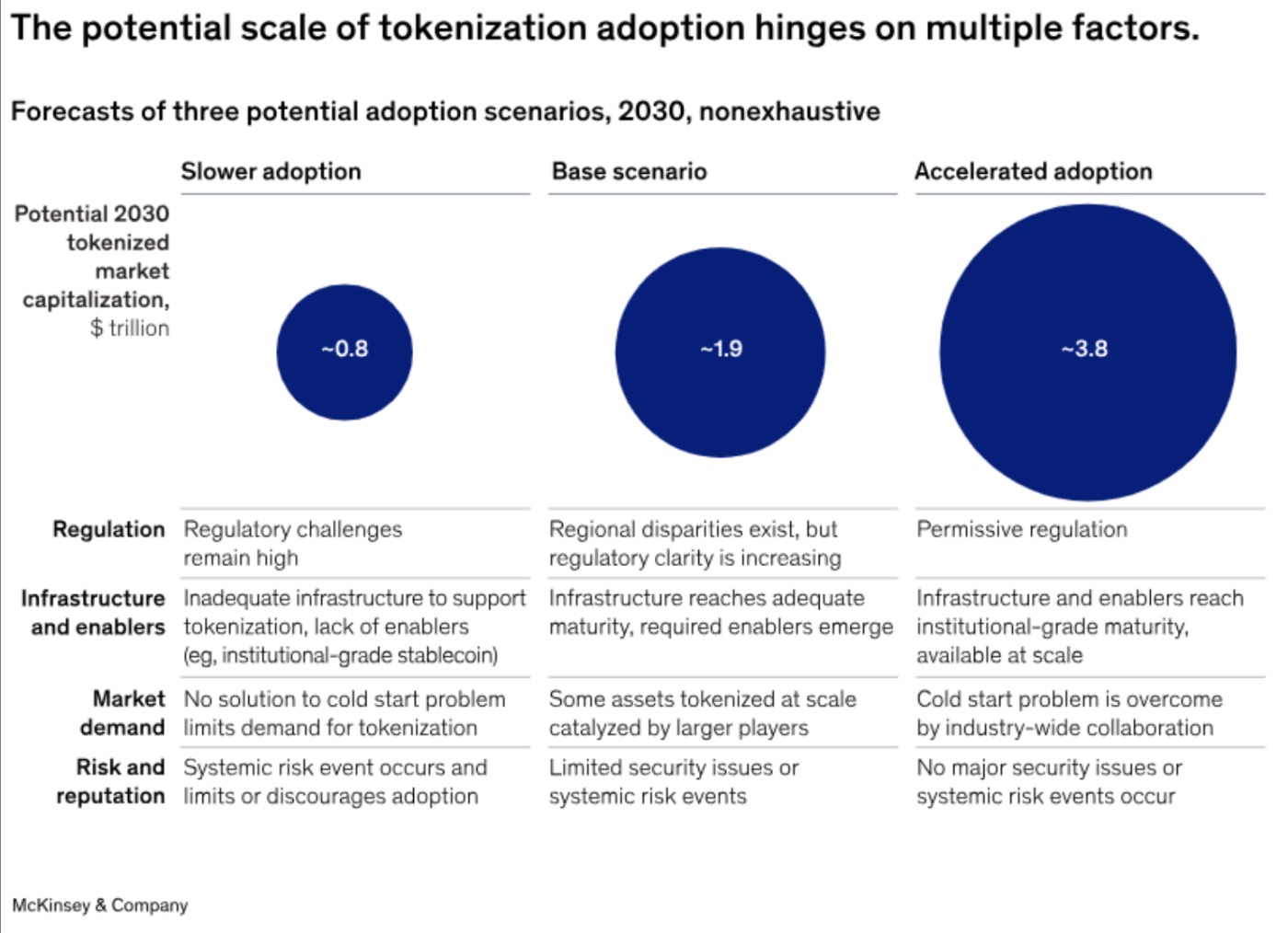
Private markets are illiquid, opaque, and outdated. Tokenization is changing that. With trillions in assets locked up, new U.S. regulations like the GENIUS Act, CLARITY Act, and the SEC’s Project Crypto are creating the rails for programmable liquidity. Institutions are already piloting tokenized funds, and forecasts suggest $2–4 trillion in tokenized assets by 2030. The next decade will mark the end of illiquidity — and the rise of token-native private markets.

Author: Hackernoon