Stablecoins

Stablecoins are digital assets pegged to a stable reserve, such as the US Dollar or Gold, to minimize price volatility. Serving as the primary medium of exchange in Web3, tokens like USDT, USDC, and PYUSD facilitate global payments and DeFi liquidity. In 2026, the focus has shifted toward yield-bearing stablecoins and compliant stablecoin frameworks under global regulations like MiCA. This tag covers the intersection of traditional finance (TradFi) and crypto through stable on-chain liquidity solutions.

23952 Articles
Created: 2026/02/02 18:52
Updated: 2026/02/02 18:52
Pennsylvania Introduces HB1812 to Ban  Public Officials from Holding Crypto

Pennsylvania Introduces HB1812 to Ban Public Officials from Holding Crypto

TLDR PA Bill Bans Crypto Trades by Officials to Boost Ethics and Transparency HB1812 Forces PA Politicians to Ditch Digital Assets or Face Penalties Pennsylvania Cracks Down on Crypto Conflicts with Sweeping New Law No Bitcoin for Politicians: PA’s HB1812 Sets Strict Crypto Rules HB1812 Outlaws Public Official Crypto Deals During and After Term Pennsylvania [...] The post Pennsylvania Introduces HB1812 to Ban Public Officials from Holding Crypto appeared first on CoinCentral.

Author: Coincentral
Pennsylvania House sees bill to ban public officials from owning Bitcoin and digital assets

Pennsylvania House sees bill to ban public officials from owning Bitcoin and digital assets

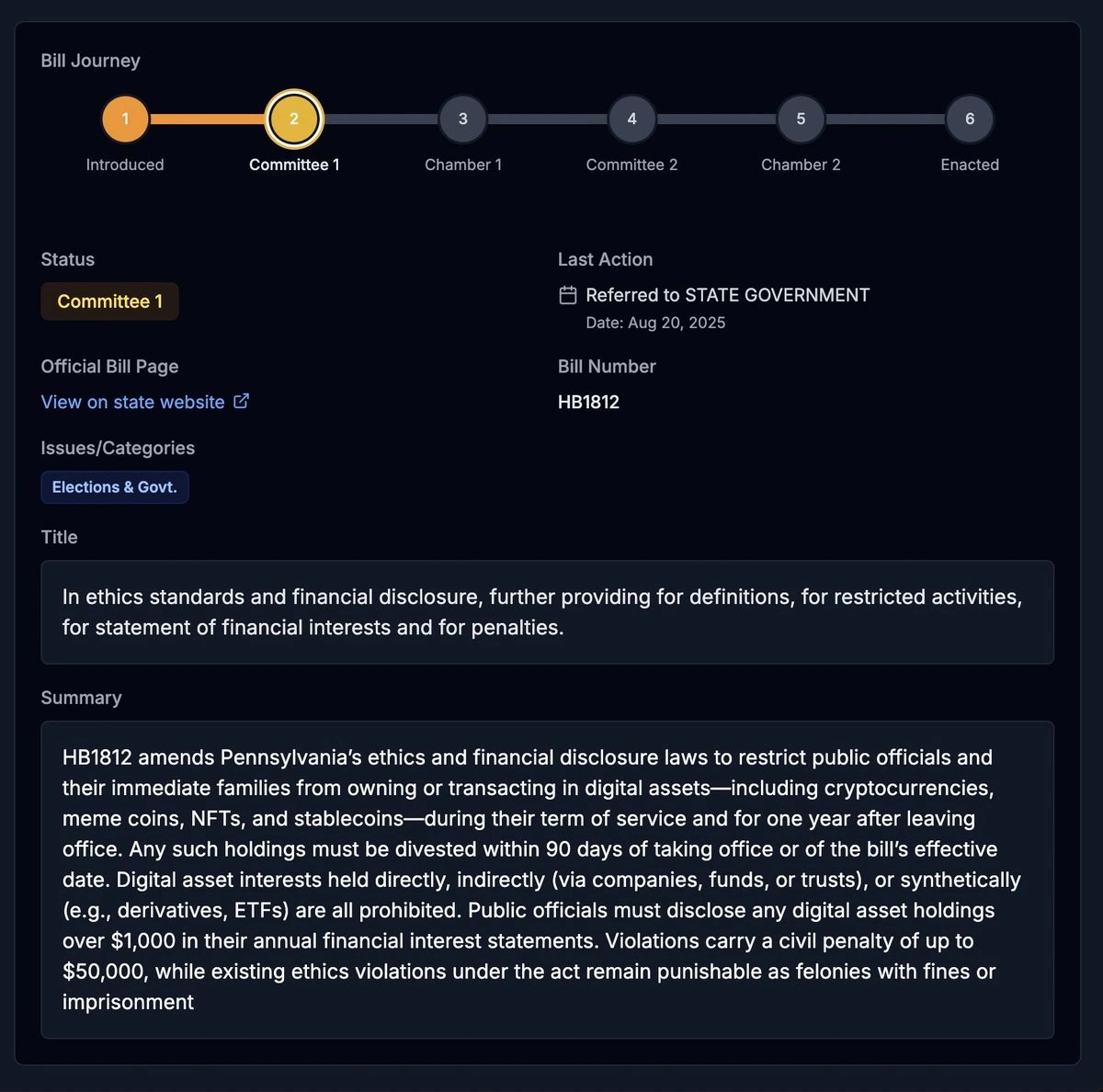
The post Pennsylvania House sees bill to ban public officials from owning Bitcoin and digital assets  appeared on BitcoinEthereumNews.com. Pennsylvania lawmakers are seeking to pass House Bill 1812, which will prohibit public officials and their immediate families from owning or engaging in transactions involving Bitcoin and other digital assets. The bill is being sponsored by Rep. Ben Waxman and co-sponsored by seven other representatives in the Pennsylvania House of Representatives. Source: @Bitcoin_Laws via X/Twitter Lawmakers seek to ban elected officials from holding crypto The bill bans public officials from holding Bitcoin and also extends to their immediate families. It aims to change the state’s ethics and financial disclosure laws in order to prevent public officials from having exposure to not just Bitcoin, but also alternative cryptocurrencies (including memecoins), non-fungible tokens, and even stablecoins. The bill would also prohibit them from holding crypto via funds, trusts, or funds. The same applies to cryptocurrency derivatives as well as exchange-traded funds (ETFs), which have gained significant adoption over the past year. Any state official who is already a holder of these nascent asset classes would be required to divest their digital asset holdings within two months of taking office to prevent potential conflicts of interest. They would also not be allowed to own crypto for up to a year after leaving their government jobs. Those who fail to comply will face potential jail or a civil penalty of up to $50,000 and will be punished as felons. What are the odds of the bill passing in Pennsylvania? The recently introduced bill has reportedly been referred to the Committee on State Government. It is still at an early stage of the legislative bill-passing process. So for now, it is unclear if it will pass. For now, no restrictions ban members of Congress from holding Bitcoin. However, there are existing disclosure laws that they need to comply with. The bill highlights the growing bipartisan…

Author: BitcoinEthereumNews
Stablecoins in Japan and China, India mulls crypto tax changes: Asia Express

Stablecoins in Japan and China, India mulls crypto tax changes: Asia Express

                                                                               Major Asian economies step on the stablecoin throttle, India’s reconsiders punitive crypto tax, and more.                     Major Asian economies are accelerating their stablecoin initiatives, with notable moves from Japan and China over the past week.Japans top financial regulator is reportedly preparing to approve the countrys first yen-pegged stablecoin within the year. The token, issued by fintech startup JPYC, will be backed by liquid assets such as government bonds. According to finance outlet Nikkei, JPYC is expected to register as a money-transfer business this month and aims to issue 1 trillion yen (about $6.81 billion) worth of stablecoins over the next three years.Read more

Author: Coinstats
MetaMask USD Set to Go Live in 2025: Spend Crypto Anywhere Mastercard is Accepted

MetaMask USD Set to Go Live in 2025: Spend Crypto Anywhere Mastercard is Accepted

MetaMask, the widely used self-custodial wallet from Consensys, has announced the launch of MetaMask USD (mUSD), its first native stablecoin. This is a landmark move since no self-custodial wallet has previously created its own stablecoin. The rollout is planned for later this year and will begin on Ethereum and Linea, Consensys’ layer two network built […]

Author: Tronweekly
CFTC Crypto Sprint: Unleashing Crucial Regulatory Action for US Leadership

CFTC Crypto Sprint: Unleashing Crucial Regulatory Action for US Leadership

BitcoinWorld CFTC Crypto Sprint: Unleashing Crucial Regulatory Action for US Leadership The cryptocurrency landscape in the United States is buzzing with a significant development: the CFTC crypto sprint. This initiative, announced by Caroline Pham, the acting chair of the U.S. Commodity Futures Trading Commission (CFTC), signals an urgent push to implement key recommendations from the White House crypto report. It is a pivotal moment for digital asset regulation, promising to shape the future of how cryptocurrencies are traded and overseen in America. What is the CFTC Crypto Sprint Unveiling? The CFTC crypto sprint is essentially an accelerated effort by the Commodity Futures Trading Commission. Its primary goal is to quickly integrate and act upon the insights and directives outlined in the comprehensive White House crypto report. This rapid response highlights a commitment to establishing clear regulatory frameworks for digital assets. Eleanor Terrett, host of the “Crypto in America” podcast, shared insights on X, noting that Pham positioned this sprint as a direct answer to President Donald Trump’s call for the U.S. to lead in crypto trading. This suggests a strategic move to solidify America’s position at the forefront of the global digital economy. Why is This Regulatory Push So Important? This initiative isn’t just about creating new rules; it’s about fostering innovation while ensuring market integrity and consumer protection. The CFTC’s proactive stance, especially in coordination with the Securities and Exchange Commission’s (SEC) Project Crypto, aims to provide much-needed clarity for businesses and investors alike. A well-defined regulatory environment can attract more institutional investment and foster safer participation in the crypto markets. Clarity reduces uncertainty, which is often a major hurdle for growth in nascent industries. By clarifying jurisdictional lines and regulatory expectations, the CFTC crypto sprint could unlock significant potential for the U.S. crypto sector. For instance, clearer rules around commodity versus security classifications could greatly impact how exchanges operate and how new tokens are launched. How Can You Participate in the CFTC Crypto Sprint? A crucial aspect of this regulatory push is public engagement. The CFTC is actively seeking input from all stakeholders – individuals, businesses, and experts – until October 20. This public comment period is an invaluable opportunity for the crypto community to voice their perspectives, concerns, and suggestions directly to the regulators. Your input can help shape the final recommendations and ensure that the regulatory framework is balanced, practical, and forward-thinking. Engaging in this process is a powerful way to contribute to the responsible evolution of digital asset regulation. Consider submitting comments on topics such as derivatives trading, DeFi, or stablecoins. What Challenges Might the CFTC Crypto Sprint Face? While the intent behind the CFTC crypto sprint is positive, the path to effective regulation is often complex. One significant challenge is the rapid pace of technological innovation in the crypto space, which can quickly outpace traditional regulatory processes. Regulators must strike a delicate balance between encouraging innovation and mitigating risks without stifling growth. Another hurdle involves inter-agency coordination. While the CFTC and SEC are collaborating, defining clear jurisdictional boundaries for various digital assets remains a complex task. Different interpretations could lead to regulatory arbitrage or fragmentation, which would undermine the goal of a cohesive framework. Overcoming these challenges will be crucial for the sprint’s long-term success. Looking Ahead: What Does This Mean for US Crypto Leadership? The convergence of the CFTC crypto sprint and the SEC’s Project Crypto signifies a concerted effort by key U.S. financial regulators. This collaborative approach suggests a move towards a more harmonized regulatory landscape for digital assets, which has long been a desire within the crypto industry. The ultimate goal is to establish the U.S. as the undisputed leader in global crypto trading and innovation. Ultimately, these initiatives aim to create a robust and transparent market where innovation can thrive under appropriate oversight. The goal is to solidify the U.S.’s role as a leader in the digital asset space, providing a secure environment for both innovation and investment. This could attract more capital, talent, and entrepreneurial activity to American shores. The CFTC crypto sprint represents a significant stride towards establishing a clear and comprehensive regulatory framework for digital assets in the United States. By actively seeking public input and coordinating with other agencies, the CFTC is demonstrating a commitment to building a resilient and competitive crypto ecosystem. This proactive approach is essential for ensuring that the U.S. remains at the forefront of the evolving global digital economy. This is a moment for the industry to engage and help shape its own future. Frequently Asked Questions (FAQs) What is the main purpose of the CFTC crypto sprint?The primary purpose of the CFTC crypto sprint is to rapidly implement recommendations from the White House crypto report to establish clear regulatory frameworks for digital assets and solidify U.S. leadership in crypto trading. Who announced the CFTC crypto sprint?Caroline Pham, the acting chair of the U.S. Commodity Futures Trading Commission (CFTC), announced the initiative. How does the CFTC crypto sprint relate to the SEC’s Project Crypto?The CFTC crypto sprint is a parallel effort to the SEC’s Project Crypto, indicating a coordinated and collaborative approach by key U.S. financial regulators to harmonize digital asset regulation. When is the deadline for public comments on the CFTC crypto sprint?The CFTC is accepting public comments until October 20. Why is public comment important for the CFTC crypto sprint?Public comments provide invaluable input from stakeholders, helping to ensure that the final regulatory framework is balanced, practical, and forward-thinking, and reflects the diverse perspectives of the crypto community. Did you find this article insightful? Share it with your network on social media to spread awareness about the crucial CFTC crypto sprint and its potential impact on the future of digital assets! To learn more about the latest crypto market trends, explore our article on key developments shaping digital asset institutional adoption. This post CFTC Crypto Sprint: Unleashing Crucial Regulatory Action for US Leadership first appeared on BitcoinWorld and is written by Editorial Team

Author: Coinstats
Tether and Circle meet South Korea’s big four banks

Tether and Circle meet South Korea’s big four banks

The post Tether and Circle meet South Korea’s big four banks appeared on BitcoinEthereumNews.com. News Tether and Circle will meet South Korea’s top four bank CEOs to discuss stablecoin partnerships. Talks focus on distributing US dollar stablecoins and issuing Korean won backed stablecoins. South Korea is preparing new stablecoin regulations, pausing its digital won project. Tether and Circle, the companies behind the world’s top stablecoins, are meeting with leaders from South Korea’s four biggest banks this week. According to Yonhap News Agency, these talks will focus on possible partnerships. Including ways to distribute US dollar backed stablecoins like USDT and USDC in South Korea and creating new stablecoins tied to the Korean won. This comes as South Korea prepares new rules for stablecoins, expected to be introduced in October. Big Banks and Stablecoin Plans The meetings involve top executives from Shinhan Financial Group, Hana Financial Group, KB Financial Group, and Woori Bank, known as South Korea’s “Big Four” banks. Shinhan’s CEO Jin Ok dong and Hana’s CEO Ham Young joo are set to meet Circle’s President Heath Tarbert on Friday. With Ham also meeting a Tether official that day. KB’s digital officer Lee Chang kwon and Woori’s President Jeong Jin wan are also planning to meet Tarbert. Though no date is confirmed. The discussions will explore how these banks can work with Tether and Circle to handle dollar based stablecoins and issue won based ones. South Korea’s government paused its digital won project in June to focus on stablecoin rules, and banks like these are already preparing. For example, Kakao’s banking arm plans to join the stablecoin market. And some banks have filed trademarks for their own stablecoins. These talks follow Tether and Circle’s meetings with global regulators. Including a US forum in March and Tether’s discussions in countries like El Salvador. South Korea’s new rules could shape how stablecoins grow in the country.…

Author: BitcoinEthereumNews
Ethena crosses $500M in cumulative revenue as synthetic stablecoins gain ground

Ethena crosses $500M in cumulative revenue as synthetic stablecoins gain ground

                                                                               While the overall stablecoin market is up 4% in August, some synthetic stablecoins, such as Sky Dollar and Falcon USD, have had even more substantial gains.                     Ethena Labs on Thursday said its Ethena protocol has generated more than $500 million in cumulative revenue. Growth in both revenue and the circulating supply of its synthetic stablecoin, Ethena USDe (USDe), has accelerated since July as synthetic stablecoins gain market share.Ethena Labs shared the news via a post on X, saying that in the past week, protocol revenue hit $13.4 million and USDe supply hit an all-time high of $11.7 billion. “Ethena’s revenue has been driven by strong inflows into USDe and favorable market conditions that have amplified returns from its delta-neutral hedging reserve model,” an Ethena Labs spokesperson told Cointelegraph. “The protocol’s momentum reflects growing demand for and confidence in USDe as a store of value.”Read more

Author: Coinstats
Ethena Makes $500 Million Revenue as USDe Supply Crosses $11.7 Billion

Ethena Makes $500 Million Revenue as USDe Supply Crosses $11.7 Billion

Ethena’s positive run continues as the protocol announced $500 million record revenue and a supply of $11.7 billion worth of USDe. Read more on the news here!

Author: Blockchainreporter
Pennsylvania Crypto Ban: Controversial Bill Targets Public Officials’ Digital Assets

Pennsylvania Crypto Ban: Controversial Bill Targets Public Officials’ Digital Assets

BitcoinWorld Pennsylvania Crypto Ban: Controversial Bill Targets Public Officials’ Digital Assets A significant development is unfolding in the world of digital assets, directly impacting public service. Pennsylvania’s HB1812 proposes a sweeping Pennsylvania crypto ban for its public officials, aiming to prevent potential conflicts of interest. This bill, if passed, would reshape how elected and appointed individuals in the state interact with the rapidly evolving cryptocurrency market. What Does the Pennsylvania Crypto Ban Bill Propose? House Bill 1812 introduces strict new regulations concerning digital asset ownership for those in public office. The legislation targets a broad range of crypto holdings, including Bitcoin, other cryptocurrencies, NFTs (Non-Fungible Tokens), stablecoins, and various related financial products. This comprehensive approach ensures that the ban covers the diverse landscape of digital assets. The core of the proposal is clear: public officials and their immediate family members would be prohibited from holding these assets. This measure seeks to ensure transparency and uphold public trust by removing any perceived financial incentives tied to digital currencies. It aims to prevent situations where personal financial interests could influence policy decisions. Who is Affected by This Proposed Pennsylvania Crypto Ban? The scope of HB1812 is quite extensive. It applies not only to public officials themselves but also extends to their family members. This broad definition aims to close potential loopholes where assets might be held indirectly through spouses or dependents. Key requirements outlined in the bill include: Mandatory Divestment: Officials must divest all prohibited digital assets within two months of taking office. This ensures a rapid transition away from crypto holdings, minimizing any potential for conflict from the outset. Post-Service Restriction: The ban extends for one year after an official leaves public service. This provision aims to prevent immediate re-engagement with crypto that might be influenced by past decisions or insider knowledge gained during their tenure. Severe Penalties for Violations: Violations of this proposed Pennsylvania crypto ban could lead to serious consequences, including potential jail time, as reported by U.Today. This highlights the bill’s serious intent to enforce compliance and deter non-adherence. Why is a Pennsylvania Crypto Ban Being Considered Now? The primary motivation behind HB1812 appears to be the prevention of conflicts of interest. As cryptocurrencies become more integrated into the global financial system and their market capitalization grows, policymakers face new ethical challenges. Public officials could potentially make decisions that directly or indirectly benefit their personal crypto holdings. Consider a scenario where an official owns a significant amount of a particular cryptocurrency. If that official is involved in drafting or voting on legislation that impacts crypto regulation, a clear conflict of interest could arise. This bill seeks to eliminate such possibilities, fostering greater integrity and impartiality in governance. It aligns with a broader trend of increased scrutiny on financial disclosures for public servants. What are the Potential Implications of This Policy? A Pennsylvania crypto ban of this nature carries significant implications, both for public officials and the broader digital asset community. For officials, it means a forced divestment from a growing asset class that many see as a legitimate and innovative investment opportunity. It could impact their personal financial planning and investment strategies. On the other hand, proponents argue it significantly strengthens public trust. It sets a precedent that public service demands a clear separation from assets that could influence policy decisions, ensuring that decisions are made for the public good, not personal gain. However, critics might argue it’s an overreach, potentially discouraging talented individuals with expertise in emerging technologies from seeking public office in Pennsylvania. Challenges and Debates Surrounding the Bill Implementing such a comprehensive ban presents several challenges. Defining “family members” and “related financial products” precisely can be complex, potentially leading to ambiguities. Furthermore, monitoring compliance in the decentralized and often pseudonymous world of cryptocurrency poses unique difficulties for enforcement agencies. The debate around this bill also touches on individual financial freedom versus public accountability. While the intent to prevent corruption is laudable, some may view it as an infringement on personal investment choices. This Pennsylvania crypto ban proposal will undoubtedly spark robust discussions among lawmakers, industry experts, and the public, weighing the benefits of integrity against potential restrictions on individual rights. In conclusion, Pennsylvania’s HB1812 represents a bold move to address potential ethical dilemmas arising from public officials holding digital assets. While aiming to bolster public trust and prevent conflicts of interest, its comprehensive nature and strict penalties will likely lead to extensive debate. The outcome of this proposed Pennsylvania crypto ban could set an important precedent for other states and even national governments grappling with similar issues concerning digital asset ownership among public servants. Frequently Asked Questions (FAQs) About the Pennsylvania Crypto Ban What is HB1812?HB1812 is a proposed bill in Pennsylvania that seeks to ban public officials and their immediate family members from owning or trading cryptocurrencies, NFTs, stablecoins, and related financial products. Why is this ban being proposed?The primary reason is to prevent potential conflicts of interest, ensuring that public officials make decisions based on public good rather than personal financial gain from digital asset holdings. Who exactly would be affected by this ban?The ban would affect all public officials in Pennsylvania, including elected and appointed individuals, as well as their spouses and dependent children. What are the penalties for violating the proposed ban?Violations of HB1812 could lead to severe consequences, including potential jail time, as highlighted by reports. Are there similar bans in other states or countries?While not widespread, some jurisdictions and entities globally are exploring or implementing policies regarding public officials’ digital asset holdings to address similar ethical concerns. What are your thoughts on this significant legislative move? Share this article with your network and let’s spark a broader conversation about ethics in public service and the evolving landscape of digital assets! To learn more about the latest crypto market trends, explore our article on key developments shaping Bitcoin institutional adoption. This post Pennsylvania Crypto Ban: Controversial Bill Targets Public Officials’ Digital Assets first appeared on BitcoinWorld and is written by Editorial Team

Author: Coinstats
DeFi Treasury Protocol ETH Strategy Deploys Over 50% of Its ETH for Yield

DeFi Treasury Protocol ETH Strategy Deploys Over 50% of Its ETH for Yield

The post DeFi Treasury Protocol ETH Strategy Deploys Over 50% of Its ETH for Yield appeared on BitcoinEthereumNews.com. ETH Strategy has deployed a significant portion of its ETH into Etherfi’s weETH token, along with deposits into Lido, Liquid Collective, Renzo, and Aave. ETH Strategy, a DeFi protocol that mimics corporate treasury operations on-chain, is now deploying its ETH into yield-generating positions through a partnership with Etherfi, a non-custodial liquid staking protocol. According to an Aug. 18 blog announcement, allocations to partners like Etherfi are “intended to generate sustainable ETH-denominated returns as part of the ETH Strategy treasury program.” Users will get on-chain receipt tokens for each position, which act as a live, verifiable “proof of reserves,” ETH Strategy explained. ETH Strategy, which has over 11,000 ETH in its treasury, says the integration is “designed to sit alongside other DeFi venues as we roll out additional partners, diversifying sources of yield while preserving liquidity and control.” In practice, this means ETH can be allocated across multiple protocols, earning returns through lending, staking, or other yield mechanisms without locking users’ liquidity. Staking Yield In an X post on Aug. 18, ether.fi said ETH Strategy “will be deploying a significant portion of their ETH holdings into weETH,” a non-rebasing ERC-20 token representing staked Ethereum. While the exact amount wasn’t disclosed, on-chain data shows ETH Strategy has allocated 2,048 ETH to weETH so far, along with smaller deposits to Lido, Liquid Collective, Renzo, and Aave. ETH Deposits ETH Strategy isn’t a company with a traditional off-chain balance sheet. It’s a set of smart contracts running on Ethereum that manage treasury positions autonomously. In its official documentation, ETH Strategy says it has “2 audits completed,” but adds that “these will be public later,” without naming the auditors or providing a timeline. ETH Strategy did not respond to The Defiant’s request for comment. The protocol’s native token STRAT is designed to give leveraged exposure…

Author: BitcoinEthereumNews