Stablecoins

Stablecoins are digital assets pegged to a stable reserve, such as the US Dollar or Gold, to minimize price volatility. Serving as the primary medium of exchange in Web3, tokens like USDT, USDC, and PYUSD facilitate global payments and DeFi liquidity. In 2026, the focus has shifted toward yield-bearing stablecoins and compliant stablecoin frameworks under global regulations like MiCA. This tag covers the intersection of traditional finance (TradFi) and crypto through stable on-chain liquidity solutions.

23900 Articles
Created: 2026/02/02 18:52
Updated: 2026/02/02 18:52
China Weighs Yuan-Backed Stablecoins to Boost Currency’s Global Use

China Weighs Yuan-Backed Stablecoins to Boost Currency’s Global Use

The post China Weighs Yuan-Backed Stablecoins to Boost Currency’s Global Use appeared on BitcoinEthereumNews.com. China’s government is considering permitting the use of yuan-backed stablecoins for the first time, people familiar with the matter told Reuters, signalling a sharp turn in Beijing’s stance on digital assets China’s government is considering permitting the use of yuan-backed stablecoins for the first time, people familiar with the matter told Reuters, signalling a sharp turn in Beijing’s stance on digital assets. The initiative is part of a broader roadmap to expand the renminbi’s international role and is expected to be reviewed by the State Council later this month. Draft plans seen by the sources would assign regulatory duties to the People’s Bank of China and call for pilot projects in Hong Kong and Shanghai, which have recently put stablecoin licensing rules in place. Officials also aim to present the topic at the Shanghai Cooperation Organisation summit in Tianjin on 31 August–1 September as they seek partners for cross-border trade and payment trials. Beijing views stablecoins as a tool to counter the dominance of U.S. dollar-linked tokens, which make up more than 99 percent of the roughly US$247 billion global stablecoin market. The yuan accounted for just 2.88 percent of global payment flows in June, compared with 47.19 percent for the dollar, according to SWIFT data. Allowing a yuan-pegged token would mark China’s biggest policy reversal since its 2021 ban on cryptocurrency trading and mining. This is an AI-generated article powered by DeepNewz, curated by The Defiant. For more information, including article sources, visit DeepNewz. Source: https://thedefiant.io/news/regulation/china-weighs-yuan-backed-stablecoins-to-boost-currencys-global-use-1d2d2c1d

Author: BitcoinEthereumNews
Stablecoins Should Not Be Exempt From New York Crypto Tax, Lawmaker Says

Stablecoins Should Not Be Exempt From New York Crypto Tax, Lawmaker Says

The lawmaker described cryptocurrencies as a form of entertainment.

Author: Coinstats
Goldman Sachs Sees Stablecoin Market Reaching Trillions as Rules Tighten

Goldman Sachs Sees Stablecoin Market Reaching Trillions as Rules Tighten

The post Goldman Sachs Sees Stablecoin Market Reaching Trillions as Rules Tighten appeared on BitcoinEthereumNews.com. Goldman Sachs says the market for U.S. dollar-backed cryptocurrencies, or stablecoins, could swell from about $271 billion today to several trillions of dollars as clearer regulation opens the door to mass adoption for payments and settlements. In a research note led by analyst Will Nance, the bank argues the sector’s potential mirrors the roughly $240 trillion in annual payment volume estimated by Visa. Goldman forecasts that Circle’s USDC alone could add $77 billion in circulation between 2024 and 2027, a compound annual growth rate of 40%. Policy makers appear receptive. Treasury Secretary Scott Bessent said stablecoins will reinforce the dollar’s reserve-currency role and lift demand for the short-dated U.S. Treasuries that back the tokens. The newly proposed GENIUS Act would align state and federal oversight, giving issuers a uniform rulebook. The bond-market impact is hotly debated. A Bank for International Settlements study found that large inflows into stablecoins can trim three-month Treasury yields by up to 2.5 basis points, while outflows raise them even more. UBS economist Paul Donovan counters that the instruments may simply shift, rather than expand, demand for government debt. Industry researchers continue to raise adoption estimates. Digital-asset firm KeyrockTrading projects stablecoin payment flows could surpass $1 trillion a year by 2030, supporting Goldman’s view that programmable, dollar-denominated tokens are poised to become a major global payments rail. This is an AI-generated article powered by DeepNewz, curated by The Defiant. For more information, including article sources, visit DeepNewz. Source: https://thedefiant.io/news/regulation/goldman-sachs-sees-stablecoin-market-reaching-trillions-rules-tighten-98bd4fdc

Author: BitcoinEthereumNews
Top-Trending Crypto For 2025: BlockDAG, Arbitrum, Render & Tron Poised for Big Gains

Top-Trending Crypto For 2025: BlockDAG, Arbitrum, Render & Tron Poised for Big Gains

As the market moves deeper into 2025, investors are increasingly focused on top-trending crypto projects that combine strong fundamentals with tangible adoption. The speculative era is giving way to a demand for assets that deliver real value through scalability, innovation, and adoption. This year’s standouts span several key niches, Layer 2 scaling, decentralized rendering, and […] The post Top-Trending Crypto For 2025: BlockDAG, Arbitrum, Render & Tron Poised for Big Gains appeared first on Live Bitcoin News.

Author: LiveBitcoinNews
Fed is studying tokenization, smart contracts, and AI in payments, says Governor Waller

Fed is studying tokenization, smart contracts, and AI in payments, says Governor Waller

The post Fed is studying tokenization, smart contracts, and AI in payments, says Governor Waller appeared on BitcoinEthereumNews.com. Key Takeaways The Federal Reserve is researching tokenization, smart contracts, and AI to further modernize the payment system. Stablecoins and recent legislation like the GENIUS Act are shaping the future of payments and dollar internationalization. The Federal Reserve is studying cutting-edge innovations, including tokenization, smart contracts, and artificial intelligence, to see how their payment systems might benefit from these technologies, Fed Governor Christopher Waller said today at the Wyoming Blockchain Symposium 2025. “As a payment system operator, it is important to understand trends in payments technology so that we can continue to support private sector firms that leverage our infrastructures, as well as understand whether emerging technologies could provide opportunities to improve our existing platforms and services,” Waller stated. Waller noted that bank regulators are collaborating with industry leaders to learn about emerging technologies as well as assess how they could improve payments. He emphasized the importance of collaboration with innovators, especially as the traditional financial sector overlaps more with digital assets and crypto. On stablecoins, Waller said they could enhance the dollar’s international role and improve retail and cross-border transactions. The enactment of the GENIUS Act, the landmark legislation that sets the legal standards for stablecoin issuance in the US, is a key development in the payment stablecoin market, he stated. “This was an important step for the payment stablecoin market and could help stablecoins reach their full potential,” he noted. As far as AI tech is concerned, Waller said the payments sector has been utilizing machine learning for fraud detection, money laundering prevention, and payment trend prediction since 1990. A number of developments in large language models and generative AI have further improved fraud detection and payment reconciliation. “The payment system is experiencing what I have called a ‘technology-driven revolution,’ where the latest advances in computing power, data…

Author: BitcoinEthereumNews
Circle Unveils Gateway to Simplify USDC Transfers Across Blockchains

Circle Unveils Gateway to Simplify USDC Transfers Across Blockchains

Announced on August 19, the platform is built to solve one of the biggest headaches for institutions — liquidity fragmentation. […] The post Circle Unveils Gateway to Simplify USDC Transfers Across Blockchains appeared first on Coindoo.

Author: Coindoo
China Considers Yuan-Backed Stablecoins in Major Policy Reversal

China Considers Yuan-Backed Stablecoins in Major Policy Reversal

China is preparing to allow yuan-backed stablecoins for the first time, signaling a major shift in its crypto policy and a new push to expand the global role of its currency. China is reportedly considering authorizing the use of stablecoins backed by local currencies, according to the latest Reuters report. The move would mark a sharp policy turnaround after Beijing banned cryptocurrency trading and mining in 2021. The proposal is part of a strategy to strengthen the yuan’s role in international finance. The State Council is set to review and could approve the roadmap later this month, according to the report. The plan is to expand global use of the yuan and counter Washington’s accelerating push for stablecoin dominance. Beyond the council review, China’s top leadership will hold a study session by the end of August.  That meeting will specifically focus on the yuan’s internationalization and the potential role of stablecoins. Senior leaders are expected to provide policy guidance, specify how the tokens should be integrated into business, and determine clear rules for their position in trade and finance, the report added. Challenging U.S. Dollar Dominance The shift comes at a time when the United States is entrenching its dominance in digital currencies. Dollar-pegged stablecoins already account for the bulk of the $275 billion global stablecoin market. Washington has also moved to formalize its lead. President Donald Trump recently signed the GENIUS Act, which aims to promote USD-backed tokens worldwide. By comparison, China’s currency has been losing ground. The yuan accounted for just 2.88% of global payments in June, its weakest share in two years. The U.S. dollar, meanwhile, controlled nearly half of international transactions, according to SWIFT data. For Beijing, the stablecoin strategy is to close that gap, positioning the yuan as a digital rival to the U.S. dollar. Laying the Regulatory Groundwork To avoid destabilizing its financial system, China is crafting a detailed framework for the rollout. The People’s Bank of China (PBOC), with other regulators, will be tasked with defining rules, assigning responsibilities, and setting targets for yuan use abroad. According to sources, the plan will also include mechanisms to manage risks such as capital flight, speculative flows, and cyber vulnerabilities. Officials see this as essential to ensuring that stablecoins complement, rather than undermine, existing monetary policy. Hong Kong and Shanghai as Launch Pads Two financial hubs will serve as launch pads for the project. Hong Kong, which introduced a stablecoin ordinance on August 1, will play a key role in offshore issuance. A PBOC advisor has already floated the idea of a Hong Kong-based yuan stablecoin to bypass capital restrictions. Meanwhile, Shanghai is building an international operations hub for the digital yuan. Together, these two financial centers will accelerate both domestic trials and offshore applications of yuan-backed stablecoins. International Push and SCO Summit China’s global ambitions will also feature at the upcoming Shanghai Cooperation Organisation (SCO) Summit in Tianjin. The summit, scheduled for August 31 to September 1, could see Beijing discuss the use of yuan stablecoins for cross-border trade and settlement. Chinese exporters have already embraced dollar-backed stablecoins for faster international transactions. By introducing a yuan alternative, Beijing hopes to wean them off the dollar and accelerate the adoption of its own currency in global commerce Challenges That Remain Despite the enthusiasm, China faces steep hurdles. Its strict capital controls limit the free movement of money across borders, raising questions about how a yuan stablecoin could function on a truly global scale. Analysts warn that unless Beijing loosens some restrictions, yuan-backed tokens may struggle to compete with the liquidity and flexibility of dollar-based stablecoins. Still, the broader significance is clear. By embracing stablecoins, China is signaling that it no longer views crypto technology purely as a threat but as a strategic asset in the global currency race.

Author: The Crypto Basic
China mulls yuan-backed stablecoin to counter dollar dominance: report

China mulls yuan-backed stablecoin to counter dollar dominance: report

China yuan-backed stablecoin

Author: Crypto.news
$6.6 Billion in DeFi Deposits, Base Network Outshines Tron

$6.6 Billion in DeFi Deposits, Base Network Outshines Tron

Coinbase’s Base has jumped well ahead of Tron and some other counterparts with $6.6 billion in DeFi deposits. The post $6.6 Billion in DeFi Deposits, Base Network Outshines Tron appeared first on Coinspeaker.

Author: Coinspeaker
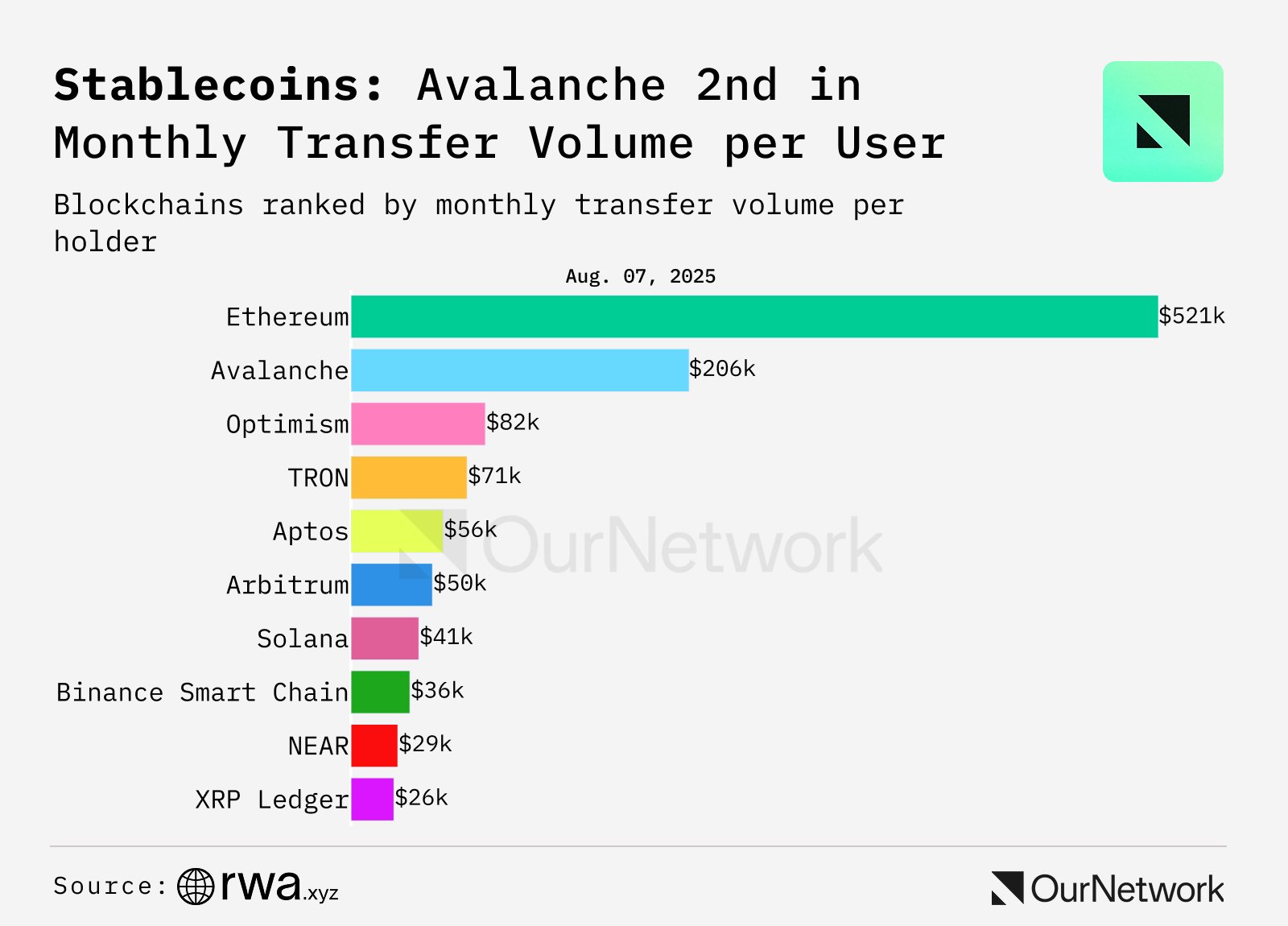
Ethereum Dominates Monthly Stablecoin Transfer Volume With $521K Per User

Ethereum Dominates Monthly Stablecoin Transfer Volume With $521K Per User

Ethereum steadies its dominance in the stablecoin market, as it commands a staggering monthly transfer volume per holder. Stablecoins mostly flow on the Ethereum network, according to recent data from the on-chain analytical platform Our Network. The report, shared by the head of research at Onchain Foundation, Leon Waidemann, identified that Ethereum has the largest share of monthly stablecoin transactions in the crypto space. Ethereum Averages $521K Stablecoin Transfer Per User For context, the report ranked blockchains by monthly transfer volume per holder. Unsurprisingly, Ethereum led the chart, with an impressive $521,000 moved per holder over 30 days in the network. Notably, this indicates that massive capital flows through Ethereum and stablecoins account for a considerable part of it. This comes as no surprise, as the smart contract-infused blockchain hosts 51% of the total stablecoin market cap, around $142.6 billion. Meanwhile, this further confirms a trend of massive institutional stablecoin use case, especially on Ethereum. Fiat-pegged cryptocurrencies are gaining increasing attention from large financial institutions, which have identified their use case in settlements. Interestingly, the total stablecoin market cap is slowly growing, as issuers inject more liquidity into the market in response to user demand. The total stablecoin market has grown to $275.5 billion, adding $9.06 billion (3.40%) in the past seven days alone. The majority of these supplies are being transacted on Ethereum, providing use cases and fee revenue for the network. Some believe this would boost revenue, increase Ether’s utility, and consequently drive prices to unprecedented levels. A New Contender to Ethereum’s Stablecoin Dominance? Meanwhile, despite holding a mere 0.64% ($1.77 billion) of the stablecoin supply, Avalanche recorded an impressive monthly transfer volume per holder. Users moved stablecoins on the chain at an average volume of $206,000 per holder, signaling stablecoin interest on Avalanche. Stablecoin Chain Ranking by Monthly Transfer Per Holder Notably, Avalanche has expanded its stablecoin ecosystem lately in collaborations with institutional players. Visa recently announced adding Avalanche to its stablecoin settlement network, with Wyoming testing America’s first state-issued stablecoin, WYST, on the blockchain. Other chains in the top five by monthly transfer volume per holder include Optimism at $82,000, Tron network at $71,000, and Aptos at $56,000. Meanwhile, the list featured other notable networks such as Solana, BNB, and the XRP Ledger, where users transferred an average of $41,000, $36,000, and $26,000, respectively, per holder.

Author: The Crypto Basic